Chitika Ad

Showing posts with label worst movies. Show all posts

Tuesday, September 10, 2013

Worst Actors - Eddie Murphy: Part 1

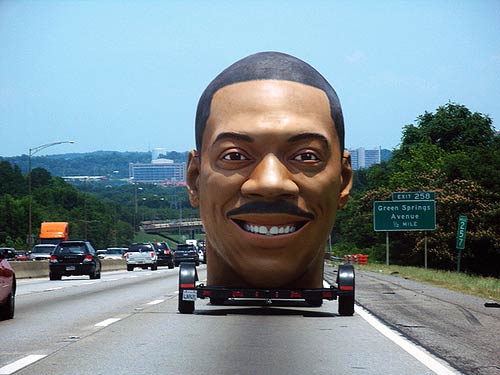
Just... Terrifying.
source: also.kottke.org/
As discussed in a previous article observing the career of Adam Sandler, SNL has been successful at turning out major Holywood stars.  Still, as is often the case, its successes are outweighed by its failures.  A vast majority of SNL performers have their run on the show, then fade away, rarely to be heard from again.  However, about once every generation or so, the series has one huge, breakout star.  In the disastrous 1980-1981 season, a young African American comedian joined the Not Ready for Primetime Players and became one of the show's biggest successes, seemingly overnight.  

Eddie Murphy’s run on SNL was a combination of classic hits and a few rare misses.  I would contend he is easily in the top ten best cast members of the shows history, most notably for his hilarious Buckwheat sketches (Buckwheat sings the hits in-particular) and what is arguably my single favorite sketch in the entire series’ history: White Like Eddie Murphy, in which Murphy (as himself) goes undercover to see what the world is like as a white man.  If you haven’t seen this, it is on YouTube, and it is amazing!

So, it sounds like this is so-far pretty positive, right?  Well, like many of the performers that have been and will be on this list,  Eddie Murphy’s career did not start getting really bad until later.  He started off as an edgy, funny comedian coming off a period in the 1970’s of comedy that was either overtly slapstick, or wry and self-aware.  There was really not too many comedies being released that held that nice middle ground.  The most successful comedies were more low-key (for the most part), as was the case with Harold and Maude and The Last Picture Show, then came SNL.  SNL’s contribution to comedy was essential.  It shocked, it broke down barriers, it put black and female comedians on even ground with their white male counterparts, and it addressed social mores and taboos with gusto.  It was brazen, and that is what made it great.

Eddie Murphy wanted to be a pop star... Isn't that cute?
Source: http://burningtheground.net
After three successful seasons on SNL, Eddie Murphy was already a Hollywood hit-maker.  48 Hours and Trading Places (my favorite Eddie Murphy comedy) were both released during his time on the sketch comedy show, and both were successful.  He began a pretty remarkable run in the 1980’s, racking up hits with Beverly Hills Cop, Coming to America and Harlem Nights.  However, as the 90’s came around, there was this strange washout of the 80’s, as though everybody wanted to just forget it happened.  Shows like Saved By the Bell tried to keep the neon pink, big hair and bubblegum pop alive, but I always hated that show, and I know more than a few other people who did as well.  No, the early 90’s had a cultural split.  Generation X took over and with them there was a new generation of comedies like Clerks and Dazed and Confused.  80’s film culture was more or less dead at this point. Most of the A-list comic actors of the 80’s had to adapt or fade away.  Tom Hanks and Robert Downey, Jr. became bonafide dramatic performers to cope, and they have had many successes since, but for the most part, things were not looking good for comic talents out of the 80’s.  Eddie Murphy was arguably the biggest start to fall due to this trend, coming off of a truly stellar run, he just stopped being good.  Another 48 Hours, Boomerang and The Distinguished Gentleman were all critical failures but moderate successes at the Box Office.  Then came 1994… oh, boy.

I would say that 1994 was the big turning-point in Eddie Murphy’s career.  It was a point at which he became cynical, and just started taking roles I guess he thought would earn him the most money.  Beverly Hills Cop III was one of the worst sequels of the 90’s.  It had a ton of hype surrounding it.  It was directed by John Landis, who also helmed such greats as The Kentucky Fried Movie, An American Werewolf in London, the aforementioned Trading Places, and Animal House.  It also was Eddie Murphy’s return to action comedies, which had been long-awaited by fans, and it was a well-needed respite from the hard drama that was good, but still saturating in the early-to-mid-90’s.

The movie came out, and just about everyone agreed it sucked.  The plot about a giant mascot theme park (ala, Disney) as the front for car theft and counterfeiting rings was about as interesting as it sounds.  The theme park setting was a clever idea, but not really used to any effect and Eddie Murphy just seemed bored.  Shortly after the film’s release, cast and crew began leaking bytes that Eddie Murphy was basically a pompous ass during the entire production, exercising typical Hollywood spoiled-brat behavior and a refusal to cooperate with Landis.  Murphy reportedly wanted to play the role straight, as though Axel Foley had grown up and out of his famous “wise-ass” persona.  Landis himself said that he believed Murphy was trying to make himself competitive with rising stars like Denzel Washington and Wesley Snipes, casting aside his old comic stylings.  The result was a bland, boring comedy that did not have one funny or inspirational moment.  Landis said he “knew the script wasn’t any good” but he operated in hopes that improvisation and comic talent would help the movie rise above its weak screenplay.  It did not, mainly because the comedy just was not there.

Eddie Murphy had a little trouble getting roles after Beverly Hills Cop III.  He hit a slump that he would never be able to climb out of.  His films were still major releases, mind you, and they were still successful, but remember that whole thing about being more dramatic?  Well, that was a load of crap.  I chalk that up to Eddie Murphy just being an ass when he said that because he followed up Cop III with Vampire in Brooklyn, a lame horror/comedy that was severely-lacking in the qualities of both genres.  

He then, most likely out of desperation, signed on with Disney.  Disney has long been a career-killer and Eddie Murphy, though surviving Disney’s terrible run since the late 90’s (The occasionally-good Pixar movie notwithstanding), has never fully recovered.  His first film with the Disney crap-factory was the massive hit the Nutty Professor.  I hated this movie.  A lot of people found it funny but I found it obnoxious and just, well.. noxious.  Eddie Murphy can be a lot to take in, so when he’s playing multiple farting family members in fat suits spouting out annoying, loud shtick, I just want to find a high ledge and leap.  The main premise of the movie is fine, a fat: lonely doctor invents a serum that turns him into a slender player.  In the original, Jerry Lewis went from a nerdy dork to a player but, by the 90’s, Eddie Murphy was far too arrogant to play a nerdy dork, right?  Well, his character Sherman Klump (I HATE that name, by the way), was not really nerdy, just shy and embarrassed by his weight.  So, no, it isn’t the same thing.  I did not like the original Nutty Professor, and I certainly did not like the remake.

He followed that up with Metro, a by-the-numbers action comedy in the vein of Beverly Hills Cop.  It was alright.  It was certainly better than Beverly Hills Cops II and III.  Still, it was not a change to form for Murphy.  He voiced the loud-mouthed dragon Mushu in Mulan and went on to star in another dreadful Disney remake: Dr. Doolittle.

Talking animals!  Am I right?  Easy money!  Disney has long been the source for pure Hollywood cynicism and boy it does not get any more cynical than Dr. Doolittle.  This film preys on family audiences with the idea that, if we have animals run around and dub actors voices in the background, it will be funny, right?  No.  It wasn’t funny.  Still, because it was Disney, it starred Eddie Murphy, and it was a recognizable title for adults with kids, it made money.  This is exactly why Disney went through this remake binge with The Nutty Professor, Dr. Doolittle, and Flubber: Because the older audience of that time, who grew up on the originals, had kids now, and Disney was going to try to milk them for all they had while doing as little work as necessary.  Remember, at this time, Pixar was still young and Disney had not yet started to fully take credit for the fresh studio’s hard work.  Also, with Studio Ghibli still around the corner, Disney’s claim to animation dominance was sort of fading.  It was okay though, in a few years they would be able to consistently take credit (and money) from talented studios, stick their overblown logo before the film, and claim it as their own.  Disney!

Murphy went through a relatively uninteresting period after Dr. Doolittle.  He began to star in odd comedies like Bowfinger and Holy Man.  These movies were not good, and they represented a bland, soulless brand of Hollywood cinema.  They utilized the stick-popular-actors-together-on-screen and mixed that with the ebony-and-ivory formula, generating truly uninspired and uninteresting cinematic nothingness.  What’s worse is, they were essentially the same movie.  Eddie Murphy is a naive black outcast of some sort, who is exploited by a white guy who wants to use him to star in a movie/sell products through his ad agency.  There was very little to distinguish these two films, and very little to hold anyone’s interest.

Murphy starred in Life alongside Martin Lawrence, in which he and Lawrence play wrongfully-convicted men sentenced to life in a black prison in the first half of the 20th century.  It was another nothing movie.  It was, I think, meant to be a sort of spoof of the Shawshank Redemption, only it was a few years too late and played too straight.  It tried to be serious at times and these scenes just bogged the movie down in lame melodrama.

He premiered his short-lived animated TV series the P.J.’s about an apartment building superintendent, and starred in the dreadful Nutty Professor 2, which centered more on the Klump family than the actual plot.  It was terrible.  Showtime followed, which was another nothing comedy about cops working together while being filmed for a reality show.  It was bad and his co-star Robert De Niro just looked like he was sleepwalking through this tripe.

This ends part 1.  If it seems that I sort of knocked out a large chunk really fast, it is because I did.  Eddie Murphy’s 90’s run was bad, but nobody could have seen what was right around the corner.  We have yet to explore the darkest depths of this fallen star’s worst performances, so standby for the next post where we take a look at, in one single article, some of the worst comedies ever made by Hollywood.

Thursday, September 5, 2013

Worst Actors - Cuba Gooding, Jr.

Each era of film has a few performers who have a degree of popularity for a short time, then burn out really fast.  We saw this with the unfortunate career of Bobcat Goldthwait, who spent the remainder of his run after the 80’s writing off-kilter black comedies, but remained out of the limelight.  Then there was Pauly Shore, whom I previously covered.  His time in the spotlight lasted only a few years, but seemed like an eternity.  However, there is one flash-in-the-pan actor that has fascinated me for just over a decade.

Cuba Gooding, Jr. was a rising star in the 90’s due, in part, to his early role in the 1991 drama Boyz n the Hood, directed by the talented-yet-often-misguided John Singleton.  I found Boyz n the Hood to be an excellent exploration of the life of teens with various upbringings in the Los Angeles ghetto featuring particularly-superb performances by Laurence Fishburne and Morris Chestnut.  The film was universally critically-successful, and earned Singleton two Oscar nominations: one for Best Original Screenplay, and one for Best Director.  What is even more impressive is that the movie made back almost ten times its $6 million-dollar budget, making it one of the most successful films of the 90’s in terms of budget-to-gross ratio.

After his initial surprise success, he had a period of lesser roles for a few years.  He had a run as a recurring character in the hit series MacGuyver and went on to star in the first of many bombs of his career, the 1992 mess Gladiator.  No, this is not the excellent 2000 film starring Russel Crowe, this is the OTHER Gladiator from the 90’s.  The story centers on two boxers caught in an illegal, underground fighting ladder.  It was ignored by audiences, mocked by critics and failed to perform at the Box Office.  Over the last ten years or so, Gladiator has gained somewhat of a cult following, though I still find the film to be mostly-bland, badly-acted and poorly-edited.

He had a supporting role in the excellent 1992 film A Few Good Men, and this kept him in the limelight, but a series of career missteps would start him down a path of ultimate collapse.  The first one was a mostly-forgotten, uninspired, 1994 retread called Lightning Jack, in which Paul Hogan literally plays Crocodile Dundee in the Old West, except he is most definitely not Crocodile Dundee, he is Lightning Jack!  This movie was astounding.  It was such a cynical, pointless piece of crap and nobody involved seemed to really care about it.  Despite having a large role in the movie, Gooding was mostly unrecognized due to the film’s very limited success.

He starred in the sloppy-yet-entertaining Wolfgang Petersen thriller Outbreak in 1995.  It was a smaller role, as he was being pushed more and more into the background, a career trend we will see him reliving in the future.  The movie overall was not bad, just a little off.  A fictional viral outbreak of Ebola hits a small U.S. town after a monkey escapes captivity and attacks a young girl, infecting her.  The CDC and Army get involved and we get a very localized, yet chilling apocalyptic scenario.  The flaws of the film come out in the form of cliched evil political characters and lazy performances by Renee Russo and Dustin Hoffman, who are both carried by supporting roles from Kevin Spacey and Morgan Freeman.

He then moved on to the bland-as-hell 1995 TV Drama from HBO Pictures, The Tuskegee Airmen.  It was stoic, conventional, and really just about as entertaining as being told the captivating story concisely by a cliche-spewing, dull-voiced professor.  The film had an ugly, grey look to it too, obviously trying to give the film some age and create a tone of being in another time, but the lack of color just made this movie kind of hideous.  Still, nobody saw this next project coming, nor could they have anticipated Cuba Gooding, Jr.’s massive success that would come as a result.  

In 1995, the Cameron Crowe-directed Jerry Maguire was released.  At the time, Tom Cruise was pretty much a guarantee of any film’s success, but Jerry Maguire surprised everyone by being not just a traditional romantic drama, but an superb character study.  In the film, Cuba Gooding, Jr. plays a young football star who puts his career on the line as he owes his fame and his shot at greatness to a single sports agent, the titular Jerry Maguire.  In the film, his now-famous line, “Show me the money!” was screamed over the phone enthusiastically.   The scenes where Cruise and Gooding, Jr. were acting off of each other were excellent, though the movie did tend to slow a little when it shifted focus to the softer romantic moments.  Still, it is one of the best movies of the 90’s and a must see for anyone who is interested in a drama that is both true-to-life and a little heartwarming.  The most significant result of Jerry Maguire was Cuba Gooding, Jr.’s Best Supporting Actor Oscar win.  This Oscar victory fueled his career straight into the Stratosphere, then it entered the Mesosphere, lost momentum, then came plummeting back down to Earth in a giant ball of fire.

Cuba Gooding, Jr.’s career decline is one of the most rapid, shocking failures in the history of the film industry.  The young actor still showed much promise, but, for some reason, everything just went South.  This was likely due a couple major contributing factors.  The first was the fact that Cuba Gooding, Jr. rose to stardom during one of the worst periods in movie history, the late-90’s-to-early-2000’s.  Sure, there were some great movies from this time, but there was also a lot of crap which paved the way for a third independent film revolution in the mid 2000’s.  Another contributing factor, I believe, is Cuba Gooding, Jr.’s tendency to pick movies that are accessible to most audiences instead of challenging roles, going for the I-liked-that-movie-so-I-should-like-this-one route.  Many of his choices are either heavy-handed cloned dramas or by-the-numbers comedies.  There really was nothing in between.  These extremes prove to result in a general lack of success for their lead performers if they remain trapped in this particular rut for too long.

After Jerry Maguire, Gooding, Jr.’s next major role was the successful comedy As Good As it Gets, a romance film aimed at an audience of middle-aged-to-older women.  The film centers around several varying characters who bond over a tragedy.  It is not a bad film per se, it just lacked any real motivation or direction, relying too much on the typical romantic drama tropes we have seen time and again in significantly better films.  The movie was directed by James L. Brooks, who has had a wide career spanning movies, television and even work writing for video games.  His most significant work was his run as a writer and producer on such mega-hit TV series such as Mary Tyler Moore, Taxi and the Simpsons.  Still, for Cuba Gooding, Jr., he had already plateaued, and it was all downhill from here.

His next major film was the Robin Williams drama What Dreams May Come.  The movie was a strangely Nihilistic exploration of the afterlife, where, after the death of two children, a doctor played by Williams’ dies tragically while trying to save others in an accident.   He finds himself in heaven where he is met by old friends (who are actually his children in disguise.. for some reason)  who guide him and help him come to terms with his new, very permanent existence.  His heaven is inside his mind’s creation of a world inspired by a painting his wife did for him before his sudden death.  Meanwhile, his widowed love, tormented by the cycle of loss commits suicide, which leads her to a grim fate.  Bent on crossing the afterlife to find his lost love, Williams’ character takes a sort of Faustian adventure through beautifully-designed worlds.  What Dreams May Come was not exactly a bad movie.  It was more confused, I would say.  There are a number of things that do not make sense, like why his children disguise themselves as old colleagues and acquaintances, and why this afterlife has no mention or exploration of God or the existence thereof.  We see his wife, because she commits suicide, is sent “somewhere else”, and when we see it, we find her trapped in a lone house at the bottom of an enormous dome of an upside-down church.  Is this Hell?  Purgatory?  Why, if he is in some sort of Heaven of his own creation, is he unable to drink tea without it being paint?  Why?  A lot of the elements in this movie made no sense, and were never addressed.  The writers played it safe, never straying into one dogmatic territory over another, treading this strange middle line and, as a result, failing to paint a proper picture of this world we’re supposed to accept.  

Cuba Gooding, Jr.’s performance in What Dreams May Come was bad.  He spends a majority of the first act spouting exposition and driving the plot forward with uninteresting mythos disguised as revelation.  As the plot meanders about, waiting for the wife to off herself so the story can actually start, he focuses on getting William’s character grounded, failing constantly.  The film is really joyless too, despite obviously trying to be a reassuring fable of the afterlife, and this is not helped by Gooding, Jr.’s bland delivery.

His next major entry was the 1999 film Instinct, which is a bad, baaaad film.  This, at least in my opinion, is probably the point where people were starting to realize something was going really wrong in Cuba Gooding, Jr.’s career.  Instinct is a lazy, unoriginal mess of a movie about a psychologist, played by Cuba, who wants to reach an introverted, traumatized anthropologist who was driven back to primal instincts after spending years living with gorillas only to see them slaughtered by poachers.  The interviews are slow, repetitive and boring and the remainder of the film is padded out with bad, cliched, drama in a prison for the mentally insane.  So, if you have not already guessed: it’s Silence of the Lambs meets Cuckoo’s Nest, and I am not the first person to make that comparison.

Everything about Instinct is calculated to form the most perfect blend of dramatic tension for the folks out there that have never seen a movie.  It reeks of being written-by-committee and has studio stains all over it.  It is a shallow, ugly film that plays on the emotions with manipulative moments and a cartoonishly-villainous prison staff, who seem to only exist to torment the souls we see trapped inside.  The ending of the movie is so pandering and stupid that I was just astonished.  This film came out about the time that I was starting to develop a more discriminating taste in films, and when I saw it I was captivated by how little thought actually went into it.  

The next few projects ranged in quality, from a terrible bomb (Chill Factor) to a mediocre attempt at a military drama (Men of Honor).  Cuba Gooding, Jr. was finding it impossible to live up to the hype that surrounded him just a few years before.  He followed these two films up with the overstuffed Jerry Zucker comedy Rat Race, a movie about groups of buffoons doing slapstick across the country for a chance at a windfall price, hosted by a team of gambling billionaires.  Essentially, the movie was a remake of the 1965 comedy The Great Race, which itself was the original inspiration for Hanna Barbera's Wacky Races cartoon series.  I know Rat Race has fans, and that is fine, there are certainly worse comedies out there (Cuba Gooding, Jr. would go on to star in a few of them), but I was never a fan of most of the performers that headline the film, so I just found it to be a desperate and lazy movie, filled with lots of mugging and screaming.  

Rat Race began a series of comedy bombs for Cuba Gooding, Jr.  The next major film he appeared in was the absolutely awful Snow Dogs, about a man who inherits a sled dog team.  In the film we see the once-heralded actor planting over-the-top expressions into the camera while seemingly-sadistic dogs appear to torture him.  It was a bad movie.  This was no surprise to film fans though as the movie was from director Brian Levant, one of the worst filmmakers working in major cinema and his typical buddy-style slapstick permeates this piece of Disney garbage. I am going to spotlight one more movie here, because he has been in a large number of films since Snow Dogs, but most of them are not even worth mentioning.  

His follow up to Snow Dogs was sort of the nail in the coffin for Cuba Gooding, Jr’s A-List run.  Boat Trip was so bad, so much of an epic fail, that I wonder if it was actually on purpose...  Seriously.  I cannot pinpoint a motivation for this now, but I don’t think anyone could or would want to make a comedy this bad without wanting to hurt someone’s career.  I’m not pointing any fingers, but something amiss had to have been up with this.  Boat Trip follows the exploits of two straight men hoping to pick up chicks who accidentally end up on a gay cruise trip.  The movie is filled with abounding homophobia and then has the nerve, as many of these films do, to try to back off on it in the end, as though we’re supposed to except that these two jerks learned some sort of lesson.  It is tremendously unfunny movie too, and Cuba Gooding, Jr. is out-acted by the astoundingly-awful Horatio Sanz!  That is how far he fell.

From here Cuba Gooding Jr., would go on to star in the football flick Radio, which is an emotionally-manipulative sports drama.  Then he spent most of his career up to present day staying safely in smaller parts in lesser movies.  He starred in the purely-evil Daddy Day Camp and had a minor role in the good film American Gangster, but his Box Office prominence was over.  He would continue to appear in limited release dramas and thrillers and has spent his entire career since the mid-2000’s trying to regain some recognition from fans, and failing every time.

Cuba Gooding, Jr. is the epitome of wasted talent.  He showed promise, then got cynical.  He took what he was offered and obviously had terrible taste in screenplays, picking dramas that I assume the thought were poignant, and comedies that he had to have known were losers.  It is a shame because, early on, I wanted to like Cuba Gooding, Jr., but his poor role choices just made it impossible for me to do so.  You cannot spend your time in movies making films that you think will get you an Oscar, because about 90% of the time, the movies that are trying to be Oscar-bait, are really just disasters.

Tuesday, September 3, 2013

Worst Actors - Pauly Shore

Pauly Shore.. Being manly
Source: huffpost.com
There are few actors in history that have been so deservedly and universally-hated as Pauly Shore.  Born the child of a showbiz family, Shore started in stand-up comedy in the 80's.  He is mostly known by his persona, a parody of a valley kid from California he dubbed "the Weasel".  It is this character that would define him in the eyes of millions for the rest of his career.  


Shore's first big break came in the late 80's in the form of an MTV VJ gig.  His run on the network would continue until 1994.  In the meantime, Shore would star in five major roles that are now legendary as some of the worst performances of the 90's.  Many called him grating and unfunny, and as films have shown us in the past, just because your standup comedy is funny (Shore’s wasn’t, by the way), this does not necessarily  make you an actor.  This was exasperated by Shore’s use of his Weasel character in almost all of his film roles, likely due to studio pressure as this is how he is known by the public.


Still, like any Hollywood actor, Shore’s beginnings were humble.  It would take him a few years to start draining the life of audiences.  His first major movie was a small part the 1988 comedy/drama For Keeps.  The film was at a point of career-decline for the once-sensational Molly Ringwald and was really not a good movie.  It has been long-forgotten and was a forced, bland story of a two teenagers who pass up on college in favor of raising a kid, who the girl Darcy (Ringwald) conceived accidentally.  It had all the tone and production quality of a made-for-TV after-school special but was actually a major movie brought to us by the director of Rocky!


That same year Pauly Shore was in the long-forgotten George Burns comedy 18 Again!, a one-in-a-million body-swap comedy about an elderly man who gets a second shot at youth in the form of his grandson.  18 Again! was not a good movie.  It was yet another uninspired retread of the Freaky Friday plot done poorly.  Shore’s character was small and left no impact on the audience, despite him being audacious and annoying in his scenes.


He continued to act in awful messes into the 90’s but never really got top-billing.  Meanwhile, he was increasing in popularity on MTV, and as a result, he was rewarded with a more major part in a Hollywood movie was the first major release for director Les Mayfield, a sparsely-working director and producer who would go on to direct such dreadful films as the Miracle on 34th Street remake, Flubber, the Man, and Code Name: the Cleaner.  Encino Man, released in 1992, was an awful comedy about a caveman (played by Brenden Fraser), thawed out in modern day Southern California.  It’s a little like Eegah! only instead of exposition in a cave, we get Fraser grunting and acting like an ass around Venice Beach all the while being exploited by two teenagers (played by Sean Astin and Pauly Shore).  Shore’s move to the foreground, as the character Stoney, was not a welcome change.  The movie had some success at the box office but was ultimately met with universally-negative opinions from critics and fans alike.  Still, the film’s production company, Hollywood Pictures, was not done milking Shore for all he was worth.  


Shore’s next major role came the very next year in 1993 in the comedy Son-In-Law.  The film was instantly hated by most, but has been defended by some as Pauly Shore’s “best” film.  This is not saying much, mind you, but Shore is given a little more to do acting-wise Still, he squanders his potential to strut his stuff in favor of predictable fish-out-of-water schtick and lazy, forced melodrama.  The plot of the film is a pretty typical one: Rebecca (Carla Gugino) is a country-gal who goes to a major college in California where she befriends a neanderthal named Crawl.  Crawl’s behavior is somewhat bizarre but Rebecca begins to trust him.  After finding he will be spending Thanksgiving vacation alone, she invites him home with her to meet her family.  In a very contrived incident in which Rebecca is trying to stall being proposed to by her longtime boyfriend, Crawl interrupts a town celebration to falsely announce her previous engagement to him.  Now the two must keep the ruse up for the duration of the holiday.


Son-In-Law’s typical, uninspired premise was a beacon of warning to anyone who would want to see any future films starring the bizarre performer.  It was an announcement of sorts: that Shore will only star in contrived, cookie-cutter, by-the-numbers plots stolen directly from significantly-better films.  This would become even more obvious in 1994 when Shore would star alongside the equally annoying Andy Dick in the military comedy In the Army Now.  


And... Now you're blind.  You're welcome.
Source: last.fm
In the Army Now is a very basic war comedy in which two slackers named Bones and Jack (take a while guess which one was played by Shore) join the military on a whim to take advantage of an enlistment bonus.  The result has half the film slogging through overused basic-training cliches followed by another thirty minutes of Shore, Dick, the ear-bleeding Lori Petty and the generally-unfunny David Alan Grier parked in some American sand dunes (which we are supposed to believe are in the Sahara Desert) next to a truck arguing with each other.  It is a grating movie from start-to-finish, made worse by the fact that every actor shouts, screams and squeals half their lines, as though these four performers were not already annoying enough as it is without their vocal contortions.

In the Army Now was actually more of a trend-setter than a cash-in, and I want to make a brief aside on the controversial subject of war comedies.  The 90’s saw a large quantity of high-profile military comedies starring washed-up former-A-listers that started roughly around the time In the Army Now was released.  Renaissance Man was released the same year, it bombed, and was followed up by a number of shallow remakes of classic military movies like Mchale’s Navy and and spoofs like Down Periscope and Sgt. Bilko.  This comic sun-genre was likely relaunched due to the critical and financial successes of such movies as Born on the Fourth of July (1989), A Few Good Men (1992), The Hunt for Red October (1990), Casualties of War (1989) and Full Metal Jacket (1987).  This influx in the popularity of war movies was also accelerated by the Gulf War, which ran from roughly 1989 to 1991 in multiple engagements and iterations.  Time has shown that a movie about an ongoing conflict, such as World War II, the Vietnam War, or the current military encroachments in the Middle East, have a degree of success due to interest in the subject by the public at large.  However, many movies on the subject of war released during said war are often not well-received in retrospect.  The extreme polarization in the country during Vietnam had a percentage of the population interested in movies with strong anti-war messages like the Deer Hunter as the wars they depicted were widely unpopular, so they tended to go over well with those that did not support the engagement in the first place


The military comedy, on the other hand, has had a rougher history.  Often following on the success of a major war movie, these films are usually poorly-received by audiences, with the exceptions of some high-quality examples like M.A.S.H. or Kelly’s Heroes.  As a rule, they tend to follow only a few paths plot-wise, and rarely attempt to do anything particularly clever or original.  They also tend to suffer in the budget department as the anti-war sentiment that is strong in Hollywood rarely sees war as a laughing matter, and often rejects or cuts down on the budget of pitched movies in the genre.  This is, unless there is an offer for the film to be picked up by a well-known director or producer with connections, as was the case with Barry Levinson and Good Morning Vietnam.  In the Army Now did not do this genre any favors with its weak premise, obvious budget limitations, cheap sets and all-around poor acting.


Through his run with Hollywood Pictures (Encino Man, Son-In-Law, In the Army Now), Shore had pretty much proven that he is not able to draw a crowd.  His over-the-top acting, crazed self-caricature and cheap, uninspired movies left producers and audiences cold, and he did not return to Hollywood Pictures.  His next major project began shortly after his departure from MTV, during the network’s mid-90’s format shift towards more original programming and less music-centered entertainment.  His leaving could also be attributed partly to the sudden and rapid collapse of Shore’s popularity as a performer.  Jury Duty was released in 1995 to widespread derision.  


The film was a send up of the 1957 Sidney Lumet classic 12 Angry Men, in which Shore plays Tommy (A normal name?! Well… Shit!), a schemer who is called in for jury duty (That's the TITLE!) just as he loses his job.  Tommy manipulates his way into a luxury hotel and, enjoying the taxpayer-funded board in the five-star establishment, he does everything he can to keep the trial going for as long as possible until he is ultimately found out.  The movie could have worked, to be completely honest.  It did not work, however, due mainly to the middle-school-level screenplay and dreadful performances by Shore, Tia Carrere and other supporting cast members like character actor Brian Doyle-Murray and the usually-excellent Stanley Tucci.  The talent in this movie, like the aforementioned Doyle-Murray and Tucci, as well as Abe Vigoda and Charles Napier are just phoning it in.  They really do not give a crap, and they don’t care who knows it.


At this point, Pauly Shore was pretty much washed up and he took the next bit of work that came along.  Unfortunately for everyone, that next bit of work was the notoriously-bad Bio-Dome.  Every few years a movie so bad comes out and just blows everyone’s minds.   The idea that someone, somewhere, with deep pockets and (one would think) some business sense, would green-light something this atrocious, this brainless, this soulless…  It’s just maddening.  To Bio-Dome’s credit, I am certain that there was no attempt to make a good movie here, so at least it knows it is a piece of garbage.  That is more than I can say for most of Adam Sandler’s movies.  Still, there is something to be said about a movie this bad.  It is just… astounding.


Bio-Dome follows two slackers named Bud and Doyle who revel in self-referential homophobia and thinly-veiled, but still very PG-13, misogyny.  The two man-children attempt to escape the reach of their environmentalist girlfriends, who are both trying to get their men to stand up and take part in saving the planet (Environmentalism is the key message of the movie, by the way.  Yeah!  This movie has the BALLS to have a freaking message!  UGH!).  During an outing, they pass an experiment in which five scientists are to be locked in a self-contained environmentally-pure, terrarium for one year.  The two idiots, mistaking the glass structure for a mall, sneak inside (despite obvious heavy-security, they get right inside with a simple distraction).  Now, because this movie was obviously written by mentally-defective fifth-graders, the two jackasses cannot simply be let out, and the experiment be reset.  No, they have to stay inside with the other five scientists for one full year.  Intensely-unfunny antics ensue.  


Bio-Dome is not just a bad movie.  No, it is a legend among bad movies, and film fans have considered it one of the absolute worst comedies of all time.  The extremely-low $15 million-dollar budget was made back, with profit, but this film ultimately killed Pauly Shore’s career, seemingly permanently.  Though he did not stop acting, his top-billed performances in major studio films came to an end.  Critics hated Bio-Dome with a passion, classifying it as one of the worst movies of all time.  The film holds an impressive 5% on Rotten Tomatoes and an even more-proper 1% on Metacritic, cementing Bio-Dome as a monument to bad filmmaking.  


So, what has Shore been doing since Bio-Doom?  He’s appeared in a few smaller films that I have not seen and made a number of guest voice-appearances on various popular TV shows like King of the Hill and Futurama.  His next lead role since the new Millenium was in a mockumentary entitled Pauly Shore is Dead, in which he picks fun of his own failed career.  I did not see the movie because I honestly did not want to waste my time.  Some people did apparently enjoy it, but for the most part it remained under the radar.  He starred in another mockumentary in 2009 called Adopted, where he plays himself traveling to Africa to adopt some kids.  Many of those that claimed to like Pauly Shore is Dead admittedly hated Adopted, calling it offensive.  The film, which was an obvious send-up of celebrity charity, failed to draw an audience, and like, his previous comedy doc, it just sort of came and went.  Shore continued to act in generally-awful movies and small roles in crap like his second attempt at a body-swap comedy in Opposite Day, in which all adults and kids all swap bodies.  It’s zany!  I watched the first few minutes with the full intention of writing a scathing review for it on this blog some time ago, but I could not get past the utterly dreadful theme song that plays over the opening credits, followed by the truly annoying child actors.  


Pauly Shore has continued through the years, doing standup and appearing in roles where he can get them.  Still, at this point Shore is pretty much audience-repellent.  His last major movie was the absolutely abhorrent Bucky Larson: Born to be a Star, in which he had a very minor part, and if you want an idea of how bad this movie is, I’ll just say that Shore is nowhere near the worst thing about it.

Ultimately, Pauly Shore is remembered for being a loud, unfunny flash in the pan.  He contributed nothing of value to acting or to film, his legacy bears some of the worst films of the 90’s and he is by and large one of the most hated performers of all time.  After the mid-90’s, audiences just refused to buy into Shore’s crap, and even though he seems to vehemently refuse to go away for good, nobody really cares about him, and he is pretty easy to ignore.