Chitika Ad

Showing posts with label best films. Show all posts

Wednesday, July 23, 2014

My 40 Favorite Films of the 90's - 15 - Ed Wood (1994)

Ed Wood (1994; Touchstone Pictures)
Director: Tim Burton
Writers: Rudolph Grey, Scott Alexander
Starring: Johnny Depp, Martin Landau, Sarah Jessica Parker, Jeffrey Jones

Edward R. Wood, Jr. is one of the most captivating and bizarre anomalies in the history of filmmaking.  Hardcore movie fans know his name.  He is the legend behind such “disasterpieces” as Plan 9 from Outer Space, Bride of the Monster, and (most notoriously) Glen or Glenda.  Widely-regarded as one of the absolute worst filmmakers in the history of the medium, Ed Wood’s story makes for some great comedy.  This is a funny and heartfelt tribute to a filmmaker whose schlock was once mocked, but is now considered an inspiration to many hopeful artists.

Ed Wood chronicles the rocky career of the titular director who, along with a small band of friends, created some of the worst movies ever made.  It explores everything from Wood’s boundless enthusiasm, to the aging Bela Lugosi’s crippling addiction.  The legends and myths about Wood’s less-scrupulous tactics are drawn and highlighted as comical moments of weakness fueled by desperation.  It all comes together to make a bright, cheerful and warmhearted tribute to the storied director and his endless, and very much deluded, optimism.

Johnny Depp gives my favorite performance of his celebrated career here.  He plays Wood as a fast-talking Hollywood man who is crippled by his immense lack of talent, which he always fails to see or admit.  Every touch and idea of Wood’s quirky filmmaking is presented in Depp’s energetic, bright-eyed performance.  Alongside Depp is a cast of supporting performances that just nail their real-life counterparts perfectly for anyone who has seen a film by Wood (I own both Bride and Plan 8 on DVD).  Martin Landau landed a Best Supporting Actor Oscar for his portrayal of the sad and broken Lugosi, the former star of the legendary film Dracula who, by the time Ed Wood came into his life, was a shell of his former self.  It is a heartbreaking and loving piece of acting from a legendary performer.

Tim Burton directs Ed Wood as a black and white picture attempting to recreate some of Wood’s style.  He shows us the ins and outs of Wood’s more infamous moments, all taken from a book that was a first-hand account of the notorious director’s dedication to his art.  This is both a loving tribute and a brutally-honest expose, and is a must-see for anyone who loves film, or is interested in gaining a further understanding the medium.  

Succumbing to cliche, I end with Criswald’s famous line from Plan 9 From Outer Space:  “And remember my friend... future events such as these will affect YOU in the future.”

My 40 Favorite Films of the 90's - 16 - Apollo 13 (1995)

Apollo 13 (1995; Universal Pictures)
Director: Ron Howard
Writers: Bill Broyles, Jr. and Al Reinert (adapted screenplay); Jim Lovell and Jeff Kluger (novel)
Starring: Tom Hanks, Bill Paxton, Kevin Bacon, Gary Sinise, Ed Harris

The Apollo missions were the culmination of centuries of science and mathematics evolving over generations, ending with a few chosen men walking on the dusty terrain of Earth’s Moon.  It is a story that has been told time and time again.  However, the flight of Apollo 11 was not the last of the NASA’s lunar excursions.  The Apollo 13 mission was intended to send a few astronauts to the Moon for further study but this objective was cut short due to a sudden and shocking tragedy.

The story of how Jim Lovell (Hanks), Fred Haise (Paxton) and Jack Swigert (Bacon) survive a crippling explosion aboard their ill-fated vessel is a gripping and captivating tale of strength and ingenuity.  A fuel leak leads to an explosion that rocks the ship and severely damages several essential systems, most dangerously were the climate control unit and the oxygen and air filtration system.  With certain death looming just around the corner, these three men fight to stay alive and escape the cold and deadly throws of space.  To make it back, the heroic explorers require the help of a dedicated team of technicians in Houston and one astronaut named Ken Mattingly (Sinise) who, after testing positive for measles, was forced to stay grounded.  The lengths that the headstrong NASA workers go to keep their men alive are the stuff of legend, and make for some fascinating dramatic tension.

Through the 90’s, Ron Howard had proven himself to be one of the most talented and consistent directors in Hollywood.  The former child actor and Happy Days star shocked everyone by becoming a super-talent behind the camera, taking on challenging projects that use tension and drama to keep their audiences frozen to their screens.  His work on Apollo 13 is astounding, and though the film did not sweep the Oscars (being up against the titan that was Braveheart), it deserved the awards it was nominated for.  In my honest opinion, Apollo 13 ranks alongside some of the most idiotic Oscar snubs in history, close to the likes of Citizen Kane losing Best Picture to How Green Was My Valley in 1942.

Apollo 13 is a blend of beautiful cinematography, superb performances from everyone involved, an engaging and true story and a very intelligent screenplay.  There is not a boring or pointless scene in this movie.  Everything counts, from the time the astronauts spend on Earth preparing for their missions, to the scenes that cut back to their families.  There is no filler.  The film paints a vivid picture of how everyone connected to this shocking event felt upon hearing the news.  Tom Hanks, Ed Harris and Gary Sinise (a personal favorite performer of mine) all give some of the best performances of their excellent careers in this enthralling and tense drama.

Monday, July 21, 2014

My 40 Favorite Films of the 90's - 17 - Philadelphia (1993)

Philadelphia (1993; Tristar Pictures)
Director: Jonathan Demme
Writer: Ron Nyswaner
Starring: Tom Hanks, Denzel Washington, Jason Robards

I sat and thought carefully about how I would approach this film.  If you already know what Philadelphia is about, I’m sure one could understand how difficult this subject is, both on an emotional and (unfortunately) a political level.  That said…  Here we go:

By the late 80’s the AIDS scare was in full effect, with many people unsure how the disease operates, and despite educational material being out there, most people preferred to be afraid of the victim rather than the disease itself.  Much of this fear was founded in bigotry, as AIDS was originally considered an illness that only affected gay men.  Despite this being utterly untrue, the facts did not alter the stigma.  As we began to understand the disease HIV, and its progression into AIDS, things and attitudes began to change, but even by 1993, there was still a great deal of ignorance about the subject.

Philadelphia is the incredibly challenging and heartfelt story of an attorney named Andrew Beckett (Tom Hanks), a gay man who contracts the dreaded virus.  After his termination from his firm, which was claimed to be due to negligence, he concludes it was because of his own bosses’ ignorance and bigotry.  Beckett asks another attorney named Joe Miller to help him with his case, but is turned down as Miller is himself a homophobe.  Feeling alone and fearful, the young Beckett steadfastly begins to file his own case.  With support from his partner Miguel (Antonio Banderas) and his family, Beckett struggles with his future.  Ultimately, with guilt and empathy, Miller comes around and offers to represent the man.  This leads to a rough trial both in the courtroom and in the life of a horribly afflicted man.

Philadelphia is an emotional and complex exploration of the time and the fear and unfair prejudice surrounding the AIDS epidemic.  The associations of the characters reflect of a variety of feelings about the subject, discrimination and acceptance and the struggle of a man who becomes the center of a charged political melee.  Hanks won his first of two Academy Awards for his performance in this film, as only the third actor to be nominated for playing a gay character in a Hollywood film.  Philadelphia won other awards including a Golden Globe for best drama as well as a list other international statuettes.  

Philadelphia is a rough sit made even more emotional by its characters.  Tom Hanks gives an incredibly moving performance here.  In particular, during his scenes on the stand, which most likely netted him the Oscar win.  The years leading up to Philadelphia were marked with a few hits and a lot of misses for the now-lauded actor, who was mostly known for comedies.  Philadelphia was not Hanks’ first Oscar nomination as he was nominated for the 1988 classic Big, and he received critical acclaim for his performance in the touching drama Sleepless in Seattle.  However, despite his recognition before the release of Philadelphia, the film marked a turning point in Hanks’ career, where he began focusing on more dramatic performances almost exclusively, with a line of Oscar nominated movies after 1993.

Denzel Washington gives an excellent performance as well, strengthening his already established dramatic resume as an outsider’s point of relatability to the subject.  The ideas of others change as he changes from a bigoted man to one who befriends and begins to care about Beckett and his plight.  Washington was perfect for this role.  He has a strong voice, tremendous screen presence and has always been an excellent dramatic performer.  Here, however, I would argue he gives the best performance of his excellent career.  We see a transformation in Joe Miller through him, and throughout the movie, even when the character’s views are detestable, he has a charm that is instantly gripping, and as he warms to Beckett, we feel their bond growing.  The two actors have an admirable chemistry that works and paints a vivid picture of a man whose heart steadily changes over the course of the story.

These performances, along with just about every other aspect of the film, makes Philadelphia a must-watch classic.  It is one of the most celebrated films of the 90’s for good reason, it is a strong, heart-wrenching story told wonderfully through masterful performances.  Jonathan Demme, who won an Academy Award for his Oscar-sweeping 1992 film The Silence of the Lambs, was a perfect choice for this movie.  He uses an interesting device throughout the film showing us a number of scenes with actors appearing to break the fourth wall.  While this begins as a strange little idea that would likely take one out of the movie, instead, here it puts us in the shoes of the characters and as the film goes on, is used to show us the pain and fear of Andrew Beckett as he steadily deteriorates.  There is a love for these characters that we feel through Deme’s direction, which makes the movie that much more powerful.  When screenwriters and directors really care about the characters they are creating on screen, the viewer can certainly tell.  They feel like real people, and in Philadelphia, it is very, very easy to forget, from time to time, that despite the film being loosely based on a true story, is not real itself.  Philadelphia is easily one of the greatest, and most heartbreaking films ever made.

Saturday, July 19, 2014

My 40 Favorite Films of the 90's - 19 - Princess Mononoke (1997)

Princess Mononoke (1997; Studio Ghibli,
Miramax (U.S. Distributor))
Director: Hayao Miyazaki
Writer: Hayao Miyazaki
Starring: (Original Japanese Cast) Youji Matsuda, Yoriko Ishida; (English voice cast) Billy Crudup, Claire Danes

Anime is a modern type of filmmaking that spans many genres and ranges from quality dramas to silly romps.  Spanning decades in Japan and growing immensely in popularity in America in the late 90’s due to the domestication of series like Dragonball Z, Neon Genesis Evangelion and Cowboy Bebop, and with the help of movie releases like the cult classic Akira and the wondrous piece of fantasy Princess Mononoke or もののけ姫 (Mononoke-hime) in Japanese.  Written and directed by the Walt Disney of Japanese animation, and arguably the second greatest animation director in film history (after the great Disney, of course), Hayao Miyazaki, Mononoke is a fantasy that is powerful and brilliant in every way.

The story begins following a warrior name Ashitaka, who is cursed by a rogue boar that became possessed by a evil spirit.  When he returns home he is forced to exile so as not to curse the rest of his village.  He travels a great distance on the back of his companion, a “red elk” (that isn’t a freaking elk, by the way) named Yakui.  Hoping to find a cure for his ailment, he seeks aid from the spirits of the forest that guard the untouched natural landscape from the fires of man, in particular those coming from the nearby forge fortress of Irontown.  Run by a headstrong matron named Lady Eboshi (Minnie Driver), who rescued many of her working girls from the cities’ brothels to help forge more powerful weapons, the town awaits the return of its men and readies itself for war against the animal spirits.  When the town is attacked by a nimble and fearless girl named Mononoke, who refuses to identify herself as human as she grew up with the guardian wolves in the nearby forest, Ashitaka rescues her from her fate but is wounded in the process.  Nursed back to health by the wolf girl, the young warrior is now caught in the middle of a war between his fellow man, and the spirits of nature that could cure him of his curse.

Typically, the man versus nature theme is done very, very poorly.  This is especially the case when the story has a shoehorned, heavy-handed environmental message in it.  Films like Avatar always came off to me as more PSA than film, especially since that movie in-particular is just several hours of Cameron telling everyone how “awesome” he is.  However, Mononoke actually shows us the struggle of violence against nature and puts us in the shoes of the creatures and lives destroyed by man’s lust for power.  Mononoke herself is a direct contrast to Eboshi. The titular heroine is gruff, strong and devoted to her forest family, while Eboshi is arrogant, beautiful and willing to sacrifice her own people to get what she wants.  The most interesting thing about this contrast is how the characters are introduced.  When we first meet Eboshi, it is a natural assumption to assume she is good, while Mononoke, clad in furs and a wooden mask, wields a dagger and slashes and dives at the frightened villagers.  

Princess Mononoke plays with expectations, and is actually, and surprisingly, not bound by too many cliches, despite the obvious references to Burroughs’ Tarzan novels as well as a number of other man-vs.-nature stories.  It is an inspired story that is both empowering and heartbreaking.  We see the once-mighty spirits stumbling and bleeding from the powerful weapons of the humans of Irontown.  They are prophets of their own doom, so willing to give in to their collective fate.  We see that nature becomes helpless against man’s rage unless some are willing to help fight with and for it.

Like all of Miyazaki’s writings, this film has touches of Japanese folklore and spiritualism in it as well, and the cultural elements of his movies are often some of the of most fascinating parts.  Environmental themes aside, this is a great allegory to growing into one’s self, overcoming the past and accepting who you really are.  It pulls you into the world and shows you the pain each character is feeling without being emotionally-manipulative, instead it relies on one’s own empathy to truly relate to and understand what these characters are going through.  What is even a greater testament to the complexity of this film: I did not even scratch the surface in terms of plot.  There is a lot going on here that tie the emotional elements and themes of the film together better than most that have tried have been able to do in narratives past.  Miyazaki created a masterwork here, and it is widely regarded as one of the greatest animated films of all time.  It earned this title, as Princess Mononoke is a deep, engaging masterpiece, and even though it is only my second favorite film of Miyazaki’s (Spirited Away is my #1), it is certainly high among the greatest animated features in the history of movies.

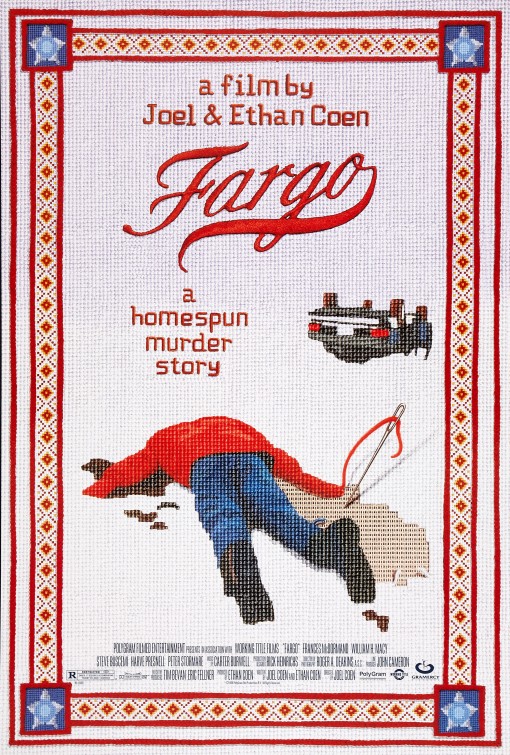
My 40 Favorite Films of the 90's - 21 - Fargo (1996)

Fargo (1996; Polygram
Filmed Entertainment)
Directors: Joel and Ethan Coen
Writers: Joel and Ethan Coen
Starring: Frances McDormand, William H. Macy, Steve Buscemi, Peter Stormare

The Coen Brothers have been appeared on my list numerous times thus far and Fargo marks their final film featured in this series.  Fargo is a twisted black comedy from two filmmakers who know how to direct the most disturbing things in such a way that they are actually funny.  This is not uncommon, but what makes Fargo work so well is its tone.  The film itself seems rather condescending towards its own characters, which is strange and, for some, off-putting. However, I find it to simply add to the humor already on display.

The film centers on a small town family man named Jerry (Macy) who, motivated by a personal financial crisis, pays two thugs to kidnap his wife for a ransom he intends to collect.  However, when the hired guns (played by Buscemi and Stormare) botch the kidnapping significantly, resulting in a triple homicide, they are forced to push up the time frame and get the job over with so they can get out of town.  What they did not count on was a smart and unrelenting small town sheriff named Marge (McDormand) who, despite being very, very pregnant, is hot on their trail.  

Fargo is a film that can be interpreted in any number of ways.  Typically, in a film like this, the Keystone Cops trope takes hold, and things go haywire, but ultimately a mess is left.  I see the Coen brothers playing with expectations here.  The idea of the smart cop running a tight ship in a small town in North Dakota is not entirely unbelievable, however film cliches dictate that if you are not a big city cop in a trench coat, you are bad at your job.  Here we have a movie that could have easily played it safe, keeping things very simple and doing nothing fresh and it would have still been a funny romp of a crime flick.  Yet, the Coen brothers transform what would have been (in likely any other hands) a completely generic murder flick into something clever and unique.  

Other elements that are open to subjective opinion are the details of what exactly Jerry is really trying to pull.  We know he pitches to his boss (who is also his father-in-law) that he wants money for a “lot”, possibly intending to start his own auto dealership, but there is also a running subplot involving him being unable to verify a list of serial numbers for some merchandise.  The widely-accepted opinion regarding this is that he was, in some way, involved in fraud, and is possibly responsible for embezzlement.   This is never clearly fleshed out, however.  Many of the details of whatever he is involved in are provided, but there is no overt exposition, and it as a result, the audience is never entirely sure what Jerry wants the money for, and why he was willing to go to such lengths to get it.

Thursday, May 8, 2014

My 40 Favorite Films of the 90's - 27 - Fight Club (1999)

Fight Club (1999; 20th Century Fox Pictures)
Director: David Fincher
Writer: Jim Uhls
Starring: Edward Norton, Brad Pitt, Helena Bonham Carter

Fight Club is the 1999 film adaptation of the novel of the same name from writer Chuck Palahniuk.  It is a funny indictment of unbridled consumerism, drawing comparisons to shopping from Ikea with enslavement and disease.  It is certainly an anti-establishment message shoved into a strange series of parallels and metaphors.  So, who better to put together a plot puzzle like this than the man who directed The Game and Seven?

Edward Norton plays a (sort of) unnamed narrator who is tormented by his endless fight with daily life and his sudden urge to buy increasingly-useless crap from the consumer catalog du jour.  Depressed and struggling with crippling insomnia, our narrator begins to attend various support groups for disease and addiction for things he does not even suffer from, only to feel… something.  This therapy works, until a woman named Marla (Carter) begins showing up for the same groups, becoming a plaguing distraction.  During a business trip, he meets an outgoing, fast-talking man named Tyler Durden (Pitt), who seems to have none of the same fears and worries he suffers from.  Essentially, he is the narrator’s polar opposite.  A freak disaster leads the narrator to contact Tyler and they meet up, becoming friends, and eventually, this leads to them fighting in an alley.  Over time, this one fight evolves into hundreds, all over the country, from multiple groups of Fight Clubs, and replaces any need for support groups and shoulders to cry on.  Things grow and grow, becoming even more desperate, and Marla is dragged back in with Tyler, with whom she begins a very, very loud sexual relationship.  With the narrator's own vision of what Fight Club becoming distorted into a movement that has grown far out of his control, the film’s tone becomes extremely dark and more than a little threatening, all leading to a climax that is surprising and kind of terrifying..

Fight Club is a brutal rejection of casual consumerism.  It mocks marketing, and even has the Club members use that marketing as a weapon against the system they feel has enslaved them.  The mood shifts from comic to thriller steadily throughout the film, but from the very beginning there is a sense of unease.  We are told early in the film that “With insomnia nothing’s real.  Everything’s far away.  Everything’s a copy of a copy of a copy…”, and that is exactly what much of the first act feels like.  Scenes are very dreamlike, full of strange imagery of floating catalog price information and CGI penguins.  There are subliminal images that flicker and disappear, almost like hallucinations, and the whole production has this very cold, artificial feel to its benefit.  The surrealist elements of the film never feel too out of place since we are meant to be seeing this world through the eyes of a troubled man.  

David Fincher was the perfect choice to direct this movie.  He is able to weave incredibly complex and layered narratives into a cohesive and captivating story.  He is probably better at this than just about any other director working in Hollywood today, with successes like Zodiac and The Social Network telling stories that span several years with a great deal of coherence, something that is very difficult to do without losing your audience.  Fight Club just may be one of the most ambitious film adaptations of all time.  Not because of thousands of fighting soldiers and castles that need to be modeled and CGI’d, but because it is a story told in first person, from the perspective of an individual who sees the world very differently from the way most people do.  Fincher’s ability to put you in the eyes of this one broken and desperate man is simply astounding.  

Now, I am trying to stay vague with this article because if you have not seen this movie yet, it is a must-watch.  It is violent, gritty, and even a little convicting.  You could have been doing something great, and you did nothing productive.  In a shocking and brutal, but funny scene, Tyler holds a young man at gunpoint for “wasting his life” and not pursuing his dream career, for which he lets the man live with the promise that he will pursue a better life.  It is mean, but it is also honest.  Fight Club certainly has a little bit of preachiness to it, which is usually a turn-off, but I never got the feeling that this was based on some schizophrenic’s insane ramblings like I did with tripe like The Day After Tomorrow or overwrought, heavy-handed ripoff material like Avatar.  I was entranced by the film’s fun visuals and darkly humorous tone.  The screenplay is freaking outstanding and every performance is damn good.  Brad Pitt gives what is probably my favorite performance of his career as Tyler Durden and Edward Norton is bringing his A-Game as an awkward, nerdy doormat who is transformed into a tough-as-nails, takes-no-crap badass over the course of the movie.

Tuesday, April 29, 2014

My 40 Favorite Films of the 90's - 29 - Trainspotting (1996)

Trainspotting (1996; Channel Four Films)
Director: Danny Boyle
Writers: John Hodge
Starring: Ewan McGregor, Jonny Lee Miller, Robert Carlyle

My number 29 is the film that was voted by the UK public as the greatest Scottish film of all time, Trainspotting.  An examination of the lives of a group of twenty-somethings living in poverty in late-80’s Edinburgh and their constant struggle with heroin addiction, Danny Boyle’s award-winning film is a smart and occasionally horrifying melodrama.  This is easily one of my favorite films based on the theme of drugs and drug abuse as it has one of the best tonal shifts of any film I’ve ever seen.

The film primarily centers on Renton (McGregor), who narrates the film and expresses his thoughts on shooting up and coming down, as well as his inner-struggle about getting clean.  The film starts off with a funny series of narrations that run down why he and his friends do the things they do.  Unlike many other characters we see in movies, Renton is represented as loving heroin.  We hear from him the details of the high and the way it is narrated it seems almost as though the film is trying to sell the drug to its audience.  However, about halfway through the film the events take a dark turn and things get more than a little out of control.

Trainspotting is funny, but also very, very dark.  There is violence, tragedy and consequence, however the film never feels preachy.  Danny Boyle shows us some of Renton’s hallucinations that come in escapism, but also come in the form of terrifying torment as his family executes a harsh plan to force Renton to clean up, keeping him in a room as he is left to go cold turkey, a truly painful and awful experience.  As Renton writhes, sweats and screams, we see it and feel it with him thanks to Boyle’s masterful use of camera work and his flawless execution one of the most horrific scenes in film history.  I will not ruin it, though, as Trainspotting is a must-see.

Danny Boyle went on to direct the awesome 28 Days Later and was shortly-thereafter acknowledged by the Academy for his film Slumdog Millionaire.  Trainspotting is a film that looks very good, while also being occasionally unwatchable.  It is graphic, gruesome and disturbing but is never gratuitous.  Every scene has meaning to the plot, as Renton and his friends struggle with moving on from their addictions, but the drugs always seem to win.  It is tragic and smart.  It is neither a pro-drug comedy or an anti-drug propaganda film.  Instead Boyle just shows us these characters’ respective realities, as grim as they may be.

My 40 Favorite Films of the 90's - 31 - The Lion King (1994)

The Lion King (1994; Walt Disney Studios)
Directors: Roger Allers, Rob Minkoff
Writers: Irene Mecchi, Jonathan Roberts
Starring: Jonathan Taylor Thomas, Matthew Broderick, Jeremy Irons, James Earl Jones

The Lion King is Disney’s telling of Hamlet.  That’s it.  Well… Okay, the story follows Simba, a young lion who is the heir to an undefined “kingdom” in Africa called the Pride Lands.  The story is “adapted” from a number of sources including the works of Shakespeare, the Bible and an anime from the 1960’s from Japanese Animation pioneer Osmau Tezuka titled Kimba the White Lion.  The various sources of the film, with the exception of Shakespeare’s Hamlet, were not properly cited when the film was originally released (as is unfortunately typical with Disney).  This led to some notable controversy surrounding the film.  With all that, is the Lion King still a quality production?  Well, yes.

Despite the stolen premise and the disingenuous way in which it is presented, The Lion King is a strong production that set the standard for animation for years upon its release.  The film follows Simba, a young lion cub who, after witnessing the murder of his father, the king Mufasa, flees and lives his life in exile from his homeland.  There, he befriends two layabouts named Timon and Pumba, who act as the obligatory comic relief of the film but also as a parallel to Simba’s real responsibility to his homeland.  When Simba meets up with his childhood friend and promised future mate Nala, he learns of Scar’s overthrow of the crown, and his oppressive and destructive rule.  It is now Simba’s duty to return to his home and face the usurper of the throne to face his true destiny.

The story is a rather simple one, really.  It is about denial of one’s true self, and about the ideas of reason and responsibility.  Shakespeare, being a playwright for the people, often depicted the ruling class as slovenly or lazy to an extent and this story reflects that trope.  Simba, as an adult, starts off absorbed into Timon and Pumba’s laissez faire lifestyle, forgetting his roots and role in the world entirely.  The arc is his facing of adulthood.  It is a strong character shift and a well done part of the film.  It all culminates in a climax where Simba squares off against the evil Scar in the wasteland that was once his home.

Production-wise, everything about this film is top-notch.  The animation is some of the best of the studio’s history, the music is quite good, despite a few slightly annoying numbers that go on a little too long, and the story is big in scale yet it is told very accessibly for all audiences despite its source material.  The voice acting is also very good, especially Jeremy Irons as Scar.  I do love Irons as an actor and here he is funny and intimidating as Hell as one of the best movie villains ever, right down to one of the best damn musical numbers in the history of film “Be Prepared.”

As far as the rest of the music goes, it features some powerful moments.  Much of the film’s music was composed by one of my favorite artists, Elton John, and his contribution is notable.  It is a much more sophisticated soundtrack for the time.  The Disney Renaissance was littered with “kid-friendly” musical moments and for every “Part of that World” or “Be Our Guest” there was an over-silly and rather schmaltzy number like “You’ll be in My Heart” or this film’s contribution to bad Disney Music, the reason for the creation of the Mute and Fast-Forward Buttons, “Hakuna Matata”.  Still, there is one moment in this movie that hits me to the core every time I see it. The film ends as it begins, hence the film’s theme, “The Circle of Life”.  It plays as Simba’s son is presented to his subjects and the film ends on a triumphant pound of the drum.  It is a fantastic use of exposition-free storytelling and is one of the most powerful moments in cinema.

All-in-all, this was definitely the best animated film of the period, and I am not the only person to say so.  Disney was on a roll with hits leading up to this film and yes, I do like The Little Mermaid, and I am not ashamed to say it.  I think it’s a lovely story told quite well with likable characters and top-notch production value.  Beauty and the Beast was good, but not great, and Pocahontas was a successful little piece of shameless revisionism with a nice coat of paint, so take that for what you will.  However, this period also gave us Hercules, a film I most certainly did not like (except for James Woods as Hades, because Woods is a badass no matter what he does.  He wins forever.)

The Lion King has also been the subject of much accolade since its release.  Its music and score was nominated for and won multiple Oscars, it won best Comedy/Musical at the Golden Globes, it currently ranks at #57 in IMDB’s Top 250 and is a common fixture in books and lists of “Greatest Films of All Time”.  It is a memorable, nostalgic and vibrant work and, despite its flaws, it is a classic movie that I think will become one of the principal staples of the best of modern cinema that will be remembered, preserved and revered for generations to come.

Monday, April 28, 2014

My 40 Favorite Films of the 90's - 33 - Falling Down (1993)

Falling Down (1993; Warner Bros. Pictures)
Director: Joel Schumacher
Writer: Ebbe Roe Smith
Starring: Michael Douglas, Robert Duvall, Barbara Hershey

Have you ever had a bad day?  I mean a really, really bad day?  Well, William Foster had a bad day in 1993.  Falling Down is about one man’s travels through Los Angeles in the middle of a heat wave where he faces many of societies ills and decides he will deal with them in his own vigilante style.  That style, however, turns into an increasingly violent rampage as he essentially threatens his ex-wife about coming to “see his daughter on her birthday”.

The film opens with Michael Douglas sitting in his car on the freeway, stuck in a traffic jam in the smoldering Summer heat.  He makes the rash and uncalculated decision to up and abandon his vehicle and this begins his journey.  As he travels the city he crosses street gangs, Nazi sympathizers and cynical fast food workers, and as he moves from place to place, his ultimate destination being a visit to his daughters’ home.  Along the way, he exacts revenge of sorts on those who he deems to be “problems” in society.  He is the living embodiment of that frustrated feeling you get while driving behind a complete idiot on the road multiplied by one hundred.  He is society’s rage and bitterness and violence all rolled into a simple, psychotic package.

Michael Douglas nails it in this movie.  I would go so far as to say, this is my favorite performance of his entire career.  He hits the nail on the head with the mood swings, the sudden swing from rational to utterly mad, and as the day goes on, he becomes more and more dangerous.  My favorite scene in the film is actually one of my personal favorite film scenes period.  It takes place in a fast food restaurant and I really do not want to ruin it so just watch this movie, even if only for that one scene.  Douglas’ acting here is laugh-out-loud funny and more than a little disturbing.

The supporting cast is good here, though most characters are only in the film for a brief time as they are archetypes that Foster is forced to deal with.  The main supporting character is the obligatory “one-day-before-retirement” detective, obviously played as a gag on the cliche.  Detective Pendergast is acted with energy and a contrasting level of self control by the super-talented Robert Duvall, who can give a performance in a local car dealership ad and it would be Oscar material.  

The typical cat-and-mouse plot is actually only secondary, however, as the crux of the film is focused on an array of societal issues like racism, gang violence, and even the simplest acts of selfishness.  Foster is the Id.  He is the first, unfiltered, violent, extreme that one with no moral compass or social filter would become while surrounded by the things he or she despises.  Of course, he is also a caricature of judgement from On High, as he hands out the best punishment he can, even if it is him simply yelling what we are all thinking while wielding a machine gun.  

Falling Down is a brilliant work of social satire told with wit and from a surprisingly non-biased position.  It is a clever idea executed very well.  Now, about the execution: Did you note the director’s name?  Yep.  This is from the man who directed one of the most despised movies of all time: Batman and Robin.  Do not let that fact spoil this, though.  Falling Down is great fun and, despite being a little over-the-top, is actually even a little cathartic as it is a reminder that maybe you are not the only one who is “sick and tired”.

Saturday, April 26, 2014

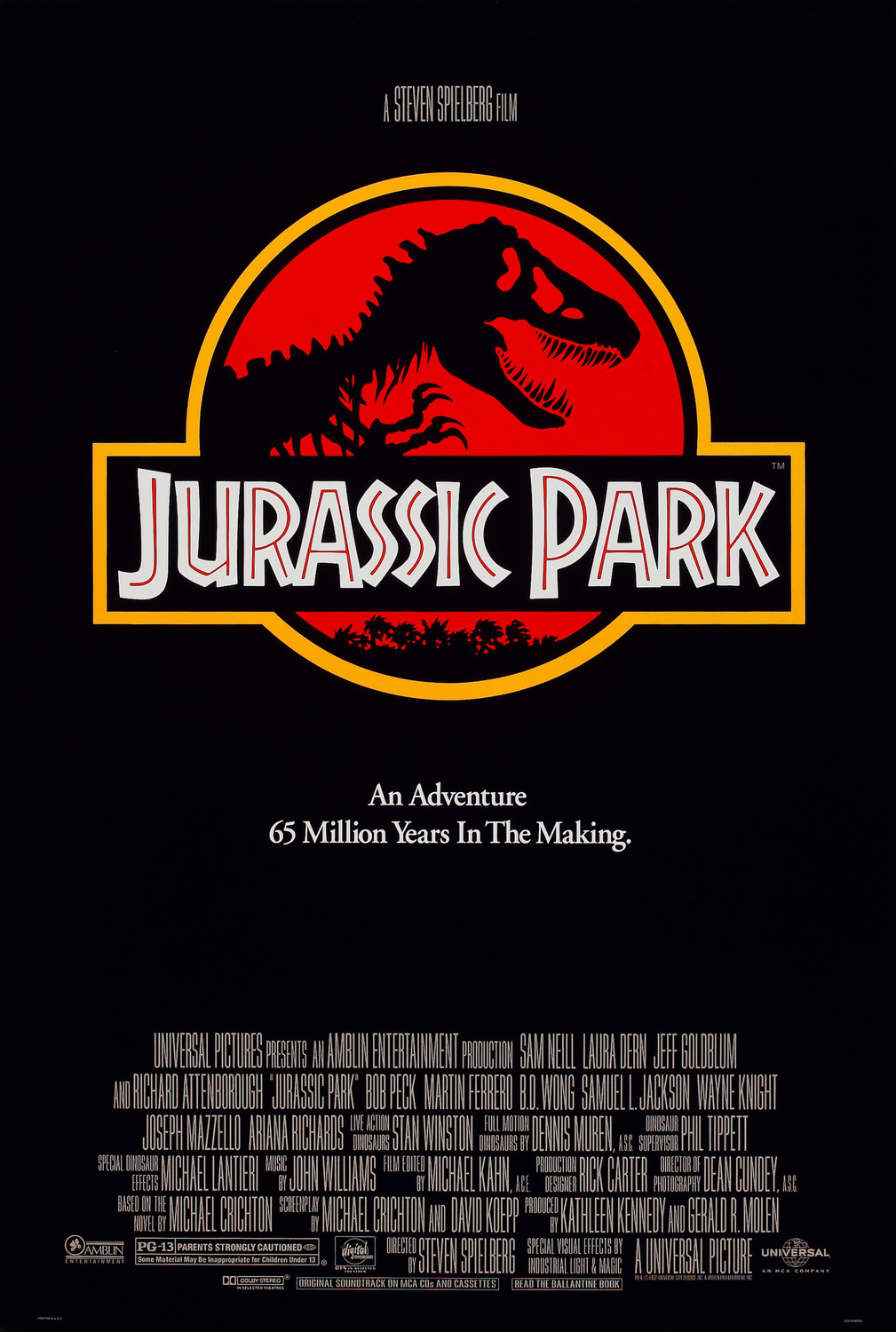
My 40 Favorite Films of the 90's - 34 - Jurassic Park (1993)

Jurassic Park (1993; Universal Pictures)
Director: Steven Spielberg
Writers Michael Crichton, David Koepp
Starring: Richard Attenborough, Sam Neill, Laura Dern, Jeff Goldblum

Here is an obvious one!  Jurassic Park is Spielberg’s very well-made adaptation of Michael Crichton’s novel.  Considered unmakable at the time, this movie was a tremendous undertaking.  The film had a massive budget, loaded with huge sets, large-scale animatronics, scientific advisors and some of the best computer animation the early 90’s could offer.  However, despite its lowered expectations due to skepticism given the scale of the production, the film nearly made its entire $63 million-dollar budget back on its opening weekend in June of 1993 (sources: imdb.com, the-numbers.com).

Jurassic Park tells the story of an eccentric billionaire named John Hammond (Attenborough) who opens a theme park populated by genetically-engineered dinosaurs.  A group of scientists and specialists, as well as Hammond’s grandchildren, arrive at the island park for its dry run, only they were not expecting a dangerous tropical storm and a slimy hacker to cause a lot of trouble for the awed visitors.  What transpires is a high-tension monster movie filmed with a lot of love for the material.  The money also shows on screen, with big sets and convincing effects.  One downside of the movie I would say is how Spielberg uses the night setting and the tropical storm to obscure some of the technical limitations, giving the movie a dark, occasionally colorless look.  It is a monster flick, though, but it is important to know that the dark imagery standard set in the 70’s was also to hide effects and makeup, so take from that what you will.

The acting is fair, with Ariana Richards giving a solid performance as the Hammond’s granddaughter, Lex.  However, she has not appeared in much outside of some B-movie material.  Laura Dern, Attenborough, and Jeff Goldblum are all quite good in their lead roles and Wayne Knight and Samuel L. Jackson give entertaining supporting performances in the few scenes they are in, and over all, there are no performances that come off as stilted or annoying, as is often the case with Spielberg's films, especially from the child actors who appear in his movies.  That said, Sam Neil is good with his lines but he really seems to be sleepwalking through the movie and his character Dr. Alan Grant only seems to exist to provide exposition about the dinosaurs.  

All-in-all, Jurassic Park is not a flawless movie, but it is an entertaining one.  It has some good effects work, some pretty tense moments and a few quotable lines.  There was effort here, and sometimes that is all you need to put something fun on screen, and despite all of the effort to make a big effects movie, Spielberg is usually pretty good about keeping the focus on the characters, which he does do here.  You never feel disconnected from the action and there is a sense of dread and fear for the lives of the park’s patrons.  You can not really go wrong with this material either, I mean it is a T-rex chasing a jeep in the rain.  That is so badass.

Thursday, April 24, 2014

My 40 Favorite Films of the 90's - 36 - Terminator 2: Judgement Day (1991)

T2: Judgement Day (1991; Tristar Pictures)
Director: James Cameron
Writers: James Cameron, William Wisher, Jr.
Starring: Arnold Schwarzenegger, Linda Hamilton, Edward Furlong, Robert Patrick

I am pretty sure it is safe to call The Terminator one of the best thrillers of the 80’s.  It is a very simple movie in its story and structure, yet it was intensely explosive and entertaining.  In the film Linda Hamilton plays Sarah Connor, a waitress who becomes the target of a time-traveling killing machine called the T-800 sent from the future by a computer-controlled consciousness called Skynet.  She was to bear the child who would lead the resistance against the machines.  Her death would mark the end of the fight for man in the future, so a time travelling human named Kyle Reese was sent back to protect her, but inadvertently falls for her, and well-shot love scene marks a major turning point in the film.  In the end, Sarah successfully destroys the machine that pursued her and shortly after the events of the film, she finds that she was pregnant with Kyle’s child, who she named John, and this brings us to Terminator 2: Judgement Day.

The titular Judgement Day is in reference to a nuclear attack from Skynet that was its first strike in the war against mankind.  The sequel is set a few years before Judgement Day, this time the Terminator is reprogrammed and sent back by the human resistance to protect John Connor.  It is discovered that Skynet is making the first move on the teenage John’s life by sending back a deadly new type of Terminator called the T-1000, a cybernetic liquid metal alloy that can take any solid shape and even replicate the face and voice of humans.  It is Skynet’s deadliest weapon yet, and sending back a requisitioned terminator is the only hope to save John’s life.  

The film focuses on the T-1000’s pursuit of John Connor, and the T-800’s attempts to protect him.  Along the way John orders his protector to help him break his mother out of a mental institution where Sarah Connor was incarcerated after her traumatic encounter with the machine in 80’s had led her to warn of their coming threat and the authorities’ rejection of her warnings resulted in her becoming increasingly violent.  After a successful rescue, he three heroes meet with a weapons dealer, gather a small arsenal, and make an attempt to stop Judgement Day by finding the machines’ architect Miles Dyson and killing him, but ultimately they acquire his aid and attempt to stop the devastating nuclear attack that was only a few years away.

Judgement Day was a mix of ideas from the start.  It was part high-concept science fiction, part action blockbuster and it featured solid performances from everyone.  A big takeaway from this film is Robert Patrick as the T-1000, which is a seemingly-unstoppable juggernaut willing and able to kill anyone and do anything to accomplish its task.  Like the Terminator that tried to kill Sarah before, it is a terror that does not sleep, eat or even slow down.  Yet, the T-1000 is even more deadly as all weapons seem useless and all attempts at eliminating it are futile.  The villain is easily the best thing about this movie, but it still quite excellent as a whole.

I do want to take just a moment and talk about James Cameron as a director.  I will not go on too long here, but I do want to say that he is incredibly talented visual artist, able to weave together great action scenes and has always been ahead of the curve in his ability to harness the latest visual effects technology to its fullest potential.  That said, he has never really come across to me as a particularly capable storyteller.  The Terminator series has a pretty straightforward story as a whole, despite a few attempts to add depth.  Yet, it seems to me that, while Cameron can certainly write an action scene and a solid David vs. Goliath plot, he does not seem particularly good at handling human characters.  One major flaw with Terminator 2 is how Sarah is a normal working woman in the 80’s yet finds herself institutionalized then escapes this facility a trained tactical weapons expert.  There is also the fact that John Connor is a conveniently-skilled hacker, an ability that is necessary for the plot to work, but not fully utilized or expounded upon.  Lastly, there are the plot holes surrounding the Terminator himself.  If he was reprogrammed, how is he being controlled?.  For that matter, how is Skynet controlling him?  If he was assigned orders before he was sent back, then why is he able to deviate from these orders at all?  We see in the unbelievably-flawed Terminator 3 that the machine is more than capable of defying the orders of anyone that sent it back in order to accomplish its ultimate task.  How are the humans able to send anyone back at all?  All of this has been addressed to an extent by outside media like books, comics and (to a certain degree) the later films, but Terminator 2 seems to exist solely for the action.  There is not much of an attempt to expound upon the basic premise, there is only the effort to make everything big and pretty.  This is a problem I would continue to have with Cameron’s films even up until today.  There is simply so much that makes no sense in all of his films, yet these problems are readily dismissed.  I just cannot let him off the hook for his films’ issues, however, because there are just too many of them.

So, why then is Terminator 2 (or T2, as it is known from its early-90's marketing campaign) even on my list at all?  Well, that is a very easy question to answer.  Terminator 2 sits at number 36 because it is a loud, aggressive, fun action flick.  Nothing more, nothing less.  For the same reason Die Hard is held at such high regard, Terminator 2 is a movie I love because it is simply fun to watch.  The performances, while written in a hackneyed sort of way, are still acted well, and the action set pieces and effects scenes are all some of the best of the 90’s.  It is a driving, high-energy film with very little downtime, and that pace keeps me coming back to it every once in a while.

Wednesday, April 23, 2014

My 40 Favorite Films of the 90's - 40 - Audition (1999)

Audition: 1999; Basara Pictures
Director: Takashi Miike
Writer: Daisuke Tengan
Starring: Ryo Ishibashi, Eihi Shiina

Kicking off this list of my 40 favorite movies from the 90's is one of the hardest sits of my life.  I watched Audition shortly after its release and was disturbed, disgusted, shocked and yet I loved every minute of it.  I will not hold back in saying that Audition is easily one of the most disturbing films ever made as director Takashi Miike is a master of sensory filmmaking and with films like Gozu and the Happiness of the Katakuris he blends different visual and tonal ideas, all having a certain visceral feel to them.  Audition is built upon a very simple, yet structural, use of tension and as it grows and grows the events in the movie become even more disturbing, revealing one of the most hard-to-watch final acts of any film I have ever seen.  

The plot follows a widower named Shigeru (Ishibashi) who is convinced by his brother to hold a fake audition for musicians, with the true intention being to find a new wife for the lonely man.  The one perfect girl, Asami (Shiina), seems so beautiful and so sweet to Shigeru and we get the same impressions of her from the start.  However, this expectation is promptly crushed as the film progresses and, at the start of the 2nd act, we finally get a glimpse into just how disturbed she really is.  The conclusion of this film is a prolonged, slow and quiet torture scene, where we can hear and even feel the acupuncture needles going behind the eyes and the piano-wire sawing Shigeru's feet off.  It is all done in graphic detail and with a shocking level of intimacy, especially in the sound production, which is some of the best in the horror genre.  Every sinew, every severed vein, ever prick and prod is heard over a deafening silence, otherwise only broken by a heavily-drugged and nearly-paralyzed Shigeru’s stifled cries of pain and Asami’s gleeful yet eerily-soft singing.

Now, despite its disturbing premise and final scenes, Audition is a beautiful film.  It is all very soft and delicate, with lots of close shots and lingering scenes that do not feel dragged out, instead they all add to the boiling pot.  There are a few scenes in particular that are framed just beautifully.  Long shots down a dark hallway lit in the foreground by a soft blue fluorescent light, and beautifully-framed scenes of silhouette and interior scenery that are surprisingly not boring.  Miike is very good at visual tone, and he uses the cold, sterile fluorescent lights of Shigeru's life to contrast with the warmer golden of Asami’s.  It is meant, I believe, to be a siren’s song for the audience, as though she can bring warmth and color to his world again.  We know in the end, however that this will not happen.