Chitika Ad

Wednesday, May 14, 2014

My 40 Favorite Films of the 90's - 26 - Toy Story (1995)

Toy Story (1995; Walt Disney/Pixar Studios)
Director: John Lasseter
Writers: John Lasseter, Joe Ranft, Andrew Stanton, Joss Whedon, Joel Cohen, Alec Sokolov
Starring: Tom Hanks, Tim Allen

In July of 1928, Steamboat Willie became the first “talkie”, with a full spoken audio track playing over an animated short film.  It was a landmark achievement in filmmaking from an idealistic young director named Walt Disney.  A decade later, Snow White and the Seven Dwarfs became the first feature-length animated film and set the standard for the art of animation in its time.  Walt did much more for filmmaking than adapting classic fairy tales and building theme parks, though.  He designed and engineered the multiplane camera, allowing for the effect of perspective and depth in 2D animated films and was responsible for implementing many new forms of editing and effects that would revolutionize the way we look at the art of movies.

By the 70’s, however, Disney, as a company, was at an all-time low in terms of morale and success.  When Walt Disney died from cancer in 1966, the studio had a hard time keeping up the pace and begin producing fewer and fewer successes until the late 80’s saw the Disney Renaissance, a period of massive growth for Disney as a company.  In 1994, Disney gave us The Lion King, a massive achievement in filmmaking, and a year later, a small group of animators introduced the world to the first feature-length computer animated film: Toy Story.

Toy Story is an incredibly simple, timeless story told very, very well.  It follows the secret lives of toys when their owner, a boy named Andy, is not around.  They have a hierarchical ruling structure based on how much Andy loves them, with Woody (Voice of Tom Hanks), a pull-string talking cowboy, being the favorite and thus, the leader.  On Andy’s birthday he is given the next big toy, an electronic space hero named Buzz Lightyear.  Immediately Woody feels cast aside as Buzz appears to become Andy’s favorite new toy.  The only problem is, Buzz does not believe he is a toy, and thinks he is a real interstellar action hero.  Over time, Woody becomes so angry and envious of Buzz, that at one point he is accused by the other toys of killing Buzz when the space hero disappears.  This forces Woody to take action to find Buzz and prove his innocence, the two becoming friends in the process.  The film takes several turns in the story, with one surprisingly dark subplot involving a toy-torturing, truly messed-up kid who temporarily gains possession of Buzz and Woody.

Toy Story is a tale of unlikely friendship told through the a technology that was, at the time, still very new to general audiences.  Computer animation had been around for well over a decade but it was always very shallow-looking.  Bright colors and blocky figures dominated the artform, so imagine audiences’ collective surprise when Toy Story featured fully-animated characters in highly-detailed scenes.  It was a shock to most people, and it put Pixar near the top of the animation totem pole, right up there with Walt Disney Studios (a separate entity from Pixar) and Studio Ghibli.  The characters are interesting and relatable without being too cliched, the voice performances are all top-notch and art is still astounding by today’s standards, even after we spent years sitting through one mediocre CGI-fest after another, with the medium no longer being novel, just boring.  Toy Story is a reflection on a time when talented filmmakers were still very excited about a new art-form, and the potential of this new style of animation was still on the horizon.

NOTE: I would also point out that this was an early major screenwriting project for fan-favorite filmmaker Joss Whedon, so there's that, too!

Thursday, May 8, 2014

My 40 Favorite Films of the 90's - 27 - Fight Club (1999)

Fight Club (1999; 20th Century Fox Pictures)
Director: David Fincher
Writer: Jim Uhls
Starring: Edward Norton, Brad Pitt, Helena Bonham Carter

Fight Club is the 1999 film adaptation of the novel of the same name from writer Chuck Palahniuk.  It is a funny indictment of unbridled consumerism, drawing comparisons to shopping from Ikea with enslavement and disease.  It is certainly an anti-establishment message shoved into a strange series of parallels and metaphors.  So, who better to put together a plot puzzle like this than the man who directed The Game and Seven?

Edward Norton plays a (sort of) unnamed narrator who is tormented by his endless fight with daily life and his sudden urge to buy increasingly-useless crap from the consumer catalog du jour.  Depressed and struggling with crippling insomnia, our narrator begins to attend various support groups for disease and addiction for things he does not even suffer from, only to feel… something.  This therapy works, until a woman named Marla (Carter) begins showing up for the same groups, becoming a plaguing distraction.  During a business trip, he meets an outgoing, fast-talking man named Tyler Durden (Pitt), who seems to have none of the same fears and worries he suffers from.  Essentially, he is the narrator’s polar opposite.  A freak disaster leads the narrator to contact Tyler and they meet up, becoming friends, and eventually, this leads to them fighting in an alley.  Over time, this one fight evolves into hundreds, all over the country, from multiple groups of Fight Clubs, and replaces any need for support groups and shoulders to cry on.  Things grow and grow, becoming even more desperate, and Marla is dragged back in with Tyler, with whom she begins a very, very loud sexual relationship.  With the narrator's own vision of what Fight Club becoming distorted into a movement that has grown far out of his control, the film’s tone becomes extremely dark and more than a little threatening, all leading to a climax that is surprising and kind of terrifying..

Fight Club is a brutal rejection of casual consumerism.  It mocks marketing, and even has the Club members use that marketing as a weapon against the system they feel has enslaved them.  The mood shifts from comic to thriller steadily throughout the film, but from the very beginning there is a sense of unease.  We are told early in the film that “With insomnia nothing’s real.  Everything’s far away.  Everything’s a copy of a copy of a copy…”, and that is exactly what much of the first act feels like.  Scenes are very dreamlike, full of strange imagery of floating catalog price information and CGI penguins.  There are subliminal images that flicker and disappear, almost like hallucinations, and the whole production has this very cold, artificial feel to its benefit.  The surrealist elements of the film never feel too out of place since we are meant to be seeing this world through the eyes of a troubled man.  

David Fincher was the perfect choice to direct this movie.  He is able to weave incredibly complex and layered narratives into a cohesive and captivating story.  He is probably better at this than just about any other director working in Hollywood today, with successes like Zodiac and The Social Network telling stories that span several years with a great deal of coherence, something that is very difficult to do without losing your audience.  Fight Club just may be one of the most ambitious film adaptations of all time.  Not because of thousands of fighting soldiers and castles that need to be modeled and CGI’d, but because it is a story told in first person, from the perspective of an individual who sees the world very differently from the way most people do.  Fincher’s ability to put you in the eyes of this one broken and desperate man is simply astounding.  

Now, I am trying to stay vague with this article because if you have not seen this movie yet, it is a must-watch.  It is violent, gritty, and even a little convicting.  You could have been doing something great, and you did nothing productive.  In a shocking and brutal, but funny scene, Tyler holds a young man at gunpoint for “wasting his life” and not pursuing his dream career, for which he lets the man live with the promise that he will pursue a better life.  It is mean, but it is also honest.  Fight Club certainly has a little bit of preachiness to it, which is usually a turn-off, but I never got the feeling that this was based on some schizophrenic’s insane ramblings like I did with tripe like The Day After Tomorrow or overwrought, heavy-handed ripoff material like Avatar.  I was entranced by the film’s fun visuals and darkly humorous tone.  The screenplay is freaking outstanding and every performance is damn good.  Brad Pitt gives what is probably my favorite performance of his career as Tyler Durden and Edward Norton is bringing his A-Game as an awkward, nerdy doormat who is transformed into a tough-as-nails, takes-no-crap badass over the course of the movie.

Sunday, May 4, 2014

My 40 Favorite Films of the 90's - 28 - Rushmore (1998)

Director: Wes Anderson
Writers: Wes Anderson, Owen Wilson
Starring: Jason Schwartzman, Bill Murray

Wes Anderson makes his first appearance on my list with his 1998 film Rushmore.  This is Anderson’s second feature film and the first one he did to really get promotion, thanks to a more recognizable cast and a higher-profile marketing campaign.  Rushmore is a strange film, as is typical for Anderson, only, it is strange in a proper way.  I will go more into Anderson’s style of filmmaking later but suffice it to say for now, if you have not seen a film by Wes Anderson, then  you have not really seen anything like it.

Rushmore is the story of a super-intelligent teenager named Max Fisher (Schwartzman) who has a great deal of influence at an exclusive private academy called Rushmore.  He is followed by his much younger protege who more or less acts as his secretary as he heads and organizes a bevy of time-consuming clubs.  As a result of his devotion to extra-curricular activities, Max’s grades are suffering and he finds himself at odds with the headmaster, who places him on academic probation.  Meanwhile, a beautiful young teacher named Ms. Cross becomes the target of Max’s affection, a crush that comes between him and his much older friend named Herman Blum (Murray), when she and Blum begin dating.  The plot shifts to focus primarily on Fisher and Blum’s fight over Ms. Cross, which increases in desperation.

If the synopsis seems a little broad, that would be because it is a Wes Anderson film.  Anderson’s stories are usually a series of layered plots that are intermingled with the film never focusing firmly on just one for too long.  There is enough of an underlying focus for the story for there to actually be a movie, but it never becomes the center of the film, it is just there to tie together the various other subplots.  Rushmore is a constant stream of sight gags and an odd awkwardness that may come off as ineptitude, until you actually watch the entire film.  The strange pauses, fourth-wall-breaking montages and tone throughout the film all add up to a strange experience, but a funny one.  Chances are, however, that if you do not like one Wes Anderson movie, you will probably dislike all of them, with the one exception of the more recent Moonrise Kingdom, which was an excellent movie, and a definite evolution for Anderson as a filmmaker.  

Rushmore is a funny, slightly disjointed and unhinged movie about teenage awkwardness and social standing and it challenges norms of filmmaking in just about every scene.  Anderson has made it part of his style to break the established “rules” of direction, and what comes of it is both a funny film, and a unique artistic idea.  All of his movies have a distinct palette as well, which further add to their identity.  Anderson makes a distinct sharp yellow the chromatic focus of every scene, with browns and soft greens becoming compliments.  These earth-tones are then contrasted with foreground elements like Max’s bright red beret.  Another interesting trademark of Anderson is how he makes certain performances stand out in scenes by have them follow slightly more subdued acting from other lead characters.  This makes some more dramatic scenes seem louder than they really are, giving the illusion of a heightened series of events, without ever breaking the sardonic feel of the movie.

Tuesday, April 29, 2014

My 40 Favorite Films of the 90's - 29 - Trainspotting (1996)

Trainspotting (1996; Channel Four Films)
Director: Danny Boyle
Writers: John Hodge
Starring: Ewan McGregor, Jonny Lee Miller, Robert Carlyle

My number 29 is the film that was voted by the UK public as the greatest Scottish film of all time, Trainspotting.  An examination of the lives of a group of twenty-somethings living in poverty in late-80’s Edinburgh and their constant struggle with heroin addiction, Danny Boyle’s award-winning film is a smart and occasionally horrifying melodrama.  This is easily one of my favorite films based on the theme of drugs and drug abuse as it has one of the best tonal shifts of any film I’ve ever seen.

The film primarily centers on Renton (McGregor), who narrates the film and expresses his thoughts on shooting up and coming down, as well as his inner-struggle about getting clean.  The film starts off with a funny series of narrations that run down why he and his friends do the things they do.  Unlike many other characters we see in movies, Renton is represented as loving heroin.  We hear from him the details of the high and the way it is narrated it seems almost as though the film is trying to sell the drug to its audience.  However, about halfway through the film the events take a dark turn and things get more than a little out of control.

Trainspotting is funny, but also very, very dark.  There is violence, tragedy and consequence, however the film never feels preachy.  Danny Boyle shows us some of Renton’s hallucinations that come in escapism, but also come in the form of terrifying torment as his family executes a harsh plan to force Renton to clean up, keeping him in a room as he is left to go cold turkey, a truly painful and awful experience.  As Renton writhes, sweats and screams, we see it and feel it with him thanks to Boyle’s masterful use of camera work and his flawless execution one of the most horrific scenes in film history.  I will not ruin it, though, as Trainspotting is a must-see.

Danny Boyle went on to direct the awesome 28 Days Later and was shortly-thereafter acknowledged by the Academy for his film Slumdog Millionaire.  Trainspotting is a film that looks very good, while also being occasionally unwatchable.  It is graphic, gruesome and disturbing but is never gratuitous.  Every scene has meaning to the plot, as Renton and his friends struggle with moving on from their addictions, but the drugs always seem to win.  It is tragic and smart.  It is neither a pro-drug comedy or an anti-drug propaganda film.  Instead Boyle just shows us these characters’ respective realities, as grim as they may be.

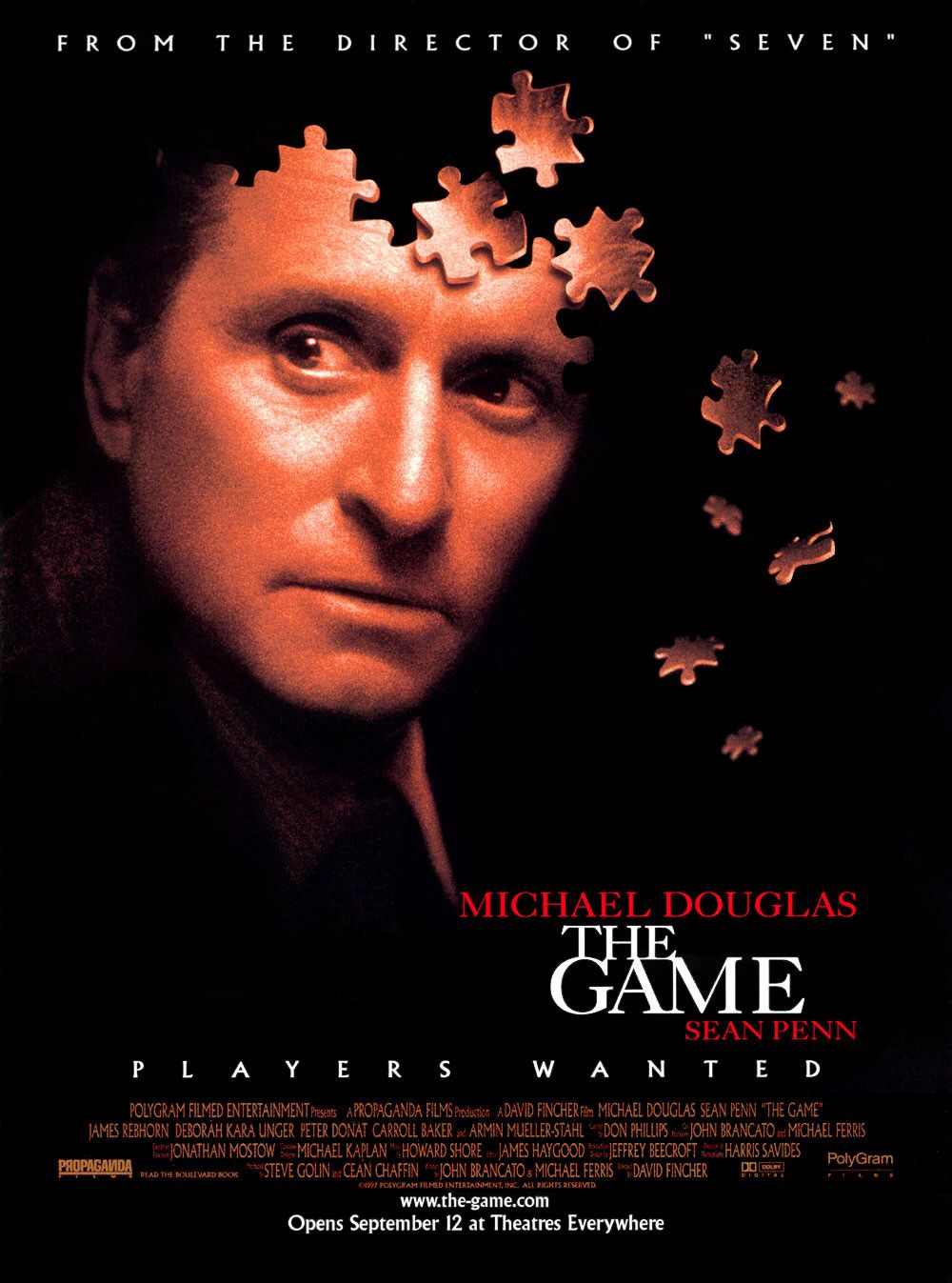
My 40 Favorite Films of the 90's - 30 - The Game (1997)

The Game (1997; Polygram Filmed Entertainment)
Director: David Fincher
Writers: John D. Brancato, Michael Ferris
Starring: Michael Douglas, Sean Penn

The Game is the first film by David Fincher to appear on this list.  The story revolves around a wealthy businessman named Nicholas Van Orton who seems to have lost his way, at least in the eyes of his brother, Conrad.  For Nick’s birthday, Conrad gives him a pass for a company that provides a strange role playing game that is interweaved into the "player's" daily life.  He reluctantly follows through with the gift and what follows is a bizarre, twisting and dark series of events where you never know what is truly real, and what is all part of the game.  Along the way, he meets a woman who becomes an unexpected ally through the course of events.

By the time The Game was released, David Fincher had already established himself as a talented filmmaker with his 1995 film, Seven.  His dark, complex cinematic style has become a trademark and his talent for weaving together complex ideas into solid and cohesive stories is undeniable.  The Game is an extremely deep fantasy, where the real world seems to disappear into the background as the events become more and more bizarre.  The interesting aspect of The Game is how the story is told.  We experience the events almost solely from the perspective of the protagonist, where rarely a single scene goes by where Nick is not present, so the audience experiences the threatening “game” exactly as he does.

The distinct style of Fincher begins to mature in this film.  The dark imagery, the creepy use of things like clowns and more abstract images like formless shadows and even the simplest reflections on stone walls are used to create a dreamlike atmosphere.  The mood of the film is easily its biggest strength.  It is unsettling, and this sense of unease throughout is palpable and effective.  Michael Douglas gives a good performance as a man who transforms through the film, starting off as a cynical and almost bitter man.  As the film goes on, and the game becomes more and more unnerving, we experience this arc with him.  Survivalist instincts take over and we see this in Douglas’ most subtle actions and expressions.  It is a great performance from a seasoned actor and it only adds to the strangeness of the events, as we can read his response and mimic him sympathetically.

The first time sitting through The Game is quite the experience.  It really is not the kind of movie that holds up to countless re-watches, however, because once we see the end, there really is no journey anymore.  Still, a new watcher of this film will likely find themselves puzzled, captivated and excited about the unfolding story.  This is a must-see for fans of complex films and puzzling mysteries.

My 40 Favorite Films of the 90's - 31 - The Lion King (1994)

The Lion King (1994; Walt Disney Studios)
Directors: Roger Allers, Rob Minkoff
Writers: Irene Mecchi, Jonathan Roberts
Starring: Jonathan Taylor Thomas, Matthew Broderick, Jeremy Irons, James Earl Jones

The Lion King is Disney’s telling of Hamlet.  That’s it.  Well… Okay, the story follows Simba, a young lion who is the heir to an undefined “kingdom” in Africa called the Pride Lands.  The story is “adapted” from a number of sources including the works of Shakespeare, the Bible and an anime from the 1960’s from Japanese Animation pioneer Osmau Tezuka titled Kimba the White Lion.  The various sources of the film, with the exception of Shakespeare’s Hamlet, were not properly cited when the film was originally released (as is unfortunately typical with Disney).  This led to some notable controversy surrounding the film.  With all that, is the Lion King still a quality production?  Well, yes.

Despite the stolen premise and the disingenuous way in which it is presented, The Lion King is a strong production that set the standard for animation for years upon its release.  The film follows Simba, a young lion cub who, after witnessing the murder of his father, the king Mufasa, flees and lives his life in exile from his homeland.  There, he befriends two layabouts named Timon and Pumba, who act as the obligatory comic relief of the film but also as a parallel to Simba’s real responsibility to his homeland.  When Simba meets up with his childhood friend and promised future mate Nala, he learns of Scar’s overthrow of the crown, and his oppressive and destructive rule.  It is now Simba’s duty to return to his home and face the usurper of the throne to face his true destiny.

The story is a rather simple one, really.  It is about denial of one’s true self, and about the ideas of reason and responsibility.  Shakespeare, being a playwright for the people, often depicted the ruling class as slovenly or lazy to an extent and this story reflects that trope.  Simba, as an adult, starts off absorbed into Timon and Pumba’s laissez faire lifestyle, forgetting his roots and role in the world entirely.  The arc is his facing of adulthood.  It is a strong character shift and a well done part of the film.  It all culminates in a climax where Simba squares off against the evil Scar in the wasteland that was once his home.

Production-wise, everything about this film is top-notch.  The animation is some of the best of the studio’s history, the music is quite good, despite a few slightly annoying numbers that go on a little too long, and the story is big in scale yet it is told very accessibly for all audiences despite its source material.  The voice acting is also very good, especially Jeremy Irons as Scar.  I do love Irons as an actor and here he is funny and intimidating as Hell as one of the best movie villains ever, right down to one of the best damn musical numbers in the history of film “Be Prepared.”

As far as the rest of the music goes, it features some powerful moments.  Much of the film’s music was composed by one of my favorite artists, Elton John, and his contribution is notable.  It is a much more sophisticated soundtrack for the time.  The Disney Renaissance was littered with “kid-friendly” musical moments and for every “Part of that World” or “Be Our Guest” there was an over-silly and rather schmaltzy number like “You’ll be in My Heart” or this film’s contribution to bad Disney Music, the reason for the creation of the Mute and Fast-Forward Buttons, “Hakuna Matata”.  Still, there is one moment in this movie that hits me to the core every time I see it. The film ends as it begins, hence the film’s theme, “The Circle of Life”.  It plays as Simba’s son is presented to his subjects and the film ends on a triumphant pound of the drum.  It is a fantastic use of exposition-free storytelling and is one of the most powerful moments in cinema.

All-in-all, this was definitely the best animated film of the period, and I am not the only person to say so.  Disney was on a roll with hits leading up to this film and yes, I do like The Little Mermaid, and I am not ashamed to say it.  I think it’s a lovely story told quite well with likable characters and top-notch production value.  Beauty and the Beast was good, but not great, and Pocahontas was a successful little piece of shameless revisionism with a nice coat of paint, so take that for what you will.  However, this period also gave us Hercules, a film I most certainly did not like (except for James Woods as Hades, because Woods is a badass no matter what he does.  He wins forever.)

The Lion King has also been the subject of much accolade since its release.  Its music and score was nominated for and won multiple Oscars, it won best Comedy/Musical at the Golden Globes, it currently ranks at #57 in IMDB’s Top 250 and is a common fixture in books and lists of “Greatest Films of All Time”.  It is a memorable, nostalgic and vibrant work and, despite its flaws, it is a classic movie that I think will become one of the principal staples of the best of modern cinema that will be remembered, preserved and revered for generations to come.

Monday, April 28, 2014

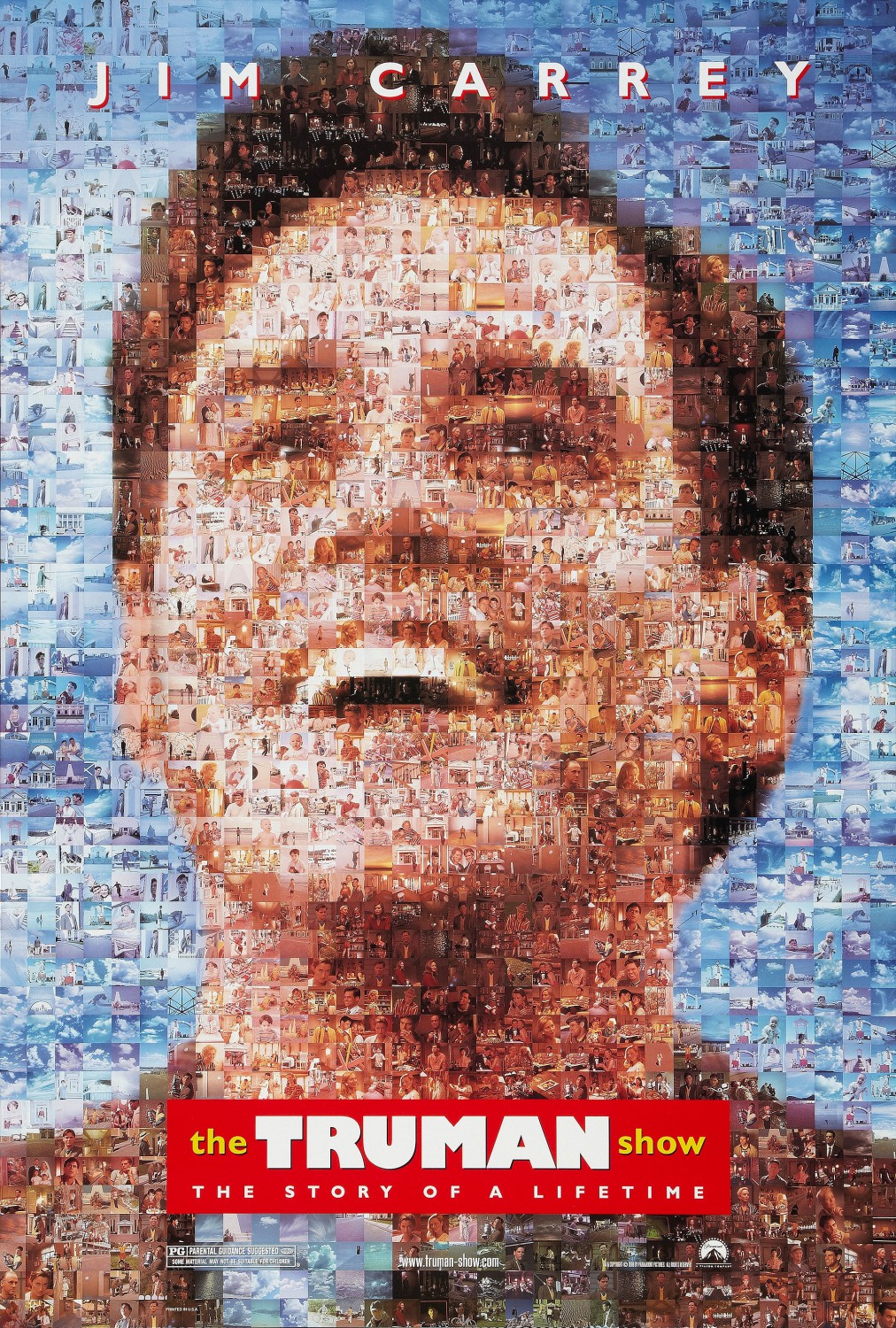
My 40 Favorite Films of the 90's - 32 - The Truman Show (1998)

The Truman Show (1993; Paramount Pictures)
The Truman Show
Director: Peter Weir
Writer: Andrew Niccol
Starring: Jim Carrey, Ed Harris, Laura Linney, Noah Emmerich

Before 1998, I do not think anybody would have thought that Jim Carrey star in a film that would be nominated for multiple Academy Awards.  The Truman Show, however, was Carrey’s chance to prove that not only could he act, but he could act in a great film and still bring his trademark energy and cheer to the role.  This is a film about a man who discovers everything he ever knew was a fabrication, a design by a few people, and a man who sees himself as “the Creator”.  It is an incredibly complex idea built on a far-fetched, but still somewhat believable, premise.

Truman was born on live TV.  He was adopted before birth to become the subject of a television show that would document his entire life in real time.  A massive town was created, with everyone but Truman in on the act.  Myths and lies were made upon which his entire life was built and the show went so far as to have his father “killed off” to make him afraid of water, as the set is built inside one of the largest structures ever created.  Truman’s world is a perfect one, where everyone knows and loves him and his happiness is a comfort for his millions of viewers, even if he does not know he is being watched.  However, as an adult, his adventurousness and restlessness get the better of him and, after a series of events that cause him to become more than a little paranoid, he begins to discover the truth about his whole life.

Jim Carrey gives one of his best performances here as a kindhearted man living a carefree existence.  Carrey’s bright smile and warmth really shine through here as all of his previous films more or less required him to subdue those traits.  Here, however, he is completely and totally convincing as a once-oblivious man faced with a shocking reality.

The Truman Show is a must-see for all movie fans, casual or otherwise.  The film is funny, smart and existential and it has a great screenplay.  Ed Harris gives an awesome supporting performance as Cristof, the director of The Truman Show, a man obsessed with Truman but, whose career depends on the show’s continued run, yet seems to also care at the same time.  I see Christof as the idea of a deity, one being who can control the world of any man.  He is dichotomous, both moral and immoral, selfish and selfless, and his actions are both reprehensible and fathomable.  

How far will one man go to preserve his legacy?  If you have lived your whole life in utter comfort only to find it was a fabrication, would you reject it to embrace freedom?  The Truman Show is a social experiment and a smart idea written and filmed with love and patience.  It is allegorical.  Escaping slavery to embrace the responsibility of freedom.  It is an astounding concept, but this is not a fast comedy romp.  It is a deliberate light drama and a movie that lets us really get to know Truman as a character before his world crumbles around him.  It is definitely a journey that everyone should experience.