Chitika Ad

Showing posts with label 70's. Show all posts

Monday, March 9, 2015

"Know" More Pop-Culture- The Grindhouse

Just before the market crash of 1929 known now as Black Tuesday, movie theatres were opening like mad to accommodate the massive demand for a growing pop culture phenomenon dubbed the motion picture.  Films were being churned out in numbers that are inconceivable by today’s standards, but shorter silent films were often inexpensive to produce and required little in terms of quality.  So, the result was a pretty wide range of film ideas, some good and some… not so good.  A not-so-well-known fact about the early days of cinema is “nudie” films were extremely common.  Even in the 19th Century nickelodeons, a short film featuring a topless dancer was far more common than one might imagine.  As films took to the big screen, and the Hays Code took over in the 1930’s, most of these sorts of films were driven out.  Given their reputation and poor storage, most of these movies have suffered the tragic fate shared by so many films of the early 20th Century: degradation through disintegration.  This was a consequence of the celluloid used for years to print film media.  Since it was now “illegal” to show nudity and other banned content in theatres, an underground was formed.

42nd Street Grindhouses (Source: Soundonsight.org)
42nd St. in Manhattan is arguably the most famous theatre district in the world (not discounting Los Angeles’ famous Beverly Cinema), and many of the joints on this stretch of road were not ready to give up the profitability of sexuality.  There was just one problem: That damn Hays Production Code!  So, many theatres repurposed their floors to become burlesque theatres, performance theatres typically featuring women dancing seductively and singing songs riddled with innuendo.  Some of these clubs also became associated with New York’s Red Light District, though most were nothing more than very tame strip clubs.

(Source: listal.com)
As the decades rolled on, the theatres that continued to show movies often bought reels to cheap movies of poor quality, showing them several times throughout the day, as opposed to the one or two showings-per-film common at that time.  The rates would increase during the day, capping off around 6pm.  This set the tradition of the Matinee Price so common in theatres.  This trend continued through until the 70’s, when things began to change dramatically.  This process of repeated showings became known as “grinding” and became the namesake of the theatres that practiced this new profitable idea.  The existence of these “grindhouses” actually spurred a new market for cheap, quickly-produced films that in many ways were built to violate the already weakening Hays Code, featuring copious amounts of sex, graphic violence and other material that was, in that period, very controversial and some films are still shocking by today’s standards.

While these same grindhouses were showing films that would or could not be shown in other major theatres, they also did show many major releases, as well as a number of films that are widely regarded as modern classics.  Another fact is some entire genres owe their very existence to these theatres.  In-particular, slasher, spaghetti westerns, martial arts and blaxploitation films would likely have never caught on without help from the grindhouse districts.  However, as the 80’s came around,  the market for these films in theatres shrunk rapidly due to the proliferation of home video.  Within a few years, the theatre market would collapse all around; a consequence of the rapidly-growing video market and the advent of megaplexes, which were competing to be bigger-budget attempts to monopolize local theatre markets by offering more and more movies and showings at a time in a single location.

The exploitation genre continues on, though it’s subgenres have split off, with newer films being mostly inspired by the 70’s classics rather than trying to craft any real identity of their own.  However, in spite of the cinema collapse, the legacy of the grindhouse persists to this day directors like Quentin Tarantino and Robert Rodriguez are highly inspired by the films of the 70’s grindhouses and many modern action and horror movies draw a lot of inspiration from the grindhouses.  Also, many films from the grindhouses’ heyday have found a new market thanks to home video and digital distribution, garnering a new cult following and have themselves crafted a dedicated and unified fan culture.

The question is: Were the grindhouses disreputable garbage heaps throwing out nothing but gore and pornography?  Or, rather, were they inspirational and daring cultural hubs that would leave a lasting impression on future audiences?  I would say they are a little of both.  If they weren’t just a little controversial and didn’t do things differently from the norm, it is likely they would not even be talked about to this day.  It left quite an impression by defying the standards and refusing to accept the rules set by a paranoid and aggressive censorship bureau, instead embracing the strange and opening the gates to a new idea of film that was not only unknown to most, but was outwardly banned by major theatres.  The grindhouses paved the way for a new era of independent filmmakers and broke down barriers to artistic expression.  Modern film would likely not even exist in its current form if it weren’t for this film culture.  So, next time you scoff at an Italian sexsploitation flick, consider that many films you love may not have even been made if it weren’t for the theatre owners brave enough to show it in the first place.

Tuesday, March 3, 2015

My 40 Favorite Films of the 90's - 3 - Pulp Fiction (1994)

Director: Quentin Tarantino
Pulp Fiction (1994; Miramax)
Writer: Quentin Tarantino
Starring: Samuel L. Jackson, John Travolta, Uma Thurman, Ving Rhames, Bruce Willis, Harvey Keitel, Tim Roth, Amanda Plummer

I want to be clear here, and I do not think this is hyperbole: 1994 is one of the greatest years in the history of film.  SEVEN of my top 40 movies of the 90’s are just from 1994.  The American Film Institute released their updated list of 100 Greatest Movies in 2005, a list spanning a century of film, and there were four movies on their list from 1994.  In fact, Pulp Fiction isn’t even the last film on THIS list from that year!

Pulp Fiction is a series of interwoven stories of violence and debauchery and it is absolutely glorious.  There is no one scene that isn’t captivating.  It is a powerhouse of cool direction, a distinct and fresh look and tone, and most of all a stunning screenplay.  So, naturally, it didn’t win the Oscar in 1995, but I’ve already gone over how worthless the Academy Awards are so I won’t bother you with that again.  Instead, let’s talk about one of the greatest films of all time.

Before directing Pulp Fiction, Quentin Tarantino made a couple other genre films including the previously-reviewed Reservoir Dogs.  Tarantino draws heavy inspiration from the classic 42nd St. Grindhouses of the 60’s and 70’s.  These theaters were known for their release of unvetted indie films, often branding the exploitation label, that for the most part remained unrated and rarely saw any release outside of these theatres until the mid-to-late 80’s.  These are the theatres that brought us the great Blaxploitation classics like Shaft and Superfly, the two of which were rare examples of great movies leaving the Grindhouse and getting a wide release (largely thanks to their hit theme songs).  We also saw a lot of graphic horror from Italian directors like Lucio Fulci and Bruno Mattei who rarely saw any form of wide distribution, even in the video market, their films mostly remaining cult classics looming in the underground horror scene.

So, what does this have to do with Pulp Fiction?  Well, this is a movie that amalgamates ideas from the various genres of the time.  The title refers to “Pulp” a largely pejorative word used to describe entertainment that is considered low-quality but is widely popular.  The movie uses directorial styles, fashions and concepts that were common in the Grindhouses, but were rarely embraced by the mainstream film industry.  This is part of what makes Pulp Fiction such an amazing film, it is a beloved, winning classic that employs and draws its inspiration from films that were almost entirely marginalized.  It’s very acclaim and success is itself a commentary on the manufactured idea of “mainstream” entertainment.

Pulp Fiction’s plot is actually a series of interconnected storylines all wrapped around a handful of jobs and the daily lives of two hitmen, Julius and Vincent (Jackson and Travolta).  They exchange memorable banter as they travel around Los Angeles, from cleaning out an apartment of misguided college kids, to taking a local crime lord’s wife (Thurmond) out for a night on the town.  Between these wrapper plot lines, we get other stories revolving around a boxer on a rough deal and a couple of crazed robbers, and that really does only scratch the surface.

The fascinating thing about the film is how everything really comes together.  We see plotlines that are, at first, complete non sequiturs, but as the film goes on, harkening back to these scenes reveals a beautifully-woven series of smaller stories forming a greater whole.  In fact, I believe (and this is speculation) a large part of why this film is so beloved is how it uses these stories to paint an involving picture that encourages audiences to see how it all comes together, creating a sort of active viewing experience.  You mind is processing the stories individually, and when it all comes together it is like an ecstatic revelation.  

There isn’t a bad performance in this movie.  Not one.  This is very rare as even the best movies have a few throwaway acting choices, but Tarantino's meticulousness pays off here.  The cast is huge and everyone has a reason to be there.  This is all supported by the screenplay and, to be honest, if this were a top 40 based on writing alone, Pulp Fiction would be number one.  This is hands down one of the greatest screenplays of all time.  It’s fast, witty and the dialogue, even from the simplest scenes, is superb.  It’s funny and has a charm and character you just don’t see in most movies, this especially goes for Oscar movies, which actually trend on the boring side (and I say this as a film snob).

Wednesday, February 18, 2015

My 40 Favorite Films of the 90's - 8 - Jackie Brown (1997)

Jackie Brown (1997; Miramax)
Director: Quentin Tarantino
Writer: Quentin Tarantino based on the novel by Elmore Leonard
Starring: Pam Grier, Robert Forster, Samuel L. Jackson, Robert De Niro,

Tarantino is a master at crafting complex stories with a large cast of characters and interweaving stories and in 1997, he would direct one of his best films.  Jackie Brown is both a throwback to 70’s Blaxploitation and the complex filmmaking styles of classic directors like Akira Kurosawa and Fritz Lang.

The interweaving plot follows a flight attendant named Jackie Brown who is drawn into a smuggling scam by a local weapons dealer and is then turned by a cop who becomes oddly enamoured with her.  Throughout the film, Jackie is constantly playing both sides (ala Yojimbo).  On one end, you have a tired, veteran cop who is sick of always doing the right thing.  Then, on the opposite side you have a disturbed arms dealer (Jackson) who is working out a sale to a sleazy thug (De Niro), whom Jackie is running money for by smuggling it through her flights.  Ultimately, the film focuses on a plan executed masterfully by the titular heroine to break out of the cycle in which she has found herself trapped.

Our lead character’s plan is reminiscent of Yojimbo, and the final act of Jackie Brown is a call back to another Kurosawa classic: Rashomon.  The scene is played out multiple times, once for each character’s perspective, until we have seen the big scam unfold from all angles.  Somehow, Tarantino reveals this over and over yet each time we see it we learn something new about what is happening.  This film is worth seeing just for the third act, which is a captivatingly-complex series of events.

Jackie Brown is a darkly comical and deeply intricate story filled with references to exploitation and b-cinema.  The film’s very title is a throwback to the 1974 film Foxy Brown, which also starred a lovely Pam Grier.  The mood, atmosphere and sudden moments of shocking violence seemingly out of the blue are distinctly “Tarantino” and this movie has one trait that is astonishingly rare: There is almost no exposition… at all.  Outside of the occasional reference to an association or what someone does, nothing is spelled out for the audience.  Rather, we see a very self-contained story play out as a visual narrative.  It is a great accomplishment in storytelling through film.

Thursday, July 24, 2014

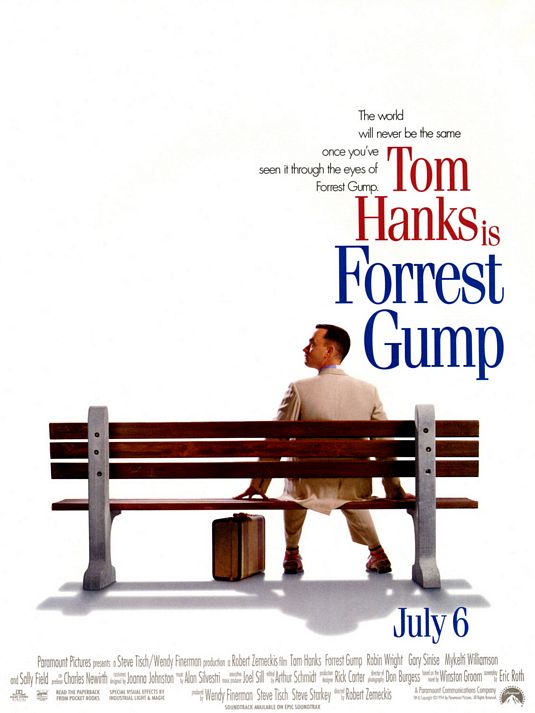
My 40 Favorite Films of the 90's - 14 - Forrest Gump (1994)

Forrest Gump (1994; Paramount Pictures)
Director: Robert Zemeckis
Writers: Eric Roth (Screenplay); Winston Groom (Novel)
Starring: Tom Hanks, Gary Sinise, Sally Field

Winston Groom’s tale of a mentally-disabled man who directly experienced almost every world-changing event in the later half of the 20th Century is a truly charming and heartfelt examination of spirit and love.  Widely considered one of the greatest films of all time, ranking #14 on IMDB’s top 250 at the time of this post, number 76 on the American Film Institute’s list of the 100 greatest American films of all time, and cleaning up in the 1995 Academy Awards with an astounding six wins, Forrest Gump is one of the essentials.  There are a few movies that I would recommend everyone see, and this is definitely one of them.

Tom Hanks plays Forrest Gump, a chatty man who patiently waits at a Savannah, GA bus stop just casually talking with his various benchmates.  He tells them tales of the things he’s done, the people he has met and the places he has been not knowing just how much of an impact he had on the lives of so many people.  Cutting back and forth from the story’s present time and flashbacks to various key moments in Forrest’s life, we see him meet presidents, fight in Vietnam, chat up John Lennon at a Black Panther Party meeting, and ultimately start a hugely-successful business, and he did all of this never knowing how great his achievements really were.

Along the way, as we explore Gump’s life, we meet a few people who will shape him.  His mother (Field) helps to ensure he lives as normal a life as possible and we watch as his childhood friend Jenny (Robin Wright) goes from a pretty tomboy to a broken and abused soul.  Gump’s lieutenant during his tour in Vietnam, Dan Taylor, leaves the war a crippled and angry man, embittered towards the so-called American dream.  We see Lieutenant Dan befriend the devoted Gump, despite occasional periods of frustration.  Then there is Bubba, a fellow recruit who is also slow, who becomes the titular protagonist’s best friend during his time in the Army, ultimately planting the seed of starting a hugely-successful shrimping business.  

Tom Hanks deservedly netted an Oscar for his performance of the kindhearted Gump.  Filled with shining moments of greatness, his performance is famously endearing.  The performances from the supporting cast including greats like Sally Field and Gary Sinise are stunning as well, and act as a great contrast to the unwitting Gump, reflecting the grievances and the disenfranchisement of the late 60’s and early 70’s.  Mykelti Williamson plays Bubba Blue with famous wit and a warmth that nearly matches Hank’s own Oscar-winning role, and every moment with the two on screen is either very funny, or extremely emotional.

Forrest Gump literally has everything.  It is a comedy, a drama, a war story, a romance, a period piece and a smart examination of the ideals and the passions that erupted during the Vietnam War era.  Despite literally trying to be everything, the film never misses a beat, always hitting just the right notes and crafting a very big, but cohesive story.  Ever since Citizen Kane there have been countless movies that have tried to weave a complex and intricate story around a single character through the years, but few have done it better than Forrest Gump.