Chitika Ad

Showing posts with label cult classic. Show all posts

Tuesday, March 10, 2015

Faces Behind the Camera - Bryan Fuller

http://ia.media-imdb.com/images/M/MV5BODkwMDg5MTE1Ml5BMl5BanBnXkFtZTYwMzQ3MTg3._V1_SX214_CR0,0,214,317_AL_.jpg
Bryan Fuller (source: IMDB)
You know “that guy”?  Yeah!  Him!  Everybody has that one actor in film and TV that just pops up everywhere but you never know his name or remember what you saw him in.  Now, what if “that guy” was not an actor but a television creator, writer and producer?  Now, imagine that the same individual was responsible for some of the best television shows of the last fifteen years.  Yeah.  That’s Bryan Fuller.

The closest point of comparison to Fuller I can make is a somewhat more whimsical version of Joss Whedon, the creator of TV’s Buffy the Vampire Slayer, Firefly and, most recently, the director of Marvel’s The Avengers movies.  Like Whedon, Fuller has a knack for writing captivating characters in unique situations and he excels at dialogue.  For a big-budget Hollywood movie, sometimes just dangling keys is enough to be entertaining, but having to operate on a limited budget for a TV show spanning a broader length in terms of story is much more difficult, especially when you are trying to sell an audience something so strange as to be occasionally unsettling.

A characteristic of Bryan Fuller’s series that I actually kind of like is his somewhat light approach to the dark topic of death.  Almost all of his shows have some darker undertone superimposed on bright or humorous backdrop.  This goes especially for his “big four” as I like to call them, but we’ll get to those in a moment.  First, it is important to know that Fuller does not have many credits to his name, and that is often a positive sign… No, really.  Granted, he has only been active in the industry since the late 90’s, so it stands to reason his career thus far would be barely impactful… right..?

Well, it really starts in 2000 with his work as a writer and producer on the spinoff series Star Trek Voyager.  I am not really a Star Trek fan, per se.  I have recently gotten into The Next Generation, watching episodes here and there, and liked what I’ve seen so far, but I have not watched Voyager, so I cannot really give any personal opinion on that one show, still, for an up-and-comer, landing such a position on such a storied franchise is very, very impressive.  The question is: Does he prove himself worthy of gaining such a credit early on in his career?

https://s-media-cache-ak0.pinimg.com/originals/28/9d/ff/289dff2b5eaf2d06ba5fd6d58e48cdb1.jpg
Dead Like Me (Showtime; source: Pintrest)
The first of the “Big Four” is 2001’s Dead Like Me, one of my favorite shows of all time and one of the most criminally short-lived shows in the history of television (both will be running themes here).  The series follows an apathetic teenager who died suddenly in an accident on her first day of work, only to be kicked back from the afterlife to the undead, tasked with becoming a Reaper.  She is then forced in with a crew of fellow veterans of the Reaper title who seemed to be trapped in limbo as she carries out her duties, ferrying souls to the afterlife.  It’s definitely a dark series but, in spite of its themes, it’s a comedy, and a damn-funny one at that.  It’s defined by its uniquely sardonic take on death, while still dealing honestly with the effects of loss, especially on the family and how they are unwittingly watched over by a daughter who only felt unappreciated before her passing.  It’s comically-grim, yet occasionally moving, and if you haven’t seen it, I give it my strongest recommendation.

http://666kb.com/i/bk6w8gzk73v2lf8vx.jpg
Wonderfalls (2004; Fox)
Now, on that note, “Big Four” entry numero dos is Wonderfalls.  This is the first show that would really begin to highlight Fuller’s curse as a producer of hitting the right note but never maintaining a series beyond a few seasons.  This series ALSO followed an apathetic young lead, this time a worker at a gift shop for a Niagara Falls tourist trap.  The cyclical girl begins to have strange hallucinations of anthropomorphic objects (sculptures and the like) around her place of employment appearing to come to life, giving her one-word clues to… something.  When she discovers what that ‘something’ is, it becomes clear that as insignificant as she may have felt at first, she really does serve a greater purpose.  Wonderfalls is a strange show filled with many of the quirks that made Dead Like Me so damn enjoyable.  The writing is good, the characters are fleshed out naturally and never feel superfluous and the performances are all excellent.  Sadly, this great series lasted only a handful of episodes before its ultimate cancellation, and I have only the simplest explanation as to why it didn’t really last: bad timing.  It came up against the NBA games for the first third of its run, then Fox did what they do best, stopping the show dead in its tracks in favor of American Idol.  After only four episodes, the show was forced into a three month hiatus, followed by another Fall hiatus that same year.  The entire season (which was only 13 episodes) took ten-and-a-half months to complete.  It never stood a chance.

This was a big problem in the mid-2000’s.  The culture-killing Writers Strike of 2001 left many producers cold and bitter and what came out of that was an unfortunate and disastrous takeover of reality television.  Since these shows were cheap to produce, required zero support from the Writer’s Guild of America and proved to be quite successful, most shows that ran in the early 2000’s were just cut off in favor of the cheaper alternative.  This is why there was this massive sudden influx of dreadful reality TV that lasted for nearly a decade, with most networks only coming out of this Hellish slump in the last five-to-six years.  During this period, Fox’s American Idol was an audience-stealer and, as a result of this, the network would preempt entire series in favor of this one show, airing it as much as five nights a week in some periods, during which they rarely offered any show alternatives.  It was because of this decision that many cable networks began to rise up with their own original primetime programming, eventually taking over a majority of the prime time slots ever since.  I’m sure, at this point, in-spite of Idol’s success, Fox is sort of kicking themselves for driving out their audience.  Dead Like Me, Firefly and the excellent Freaks and Geeks were just a handful of shows killed by the WGA strike, the latter two of the three’s demise being helped along oh-so-handily by Fox executives..
http://static.guim.co.uk/sys-images/Media/Pix/pictures/2008/05/28/PushingDaisies460.jpg
Pushing Daisies (2007; ABC)
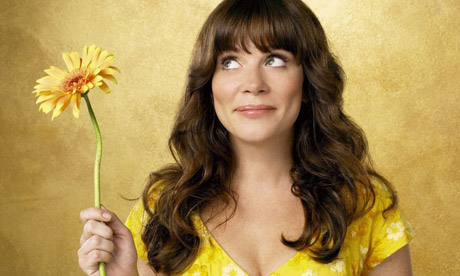
However, even after the unfortunate passing of Wonderfalls, Fuller was not deterred.  In 2007, Pushing Daisies premiered, this time on ABC.  This was a strange show.  It was honestly unlike anything else on television.  It had this whimsical tone, filled with wide-angle lenses, Douglas Adams-esque narration, odd undertones of death and sex and the occasional musical number, all set to a super-polished Americana theme peppered with very bright colors.  The series followed the Piemaker, Ned, who discovered as a boy that he had the power to bring the dead back to life with a touch, but only for a few seconds.  He learned tragically that if he did not touch the resurrected again, something (or someone) nearby will die in their stead.  So naturally, as an adult, an intrepid P.I. is there to exploit his powers to talk to the dead to solve mysteries.  Nope.  Not kidding.  They go on adventures and everything, and as funny as that sounds, there is a strong sense of tragedy surrounding the entire show.  His best friend, the love of his life, and one of his few true friends dies and his choice to raise her from the dead for good leads to more than a few complications.  Aside from someone else dying for her to live, there is the sad reality that he can never touch her.  There is a heartbreaking poetry in this idea, and it is presented nearly flawlessly in Pushing Daisies.  Also, like much of his work to this point, this series revolved heavily around death.  

Pushing Daisies is, by-far, Fuller’s most successful series.  It lasted two seasons but, unlike his previous shows that ended far too soon, I think it was enough.  It ran its course, plots were addressed and resolved and any more would have just been turning the wheels.  Instead of keeping this alive, Fuller and ABC did the right thing and touched it a second time, to put it down for good.  Yet, during its run, it won numerous awards and was nominated multiple times.  Lee Pace and Chi McBride were both great as always, but the show-stealer here was the then-mostly-unknown Kristin Chenoweth (unknown, at least, outside of the theatre scene).  At the time of the show’s production, Chenoweth was already a beloved Broadway star and it shows in her performance.  Her energy and vocal talents take over, especially in the second season, where she goes from being a supporting character to a more driving force in the overarching story.  Every show has the one character that people remember the most coming out, and for me, Chenoweth’s Olive WAS this show.

http://thefilmtransition.com/wp-content/uploads/2014/02/Mads-Mikkelsen-as-Hannibal.jpg
This brings us to today.  Bryan Fuller’s current notable project is the series Hannibal, a prequel to The Silence of the Lambs in which we see a younger Hannibal Lecter in his prime.  I’ve watched the first few episodes of the series myself and I… didn’t really like it.  Not to say that it was bad by any stretch.  It certainly stands out in terms of quality compared to most shows on network television today, but I think knowing it was Fuller’s work going in left me a little jarred.  It is so unlike his other efforts as to be sort of off-putting for me as a long-time fan.  I wanted there to be a hint of the charm found in his previous works, but what I saw of Hannibal is far too serious.  Now, I plan to go back and rewatch the first season, just so as not to dismiss it entirely because I may have missed something.  I want to like Hannibal, I really do, but I will require a lot of convincing.  

So, you have a talented young writer/producer who is notable for working on a few of the most criminally short-lived television series of all time.  This is a running theme, largely because TV executives are forced to look at short-term gain through ratings rather than long-term popularity.  It also doesn’t help that most of these shows were shoved into the fray against insurmountable odds.  Still, they have their fans; and justifiably-so.  Bryan Fuller is a tremendous talent and I as his career progresses on, I foresee him having a long string of successes and fan favorites.  His vision and style is just unlike anyone else in the industry today, despite a few imitators.  If you have not seen any of the series listed in this article, I strongly recommend checking them out, they are all good in their own distinct ways and have much wider appeal than their short runs might have you believe.

Monday, March 9, 2015

"Know" More Pop-Culture- The Grindhouse

Just before the market crash of 1929 known now as Black Tuesday, movie theatres were opening like mad to accommodate the massive demand for a growing pop culture phenomenon dubbed the motion picture.  Films were being churned out in numbers that are inconceivable by today’s standards, but shorter silent films were often inexpensive to produce and required little in terms of quality.  So, the result was a pretty wide range of film ideas, some good and some… not so good.  A not-so-well-known fact about the early days of cinema is “nudie” films were extremely common.  Even in the 19th Century nickelodeons, a short film featuring a topless dancer was far more common than one might imagine.  As films took to the big screen, and the Hays Code took over in the 1930’s, most of these sorts of films were driven out.  Given their reputation and poor storage, most of these movies have suffered the tragic fate shared by so many films of the early 20th Century: degradation through disintegration.  This was a consequence of the celluloid used for years to print film media.  Since it was now “illegal” to show nudity and other banned content in theatres, an underground was formed.

42nd Street Grindhouses (Source: Soundonsight.org)
42nd St. in Manhattan is arguably the most famous theatre district in the world (not discounting Los Angeles’ famous Beverly Cinema), and many of the joints on this stretch of road were not ready to give up the profitability of sexuality.  There was just one problem: That damn Hays Production Code!  So, many theatres repurposed their floors to become burlesque theatres, performance theatres typically featuring women dancing seductively and singing songs riddled with innuendo.  Some of these clubs also became associated with New York’s Red Light District, though most were nothing more than very tame strip clubs.

(Source: listal.com)
As the decades rolled on, the theatres that continued to show movies often bought reels to cheap movies of poor quality, showing them several times throughout the day, as opposed to the one or two showings-per-film common at that time.  The rates would increase during the day, capping off around 6pm.  This set the tradition of the Matinee Price so common in theatres.  This trend continued through until the 70’s, when things began to change dramatically.  This process of repeated showings became known as “grinding” and became the namesake of the theatres that practiced this new profitable idea.  The existence of these “grindhouses” actually spurred a new market for cheap, quickly-produced films that in many ways were built to violate the already weakening Hays Code, featuring copious amounts of sex, graphic violence and other material that was, in that period, very controversial and some films are still shocking by today’s standards.

While these same grindhouses were showing films that would or could not be shown in other major theatres, they also did show many major releases, as well as a number of films that are widely regarded as modern classics.  Another fact is some entire genres owe their very existence to these theatres.  In-particular, slasher, spaghetti westerns, martial arts and blaxploitation films would likely have never caught on without help from the grindhouse districts.  However, as the 80’s came around,  the market for these films in theatres shrunk rapidly due to the proliferation of home video.  Within a few years, the theatre market would collapse all around; a consequence of the rapidly-growing video market and the advent of megaplexes, which were competing to be bigger-budget attempts to monopolize local theatre markets by offering more and more movies and showings at a time in a single location.

The exploitation genre continues on, though it’s subgenres have split off, with newer films being mostly inspired by the 70’s classics rather than trying to craft any real identity of their own.  However, in spite of the cinema collapse, the legacy of the grindhouse persists to this day directors like Quentin Tarantino and Robert Rodriguez are highly inspired by the films of the 70’s grindhouses and many modern action and horror movies draw a lot of inspiration from the grindhouses.  Also, many films from the grindhouses’ heyday have found a new market thanks to home video and digital distribution, garnering a new cult following and have themselves crafted a dedicated and unified fan culture.

The question is: Were the grindhouses disreputable garbage heaps throwing out nothing but gore and pornography?  Or, rather, were they inspirational and daring cultural hubs that would leave a lasting impression on future audiences?  I would say they are a little of both.  If they weren’t just a little controversial and didn’t do things differently from the norm, it is likely they would not even be talked about to this day.  It left quite an impression by defying the standards and refusing to accept the rules set by a paranoid and aggressive censorship bureau, instead embracing the strange and opening the gates to a new idea of film that was not only unknown to most, but was outwardly banned by major theatres.  The grindhouses paved the way for a new era of independent filmmakers and broke down barriers to artistic expression.  Modern film would likely not even exist in its current form if it weren’t for this film culture.  So, next time you scoff at an Italian sexsploitation flick, consider that many films you love may not have even been made if it weren’t for the theatre owners brave enough to show it in the first place.

Sunday, February 15, 2015

My 40 Favorite Films of the 90's - 10 - Clerks (1994)

Clerks (1994; Miramax)
Director: Kevin Smith
Writer: Kevin Smith
Starring: Brian O’Halloran, Jeff Anderson, Marilyn Ghigliotti, Jason Mewes, Kevin Smith

In the early months of 1994, a young independent filmmaker named Kevin Smith would release Clerks, a massively influential black and white Generation-X film centering on the employees of neighboring convenience and video stores.  The worn-down and entirely passive Dante struggles with his boss, his personal life, his distrust of just about everyone and a slew of bizarre and unstable customers.  Jay, on the other hand, is cynical, bitter and entirely disinterested in just about everything, especially his customers.

Clerks is a portrait of the early 90’s.  It captures the cynicism, the uncertainty and the narcissism of the young working class while reflecting a period in time where the music was great, the attitudes were bad and the film industry essentially abandoned the idea of a good comedy.  Keep in mind that, just months after the release of this excellent low-budget movie, Hollywood would release a $40-million disaster called North.  This film is one of my all-time most hated movies and it tanked; I mean, it bombed bad.  Clerks, with around a $350k budget, grossed just over $3 million (while never getting a wide release; only being shown on just over 50 screens) but not only was it better, but most people forgot about North before its home video release (everyone except me it seems) while Clerks spawned a massive cult following, an excellent animated series and a list of other films from the writing talent of Kevin Smith including the excellent Chasing Amy and the lesser (but still hilarious) Mallrats.  

Pinning down an overall plot for Clerks is hard.  The film is told in vignettes separated by title cards with simple titles reflecting the tone or theme of the preceding scene.  While the overarching but simple story of the day in the life of an employee forced to work on his day off plays out, there are a lot of subplots and character moments that range from the slightly eccentric to the absurdly mad.  Outside the Quick Stop are two more working men, dealers Jay and Silent Bob, creations of Smith who would become omnipresent supporting characters in almost all of his films.  Bob stands coolly while Jay dances hits on female pedestrians, and acts boorish to the point of being rather likable.  

There is not one scene in Clerks that isn’t funny.  What’s better is Clerks is not tied down by many of the tropes that so often handicap the comedy genre…  Smith was saving a lot of those for Clerks II.

Saturday, July 19, 2014

My 40 Favorite Films of the 90's - 20 - Army of Darkness (1992)

Army of Darkness (1992; Universal Pictures)
Director: Sam Raimi
Writers: Sam and Ivan Raimi
Starring: Bruce Campbell, Marcus Gilbert, Anabeth Davidtz


Way back in 1981, two decades before he turned Spiderman into a blockbuster series, a young director named Sam Raimi brought together a small group of actors to star in a low-budget horror film called The Evil Dead (inflation-adjusted, the movie cost just under $1m, Daddy Day Camp cost $6m. Was it worth it, Hollywood?).  It is the story of Ashley “Ash” Williams and his group of friends who vacation to a cabin and find that the previous resident had gotten himself involved some unworldly stuff during his research into the Necronomicon ex Mortis: The Book of the Dead (A reference to the writings of H.P. Lovecraft).  What he found opened a portal to another world, allowing vile demons to enter our realm.  The young vacationers get more than they bargained for and things get kind of tragic.


What Raimi intended here was to make a legitimate horror film, one that is both terrifying and entertaining.  What he made instead was an unintentionally-funny cult classic (which is actually better, honestly).  Raimi was not discouraged by this and he set out to do one better.  The Evil Dead II was a combination of a sequel, a remake and a sendup of horror movie tropes.  There may be no single horror comedy (or horror film for that matter) that is more beloved by fans.  It is laugh-out-loud funny with tons of gore, over-the-top moments and very, very quotable lines.  The film ends with our hero Ash being sucked into a wormhole and waking up in the middle of a wasteland, with only his chainsaw arm to accompany him… at least in the beginning.


The above build-up was essential as the story of Ash getting here is part of Army of Darkness’ greatness.  As a direct follow-up, it takes the story in a direction nobody saw coming: Army of Darkness is a fantasy/action/comedy.  Now, I do not mean a comedy in that it has a few jokes in it among the actual action and horror, no, this movie is a straight up comedy starring the epic Bruce Campbell fighting the undead in a medieval world… and it’s AWESOME!  Army of Darkness is a work of perfection because Raimi set out to make a movie that just goes all-out and does the most ridiculous things, and as a result, makes a fun, exciting and damn-entertaining flick.


AoD starts with Ash in that strange world from the end of 2 in a chain gang locked in a yoke, forced into slavery.  When he proves himself an asset in helping to defeat the Deadites that plague the land, he is tasked with defeating the titular army, but first he must retrieve the fabled Necronomicon from its resting place.  It all culminates in an epic battle with the Deadite army as Ash does everything he can to save the day and finally get home to his job at S-Mart.

Occasionally silly and always energetic, Army of Darkness goes into some cartoonish territory, but at least for me, that’s a plus.  The movie does not take itself seriously at all, embracing the insanity wholeheartedly and just doing everything it can to mock its genre and utterly abuse its poor hero.  However, beyond the intermittent slapstick humor, there is a legitimate adventure film here, with some pretty good action and great makeup effects.  The film was fortunately made before the advent (and eventual abuse) of computer animation, so the practical effects have a spirit and a tangibility to them.  Knowing the actor is actually on screen with the makeup-covered actors helps to maintain the illusion of actual stakes.  CGI has, in more recent years, taken the place of classic makeup, puppetry, stop motion and animatronics and, as a result, much of the heart of special effects is lost.  Army of Darkness just may mark the last really good fantasy adventure released before CGI gave us sweeping shots of cartoonish castles and lazily-animated copy and paste creatures.  This is a film with actual sets and costumes, rather than a few actors standing in front of a green screen.