
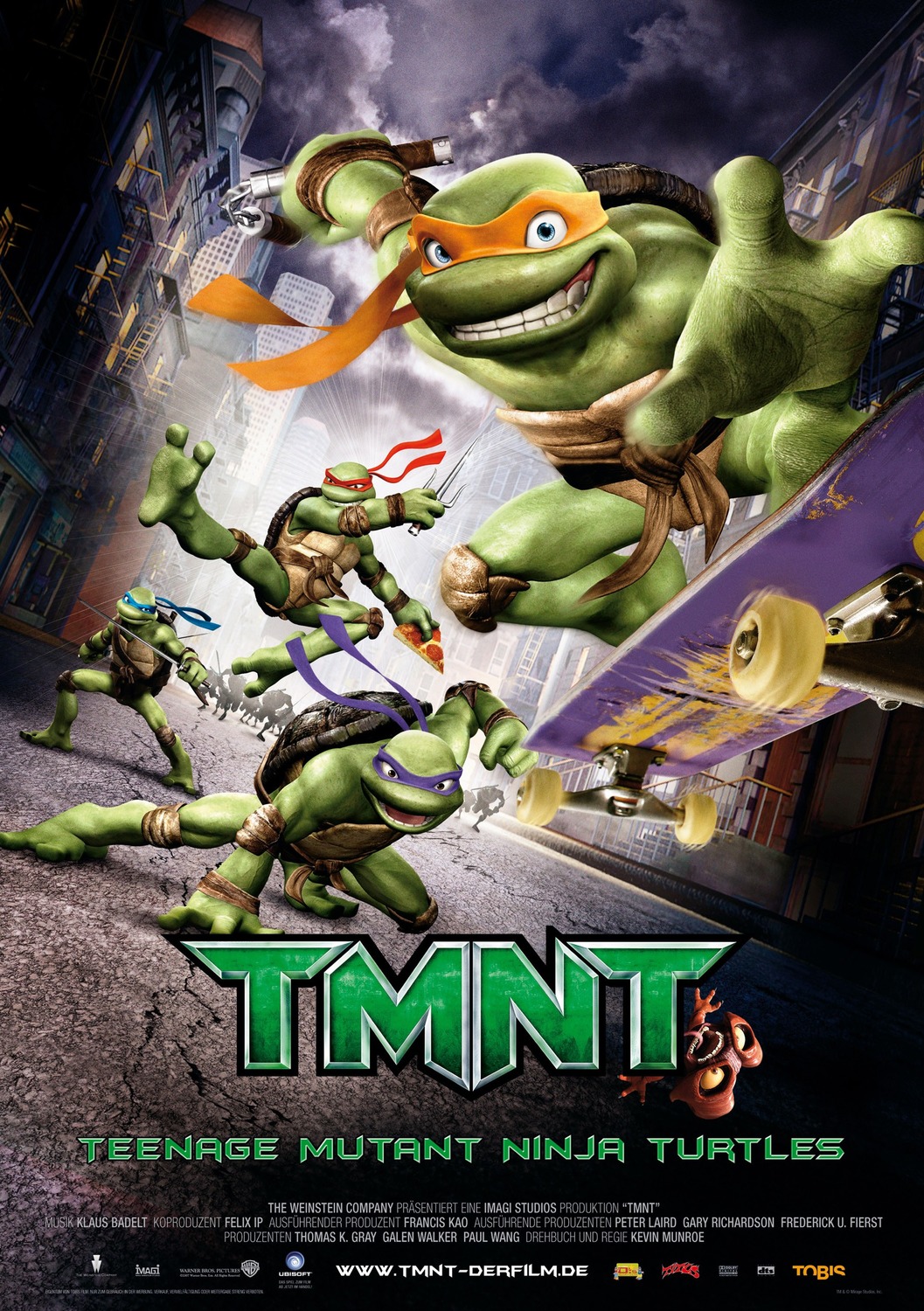


Now, I know I’m not the first person to do this, but I would like to see how many of these classic series have evolved over the years and I decided to start this series with Teenage Mutant Ninja Turtles.
Originally based on Mirage Comic’s violent cult series of the same name (created by the duo of Laird and Eastman), the Teenage Mutant Ninja Turtles made their mainstream debut in the late 80’s. Now, it’s important to note that this was a time where a lot of major companies were seeing great success with animated series based on toy tie-ins. The two biggest ones before TMNT were G.I. Joe and Transformers. These two series drew huge fans to the stores to buy every toy for everything they saw on the 30 minute TV series. The fact was, these shows really didn’t have much in terms of plot. They were really just toy advertisements. The same goes for a lot of hit series from the time, including The Real Ghostbusters and Thundercats. Then came 1987…
‘87 was a bad, BAAAAD year for movies, but on TV, things were changing. Some of the biggest shows ever made their debuts in this year. Three notable entries were Star Trek: The Next Generation, Duck Tales and Teenage Mutant Ninja Turtles. The latter of the two did something very different. Unlike a lot of their tie-in contemporaries, these two animated series attempted to craft short stories around existing characters with established relationships and arcs. They weren’t Shakespeare, but they were smart, funny and entertaining. These two shows were essentially responsible for the huge boom of Saturday Morning animation in the late-80’s and early 90’s, a genre that was starting to fade a little at the time.
Fast forward to 1990. A series as big as Ninja Turtles was not going to escape the Hollywood treatment, and on March 30th, fans of the series were treated to a hard-edge, energetic, fun and somewhat edgy action flick. This was NOT a kids movie, in spite of its rating. It had pacing, action, and the characters that were mostly known by everyone at that point were treated well in terms of their nature and relationships. It must be said, that if you did not grow up in this period, you likely have no idea just how massive this series was. Compare it to anything big today, and you may be close, but just short. TMNT was a phenomenon, and it was everywhere. So much so that it never actually went away. The series lasted well into the 90’s, running for nearly a decade (that was HUGE for an animated series), and other animated shows, comics, games, movies (to a lesser extent) and other spin-offs continued to come out. Still, the question is, does the 90’s movie hold up?
Well, not too long before writing this article I went back and watched it and was astonished by how good it still is. No, seriously. The action was good, the characters were spot on, they stayed true to the overall story and, thanks to help from Jim Henson’s Creature Shop, the Turtles themselves were amazing. The movie hit the nail on the head, transporting the Turtles out of the realm of 2D and bringing them to life. Naturally the movie was a big hit. The sequels… not so good, though. They didn’t hold up and tried too hard to be more kid-friendly, ultimately losing some of the momentum the first film built. This was partially in-response to some backlash that the first film was “for kids” but was too violent and dark for a few parents to handle… Boy how times have changed.
As a sort of hiatus, the Turtles went back to the shadows and remained out of the mainstream for a short time until being revitalized in a new 2007 animated film. TMNT debuted to mixed reviews. It sits at a 37% on Rotten Tomatoes and was generally panned by critics. Two things are wrong with this picture. First, having watched the movie, it was not a bad film; not by any means. It was certainly better than a 37%. I have SEEN what a 37% looks like and it’s a Hell of a lot worse than this. No, I think there was some backlash to the tone in some cases. First, the new movie addresses some of the things that were just glossed over in the original film and series more directly, in-particularly, April O’Neil’s restlessness and Raphael’s rebelliousness. The latter is a prominent plot point early in the movie as it is an established and ongoing trait of the character. No complaints there.
Another point of contention is the 2007 film’s plot. The story revolves around an ancient immortal warrior who is able to resurrect his ancient generals when the stars align, and with the moment right, he can open a portal to conjure up monsters and take over the world. It’s like something out of a Final Fantasy game, and it’s goofy, but it’s not the worst I’ve seen from that type of story. The other subplots involve a barely glossed-over relationship between fellow-vigilante Casey Jones and April O’Neil and the returning theme of Raphael’s lone crime fighting ways. What I liked about TMNT is how it addressed the latter. Leonardo, who returns from a prolonged absence of self reflection, finds his family in disarray and is faced with bridging a severed relationship with Raph. It turns out, another armored vigilante hero has been taking out thugs around New York and Leo, in an attempt to stop him, finds that this so-named Nightwatcher is actually Raphael. This leads to the two brothers having a nearly-fatal brawl on the rooftop. As a long-time fan of these characters, THIS was satisfying to me. It was the obvious and inevitable result of their rough relationship and at that point I was sold.
As a standalone movie, TMNT is not a masterpiece, but it does what it set out to do: Make a fun and solid TMNT adventure. The only real complaints I have about the movie is it has that odd, jagged CGI animation a lot of series do today, that has these 3D characters with Disney eyes that looks sort of odd in the high-detail world around them, and a few of the “chase” scenes are a little overlong and are basically just filler. These long action scenes make the few more meaningful ones seem longer than necessary by association. Lastly, the plot is nothing fresh or astonishing, but it sets the stage for some cool character design for the villains, and a few pretty solid fights.
As a standalone movie, TMNT is not a masterpiece, but it does what it set out to do: Make a fun and solid TMNT adventure. The only real complaints I have about the movie is it has that odd, jagged CGI animation a lot of series do today, that has these 3D characters with Disney eyes that looks sort of odd in the high-detail world around them, and a few of the “chase” scenes are a little overlong and are basically just filler. These long action scenes make the few more meaningful ones seem longer than necessary by association. Lastly, the plot is nothing fresh or astonishing, but it sets the stage for some cool character design for the villains, and a few pretty solid fights.
Really, I do not see why this has such bad reviews. It is NOT a bad movie. It’s faithful, it was obviously made by people with a lot of love for the source material, it has a lot of quality animation (especially in the case of the Turtles) and the attention to detail in the production design is great. I also like that they didn’t go overboard with references to the old series. Sure they’re eating pizza, Splinter is watching soap operas and Casey Jones is donning his trademark hockey mask, but it isn’t abused and shoved in our faces like a lot of throwback remakes and reboots tend to try to do. It’s respectful is what I’m saying.
So, which one is better. Well, in this case it really isn’t a contest. The 1990 film was engaging and had warmth as well as tension. There is just something about seeing these characters in the “real world” that brings them to life. Also, practical effects always look better than CGI and while at least the 2007 movie is entirely animated, the tangible Turtles from the earlier film are much more believable. For anyone who didn’t grow up during Turtlemania, I would say watch the original movie. It is not too dissimilar but definitely feels more real and, on the whole, is a much better movie.
