Chitika Ad

Showing posts with label movie. Show all posts

Thursday, April 30, 2015

The Avengers: Age of Ultron Review (2015) - SPOILERS!!!

WARNING!
AS STATED IN THE TITLE THERE WILL BE SPOILERS IN THIS REVIEW!!!!
YOU HAVE BEEN WARNED!!!

The Avengers: Age of Ultron (2015;
Marvel Studios)
Going into the Avengers: Age of Ultron I had high hopes.  I think everyone did.  I made a point to not check out information on the movie.  I stayed away from online sources containing anything about the film and its cast and went in entirely objectively and unspoiled.  I begin the movie wanting to know two things: How did they pull of the Ultron storyline and how badass was Scarlet Witch?  I essentially satisfied in both respects.  That does not, however, mean Age of Ultron is a perfect movie.

The problem with making a sequel to a movie as big as the Avengers is it will be very hard to top it.  Initially, I was unsure about what they were going to do, but by the beginning of the third act, I was pretty certain I had guessed at exactly what was going to unfold by the film’s conclusion with around 60% accuracy.  The movie steps things up by having the swarms of enemies that were certainly meant to be more menacing than the Chitauri, and is successful in that… kind of.  Early in the movie, a struggle breaks out with a group of Stark’s automaton sentries that come off as would-be cannon fodder but there is a sense of menace with the team battling just a handful of Stark’s creations.  However, by the end we see the Avengers decimating hundreds of them with little-to-no effort.  Did they discover their weak points?

This is a recurring problem in Age of Ultron, too.  Action scenes are built up and are, for the most part, concluded and only briefly addressed until we get to the end and the lead characters find themselves facing off against Ultron’s hoards in the climactic battle.  However, each scene that has a strong start is often cut into with momentary lapses in tension.  A key character is killed and we get a few moments of sadness, followed by more explosions, then he’s never really addressed again.  A major event will occur, and will be negated or disregarded almost as quickly as it began.  This goes most notably for the film’s anti-climax.  It ends exactly how you expect it would by the start of the third act and it just sort of peters out.  It literally ends with a bang but hits like a shot from a Nerf gun, really.  Honestly, it feels like a step down from the New York set piece in the first movie.  This isn’t helped by the fact that it uses one of the most cliched and most often-horribly done evil-plan cliches and does it well, but only as well as this goofy, overused premise can be done.

Other major problems occur in the characters.  The first Avengers had a small team of characters and we are able to get a lot of characterization in their interactions.  However, Age of Ultron goes the sequel route of adding so many characters (nearly doubling the size of the team by the end of the movie) that most of their little moments end up lost in the shuffle.  I appreciate the attempts to flesh out some of the more overshadowed characters from the first movie (like Hawkeye, for instance) but this is still the Robert Downey, Jr. Show.  I do not blame Whedon for this, though.  RDJ’s magnetism is on full display, driving up the arrogance and intellectualism of Tony Stark much more than the first movie.  He’s still a wise-ass, but he comes off as more of the brilliant character he is in this outing.  Yet, the problem with having such a big cast and only a few characters dominating the foreground is you have a lot of questions, and a lot of characters that really just feel pointless.  Quicksilver suffers this in many respects, as he is mostly just relegated to “clean-up duty” while his much more prominent sister, Scarlet Witch is elevated to full-on goddess (even though, in-canon she is significantly more-powerful than almost all of the other Avengers).  She gets her big moment.  Quicksilver doesn’t.  Don Cheadle makes his appearance as War Machine which is welcome, but he is also given next to nothing to do, and just feels like a pointless addition in the end.

Now, with all of the negatives aside, this is still a good movie.  It isn’t complex.  It will not wreck your brain-area with convoluted exposition and over-blown pseudoscience.  It gives you just enough to lay the foundation for some truly well-done action scenes.  Like in the first film, Joss Whedon lines up wonderful moments of kineticism with smart, interspersed, and occasionally funny dialogue.  Sure, some of the action scenes go on a little long, but they never drift into Michael Bay/Roland Emmerich-Level CGI Porn.  Instead, each scene is clearly-lit, everything is vivid and easily discernable (with a few brief exceptions) and the layout of each scene is solid.  Whedon also employs his trademark single, long tracking shots that flow to each character nearly-seamlessly multiple times and it’s always a welcome technique, never coming off as exploited or poorly done here.

Acting is good all-around.  The only truly weak performance comes from Linda Cardellini, who I liked in ER and loved in Freaks and Geeks, but here, she just plays Worried Pregnant Housewife #2.  Despite having a direct association with one of the MAIN characters, she’s wasted.  We cut back to the occasional worried-wife-shot then back to the action.  The editing in that one cut to her is awkward, too.  It just felt… off.  That said, James Spader was immensely entertaining as the ultimate super-intelligence, Ultron, though his reasoning does fall squarely into Final Fantasy villain territory.  Aside from that, there really was no reason to have a big supporting cast.  This is the Avengers’ show and do you know what?  That’s okay.  That is exactly what we all went to see, and Joss Whedon seems to recognize that.  He didn’t flood the movie with too many pointless subplots (there are a few, but they aren’t too awfully intrusive) and, thanking all that is holy, no obnoxious comic relief characters that are so endemic in action movies these days.  

Now I’m going to touch on Ultron a little more as a villain here.  As I said, James Spader is awesome and I do not think I’ve ever disliked a performance from him.  Even when he’s in a bad movie, Spader still busts his butt to craft a memorable character for the audience.  His inflections work very well in the role as his subtle, personal touches on Ultron’s voice gives the entity life.  Lesser writers would have just made it a cold super-T-800-style-villain-bot.  However, Whedon knows how to write characters and its dialogue, mixed with Spader’s performance makes a nice blend.  That said, in all of his efforts, I think Whedon failed to really build Ultron up to be the force it really is.  Ultron’s a powerful dude here, for sure.  Is it menacing?  Yes.  Yet, by the end of the movie, one of the most powerful figures in comic book lore is dispatched in an anti-climax that has it fade away quicker than it appeared.  With the rest of the action scenes in this movie lasting in the 10-20 minute range, the fact that the final showdown that leads to the villain’s end lasts only about two minutes in total was just a big letdown.  Note that I’m only referring to the machine Ultron built for himself, disregarding his consciousness in the rest of the sentry bots because… well, so does the movie.  This was all an obvious hint at Ultron’s return.  Which, it seems, will certainly happen.

My final thought is as a big, loud, packed action movie.  This one is a lot of fun.  It’s accessible, there’s nothing in it that’s too disturbing for younger audiences, nor does it feel like a cartoon.  It is a well-balanced movie overall.  I would say it’s probably the lesser of Whedon’s most recent film projects factoring in the first Avengers movie AND Cabin in the Woods (which he co-wrote), but it’s not obnoxious outside of being about thirty minutes too long, and it has enough fun action moments and entertaining dialogue that I would give a whole-hearted recommendation.  It won’t be topping any “greatest action movies” lists, but it’s definitely better than most of what we get from Hollywood these days.  Given the chance, I’d see this again.  It’s a balanced movie and though I feel Joss Whedon is a much, MUCH better character writer than he is an action film director, I respect his choice to make an accessible movie that cuts the fat and delivers exactly what fans want.  The Avengers: Age of Ultron a pretty fun movie.

Tuesday, April 14, 2015

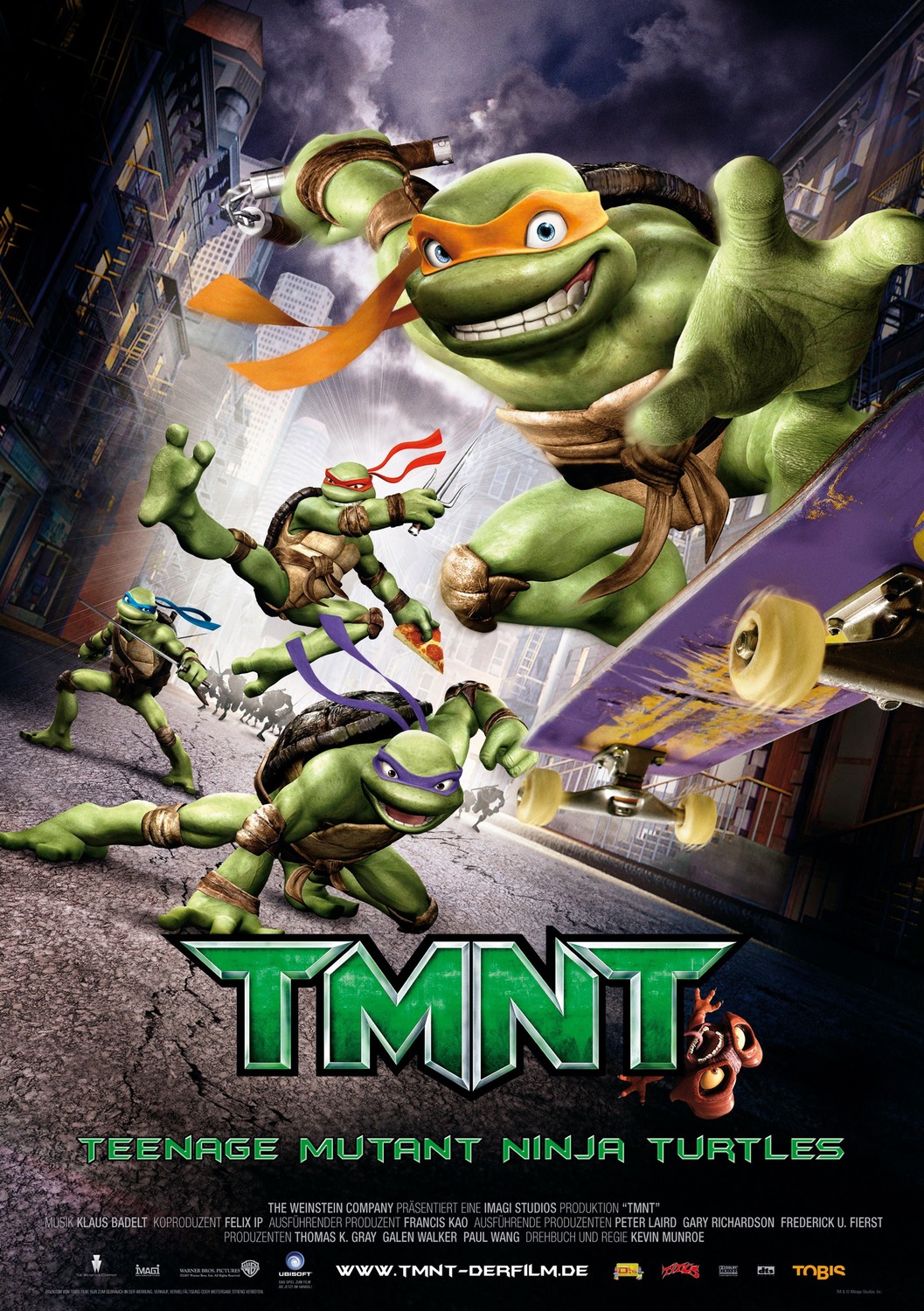
Generation Wars: Teenage Mutant Ninja Turtles (1990) vs. TMNT (2007)


Now, I know I’m not the first person to do this, but I would like to see how many of these classic series have evolved over the years and I decided to start this series with Teenage Mutant Ninja Turtles.  

Originally based on Mirage Comic’s violent cult series of the same name (created by the duo of Laird and Eastman), the Teenage Mutant Ninja Turtles made their mainstream debut in the late 80’s.  Now, it’s important to note that this was a time where a lot of major companies were seeing great success with animated series based on toy tie-ins.  The two biggest ones before TMNT were G.I. Joe and Transformers.  These two series drew huge fans to the stores to buy every toy for everything they saw on the 30 minute TV series.  The fact was, these shows really didn’t have much in terms of plot.  They were really just toy advertisements.  The same goes for a lot of hit series from the time, including The Real Ghostbusters and Thundercats.  Then came 1987…

‘87 was a bad, BAAAAD year for movies, but on TV, things were changing.  Some of the biggest shows ever made their debuts in this year.  Three notable entries were Star Trek: The Next Generation, Duck Tales and Teenage Mutant Ninja Turtles.  The latter of the two did something very different.  Unlike a lot of their tie-in contemporaries, these two animated series attempted to craft short stories around existing characters with established relationships and arcs.  They weren’t Shakespeare, but they were smart, funny and entertaining.  These two shows were essentially responsible for the huge boom of Saturday Morning animation in the late-80’s and early 90’s, a genre that was starting to fade a little at the time.

Fast forward to 1990.  A series as big as Ninja Turtles was not going to escape the Hollywood treatment, and on March 30th, fans of the series were treated to a hard-edge, energetic, fun and somewhat edgy action flick.  This was NOT a kids movie, in spite of its rating.  It had pacing, action, and the characters that were mostly known by everyone at that point were treated well in terms of their nature and relationships.  It must be said, that if you did not grow up in this period, you likely have no idea just how massive this series was.  Compare it to anything big today, and you may be close, but just short.  TMNT was a phenomenon, and it was everywhere.  So much so that it never actually went away.  The series lasted well into the 90’s, running for nearly a decade (that was HUGE for an animated series), and other animated shows, comics, games, movies (to a lesser extent) and other spin-offs continued to come out.  Still, the question is, does the 90’s movie hold up?

Well, not too long before writing this article I went back and watched it and was astonished by how good it still is.  No, seriously.  The action was good, the characters were spot on, they stayed true to the overall story and, thanks to help from Jim Henson’s Creature Shop, the Turtles themselves were amazing.  The movie hit the nail on the head, transporting the Turtles out of the realm of 2D and bringing them to life.  Naturally the movie was a big hit.  The sequels… not so good, though.  They didn’t hold up and tried too hard to be more kid-friendly, ultimately losing some of the momentum the first film built.  This was partially in-response to some backlash that the first film was “for kids” but was too violent and dark for a few parents to handle… Boy how times have changed.

As a sort of hiatus, the Turtles went back to the shadows and remained out of the mainstream for a short time until being revitalized in a new 2007 animated film.  TMNT debuted to mixed reviews.  It sits at a 37% on Rotten Tomatoes and was generally panned by critics.  Two things are wrong with this picture.  First, having watched the movie, it was not a bad film; not by any means.  It was certainly better than a 37%.  I have SEEN what a 37% looks like and it’s a Hell of a lot worse than this.  No, I think there was some backlash to the tone in some cases.  First, the new movie addresses some of the things that were just glossed over in the original film and series more directly, in-particularly, April O’Neil’s restlessness and Raphael’s rebelliousness.  The latter is a prominent plot point early in the movie as it is an established and ongoing trait of the character.  No complaints there.  

Another point of contention is the 2007 film’s plot.  The story revolves around an ancient immortal warrior who is able to resurrect his ancient generals when the stars align, and with the moment right, he can open a portal to conjure up monsters and take over the world.  It’s like something out of a Final Fantasy game, and it’s goofy, but it’s not the worst I’ve seen from that type of story.  The other subplots involve a barely glossed-over relationship between fellow-vigilante Casey Jones and April O’Neil and the returning theme of Raphael’s lone crime fighting ways.  What I liked about TMNT is how it addressed the latter.  Leonardo, who returns from a prolonged absence of self reflection, finds his family in disarray and is faced with bridging a severed relationship with Raph.  It turns out, another armored vigilante hero has been taking out thugs around New York and Leo, in an attempt to stop him, finds that this so-named Nightwatcher is actually Raphael.  This leads to the two brothers having a nearly-fatal brawl on the rooftop.  As a long-time fan of these characters, THIS was satisfying to me.  It was the obvious and inevitable result of their rough relationship and at that point I was sold.

As a standalone movie, TMNT is not a masterpiece, but it does what it set out to do: Make a fun and solid TMNT adventure.  The only real complaints I have about the movie is it has that odd, jagged CGI animation a lot of series do today, that has these 3D characters with Disney eyes that looks sort of odd in the high-detail world around them, and a few of the “chase” scenes are a little overlong and are basically just filler.  These long action scenes make the few more meaningful ones seem longer than necessary by association.  Lastly, the plot is nothing fresh or astonishing, but it sets the stage for some cool character design for the villains, and a few pretty solid fights.

Really, I do not see why this has such bad reviews.  It is NOT a bad movie.  It’s faithful, it was obviously made by people with a lot of love for the source material, it has a lot of quality animation (especially in the case of the Turtles) and the attention to detail in the production design is great.  I also like that they didn’t go overboard with references to the old series.  Sure they’re eating pizza, Splinter is watching soap operas and Casey Jones is donning his trademark hockey mask, but it isn’t abused and shoved in our faces like a lot of throwback remakes and reboots tend to try to do.  It’s respectful is what I’m saying.

So, which one is better.  Well, in this case it really isn’t a contest.  The 1990 film was engaging and had warmth as well as tension.  There is just something about seeing these characters in the “real world” that brings them to life.  Also, practical effects always look better than CGI and while at least the 2007 movie is entirely animated, the tangible Turtles from the earlier film are much more believable.  For anyone who didn’t grow up during Turtlemania, I would say watch the original movie.  It is not too dissimilar but definitely feels more real and, on the whole, is a much better movie.

Wednesday, March 18, 2015

"Know" More Culture - The Way ‘The Day the Clown Cried’ Died

Jerry Lewis in 'The Day the Clown Cried' (1972;
src: notrecinema.com)
It was the 1970’s.  One-time A-lister Jerry Lewis was working in various capacities in Hollywood but really wanted to leave his mark, and the tone and style of film was changing rapidly, more or less leaving him behind.  Screenwriters Joan O’Brien and Charles Denton finished their script for the Day the Clown Cried and Lewis was approached to play the lead.  He was apprehensive to say the least.  Mostly known for screwball humor, Lewis feared he just wasn’t the right person for this sort of role.  Yet, ultimately, he came to the conclusion that it is an opportunity to star in something truly meaningful, and took up the reins as the lead character, the doomed clown named “Karl Schmidt”.

The film’s story is pretty straightforward.  Set during the start of the Holocaust, a clown who was once a top performer at a major circus falls hard after a career slump.  One day after being arrested by the Gestapo for mocking Hitler, he finds himself in a work camp.  At the lowest point in his life, during a chance encounter with some child prisoners, he realizes that he may still be able to at least bring joy to these young kids.  Performing the best he can, the broken man is heartened by the reactions of his young audience.  However, the Nazi leaders at the camp are not too thrilled by his bringing of joy and force him to be separated.  Ultimately, after he continues to defy their orders, he is commanded by pain of death to rally and escort the children to a train headed to the notorious death camp Auschwitz, but after a mistake finds he, himself, trapped in one of the cars, he is forced to accept fate.  Ultimately he is tasked with leading the children into the “showers”, and the film ends with him entertaining the children one last time before fading out.  Their fate was sealed.  

Doesn’t that sound like fun?!  No.  This was the reaction of just about everyone who saw the film during its limited screenings in 1972.  The film was described in the nicest terms as “misguided” and “confused” and at worst “a catastrophe”.  The question is, what really happened?  Well, Lewis himself had always been rather secretive about the project, but other sources indicate that during filming and post, he took over as director and began making a plethora of changes to the script to make the lead character more sympathetic.  The clown was meant to have a redemption arc, but instead he was written as a man who was simply broken and needed that last moment of inspiration to feel redeemed, as opposed to being a complete dirtbag at the start.  On top of that, Lewis attempted to inject more of his personality into the character.  He renamed the protagonist to Helmut Doork and added several moments of schtick to the screenplay.  The days leading up the film’s initial screenings led Lewis to believe he was making something important, and his notorious arrogance shined through, not only during the production but during the pitches and press bytes.  The movie showed, and his time as a leading man was marked as “over”.  Sure, Lewis continued performing, but this movie was a demarcation point in his career.  To this day, with all of his legacy aside, The Day the Clown Cried is the single piece of ephemera that has boundlessly captivated film historians, students and fans.

Becoming something of a legend these days, The Day the Clown Cried has been the subject of discussions in terms of remakes, documentaries and just plain fascination in Hollywood for over twenty years.  A number of performers, including Robin Williams, have been considered for a remake, adapting the film’s original screenplay, but nothing ever came about.  This movie has such a legendary stigma to it that it has become somewhat untouchable, while at the same time remaining a holy grail among cinema fanatics.  It’s very, very difficult to find footage of the movie and very few people have actually seen it in its entirety, in its original cut.  Every few years or so, footage of the film will leak onto the Internet but will often be removed.  This is largely due to the fact that the only official print of the movie is in Lewis’ own possession, as he continues to demand the film never be released or seen by anyone.  It has also been tied up in litigation for decades, with various involved parties fighting over control of the finished product, but the stalwart Lewis has never stopped fighting to prevent it from coming to light.  

By all accounts, the lore and history behind the Day the Clown Cried is far more captivating than the film itself.  I’ve only seen glimpses of the finished product, getting the rest of my knowledge of the plot from various sources online.  From what I saw, it’s a dreary and honestly kind of ugly film visually, with very low-lighting and lots of walls and backdrops that are dirty or aged.  The scenes I’ve seen that are a little brighter looking are overshadowed by the film’s tone.  It doesn’t help going in knowing what the movie is actually about.  All of the fluff at the start seems that much more meaningless.  

I have always wondered what the ultimate intention was for The Day the Clown Cried.  I am of the mind that any story can be told, and any story told well, no matter what the subject, can be appreciated.  However, from all I’ve heard, this is one big hot mess.  Any time footage leaks onto the Internet, there is a brief period of buzz followed by a sudden silence.  Almost as though everyone who was ever excited about seeing it actually really regrets their decision afterward. 

Monday, March 9, 2015

"Know" More Pop-Culture- The Grindhouse

Just before the market crash of 1929 known now as Black Tuesday, movie theatres were opening like mad to accommodate the massive demand for a growing pop culture phenomenon dubbed the motion picture.  Films were being churned out in numbers that are inconceivable by today’s standards, but shorter silent films were often inexpensive to produce and required little in terms of quality.  So, the result was a pretty wide range of film ideas, some good and some… not so good.  A not-so-well-known fact about the early days of cinema is “nudie” films were extremely common.  Even in the 19th Century nickelodeons, a short film featuring a topless dancer was far more common than one might imagine.  As films took to the big screen, and the Hays Code took over in the 1930’s, most of these sorts of films were driven out.  Given their reputation and poor storage, most of these movies have suffered the tragic fate shared by so many films of the early 20th Century: degradation through disintegration.  This was a consequence of the celluloid used for years to print film media.  Since it was now “illegal” to show nudity and other banned content in theatres, an underground was formed.

42nd Street Grindhouses (Source: Soundonsight.org)
42nd St. in Manhattan is arguably the most famous theatre district in the world (not discounting Los Angeles’ famous Beverly Cinema), and many of the joints on this stretch of road were not ready to give up the profitability of sexuality.  There was just one problem: That damn Hays Production Code!  So, many theatres repurposed their floors to become burlesque theatres, performance theatres typically featuring women dancing seductively and singing songs riddled with innuendo.  Some of these clubs also became associated with New York’s Red Light District, though most were nothing more than very tame strip clubs.

(Source: listal.com)
As the decades rolled on, the theatres that continued to show movies often bought reels to cheap movies of poor quality, showing them several times throughout the day, as opposed to the one or two showings-per-film common at that time.  The rates would increase during the day, capping off around 6pm.  This set the tradition of the Matinee Price so common in theatres.  This trend continued through until the 70’s, when things began to change dramatically.  This process of repeated showings became known as “grinding” and became the namesake of the theatres that practiced this new profitable idea.  The existence of these “grindhouses” actually spurred a new market for cheap, quickly-produced films that in many ways were built to violate the already weakening Hays Code, featuring copious amounts of sex, graphic violence and other material that was, in that period, very controversial and some films are still shocking by today’s standards.

While these same grindhouses were showing films that would or could not be shown in other major theatres, they also did show many major releases, as well as a number of films that are widely regarded as modern classics.  Another fact is some entire genres owe their very existence to these theatres.  In-particular, slasher, spaghetti westerns, martial arts and blaxploitation films would likely have never caught on without help from the grindhouse districts.  However, as the 80’s came around,  the market for these films in theatres shrunk rapidly due to the proliferation of home video.  Within a few years, the theatre market would collapse all around; a consequence of the rapidly-growing video market and the advent of megaplexes, which were competing to be bigger-budget attempts to monopolize local theatre markets by offering more and more movies and showings at a time in a single location.

The exploitation genre continues on, though it’s subgenres have split off, with newer films being mostly inspired by the 70’s classics rather than trying to craft any real identity of their own.  However, in spite of the cinema collapse, the legacy of the grindhouse persists to this day directors like Quentin Tarantino and Robert Rodriguez are highly inspired by the films of the 70’s grindhouses and many modern action and horror movies draw a lot of inspiration from the grindhouses.  Also, many films from the grindhouses’ heyday have found a new market thanks to home video and digital distribution, garnering a new cult following and have themselves crafted a dedicated and unified fan culture.

The question is: Were the grindhouses disreputable garbage heaps throwing out nothing but gore and pornography?  Or, rather, were they inspirational and daring cultural hubs that would leave a lasting impression on future audiences?  I would say they are a little of both.  If they weren’t just a little controversial and didn’t do things differently from the norm, it is likely they would not even be talked about to this day.  It left quite an impression by defying the standards and refusing to accept the rules set by a paranoid and aggressive censorship bureau, instead embracing the strange and opening the gates to a new idea of film that was not only unknown to most, but was outwardly banned by major theatres.  The grindhouses paved the way for a new era of independent filmmakers and broke down barriers to artistic expression.  Modern film would likely not even exist in its current form if it weren’t for this film culture.  So, next time you scoff at an Italian sexsploitation flick, consider that many films you love may not have even been made if it weren’t for the theatre owners brave enough to show it in the first place.

Tuesday, March 3, 2015

My 40 Favorite Films of the 90's - 1 - The Shawshank Redemption (1994)

The Shawshank Redemption (1994;
Castle Rock Entertainment)
Director: Frank Darabont
Writers: Frank Darabont screenplay adapted from the short story by Stephen King
Starring: Tim Robbins, Morgan Freeman, Bob Gunton, Clancy Brown

Here it is.  After all this time, all the delays, everything… I’m here.  The Shawshank Redemption is my favorite film of all time.  I have a few reasons for this.  First, this movie came out when I was still pretty young, and I saw it for the first time at thirteen (I think).  It changed the way I saw movies forever.  It was the first real drama that I ever fell in love with, and after seeing it I needed to see more.  I was inspired to seek out all the movies I had heard about but never saw because they weren’t action or comedy movies, and it opened up an entirely new world for me.  Aside from the very personal influence this had on me as a film fan, it is objectively a great, great movie.  It was nominated for numerous Oscars but did not take home any statuettes, but then again, it was the 1995 Academy Awards, where it was up against the likes of Forrest Gump, Quiz Show and Pulp Fiction.  That is some stiff, STIFF competition.

The film follows a banker named Andy Dufresne who is convicted of murdering his wife and her supposed lover and sentenced to life within the dreary stone walls of Shawshank Prison.  There he befriends a slick smuggler named Red who begins to guide him and help him adjust to the reality that faces him.  However, Andy refuses to embrace his fate, taking every opportunity to remind his fellow inmates that there is hope beyond the prison’s walls.  He enters the corrupt prison and changes the lives of everyone there by simply refusing to let go of hope.

The Shawshank Redemption is not slogged down by a lot of the typical cliches of modern dramas.  There is no forced romance, no comic relief, no big tense dramatic moments (at least not until the very, very end of the film) and no forced melodrama.  The movie is told over several years of Andy’s sentence until his ultimate and impossible escape.  He leaves behind hope to his friends and retribution to those who abused their power.

One can come up with any number of allegories that may fit the story of Shawshank, but I like it as a simple story of a man who changes everything.  I know deeper meaning can be found, but I prefer to see this film today the same as I did in my young age.  It means something to me.  It was a demarcation point in my life as a kid growing up in a period of excess, where I began to seek out something different than what was being sold to me.  It has had a tremendous impact on me because, to this day, I remember how this movie changed me, and I am always willing to find the next movie to forever alter the way I perceive popular culture.

My 40 Favorite Films of the 90's - 2 - Schindler's List (1993)

Schindler's List (1993; Universal Pictures)
Director: Steven Spielberg
Writers: Thomas Keneally (novel); Steven Zaillian (Screenplay)
Starring: Liam Neeson, Ben Kingsley, Ralph Fiennes

This is the film a lot of hardcore film fans probably expected to be #1.  It currently ranks #7 on the IMDB top 100, it’s #8 on the American Film Institute’s, and it won an impressive seven Oscars including best picture.  It’s probably as close to “perfect” as a film can get.  The only reason it is number 2 on my list is because the number one slot is reserved for my favorite film of all time.  It’s a personal choice, and does in no way mean I think less of this movie.  That said…

Schindler’s List tells the story of industrialist Oskar Schindler (Neeson), a shrewd businessman who operates in the employ of the Third Reich for the war effort while turning a profit, but in the end, he is faced with a choice: greed, or the right thing.  The film is told in two parts: the first focuses on the Nazi’s advance in power and their segregation of Jews into the ghettos, the second centers on the Final Solution, where the remaining few were shipped to camps and a systematic genocide began.  Meanwhile, Schindler himself is hiring a number of Jewish workers for his factory and as he is essential to the Reich’s success at the time, he becomes an obstacle of sorts for the cruel Nazi Lieutenant Amon Goeth (Fiennes).  Schindler’s right-hand man Mr. Stern (Kingsley) begs him to help, but at first Schindler is reluctant until a fateful encounter at a Nazi train depot almost finds Stern in Birkenau until Schindler cames to his rescue.  After this near loss of his colleague and friend he is inspired to do all he can to save as many lives as possible by signing them on as recruits for his factories to protect them from the trains to the concentration camps.  Of course, there is a lot more to this film than that, but for a core synopsis, that’s the best I can word it.

Schindler’s List forces the audience into a hard position.  If you were Oskar Schindler, how far would you go to save these otherwise-doomed souls from the hands of the evil Third Reich?  Because, his stand against Hitler’s forces could have not only cost him his enterprise, but his very life.  Yet, the revelation that he can use his influence to help people, even if it is just a few in the grand scheme, makes his actions all that more meaningful.  This is a story of one man doing all he can to save only a few lives at the risk of losing his freedom.

The film is shot in beautiful black and white, having a deep contrast creating a very crisp look.  Every shot is astounding, too.  There are beautiful scenes juxtaposed against a rightfully-mournful tone.  Likely the most striking and memorable visual moment shows a young girl in a bright red dress against the entirely black and white scene.  This one piece of symbolism has become the defining image of the film from an artistic standpoint.

The performances by all involved are just excellent, too.  Ralph Fiennes in-particular gives a grim and harrowing Oscar-nominated performance as the Nazi officer.  Every scene with him is just chilling.  Unlike a cartoonish villain lacking humanity, we see that in him because we know what he is, but his performance is quite understated despite a few shocking moments.  Liam Neeson gives the best performance of his career here and shows a hint of just how much of an essential performer he could have continued to be if it weren’t for the dreadful Phantom Menace grinding his career to a screeching halt for nearly a decade.

I railed against the Oscars a few times during this list but the Academy got it right in 1994, because in-spite of not ONE actor from this film winning an Oscar, the movie as a whole was recognized for the artistic achievement it was.  There are very, very few films that really depict the Holocaust in any capacity for a few reasons.  First, it isn’t the sort of subject one associates with “entertainment” and secondly, if you mess things up, you are through.  Nobody will respect you as a filmmaker again.  This goes all the way back to the notorious Italian Nazi exploitation flicks of the 70’s which have gone down in legend as some of the most deplorable pieces of cinema ever filmed.  So, it’s understandably-rare to see a quality, successful film tackle this subject, especially as masterfully as Schindler’s List does.

My 40 Favorite Films of the 90's - 3 - Pulp Fiction (1994)

Director: Quentin Tarantino
Pulp Fiction (1994; Miramax)
Writer: Quentin Tarantino
Starring: Samuel L. Jackson, John Travolta, Uma Thurman, Ving Rhames, Bruce Willis, Harvey Keitel, Tim Roth, Amanda Plummer

I want to be clear here, and I do not think this is hyperbole: 1994 is one of the greatest years in the history of film.  SEVEN of my top 40 movies of the 90’s are just from 1994.  The American Film Institute released their updated list of 100 Greatest Movies in 2005, a list spanning a century of film, and there were four movies on their list from 1994.  In fact, Pulp Fiction isn’t even the last film on THIS list from that year!

Pulp Fiction is a series of interwoven stories of violence and debauchery and it is absolutely glorious.  There is no one scene that isn’t captivating.  It is a powerhouse of cool direction, a distinct and fresh look and tone, and most of all a stunning screenplay.  So, naturally, it didn’t win the Oscar in 1995, but I’ve already gone over how worthless the Academy Awards are so I won’t bother you with that again.  Instead, let’s talk about one of the greatest films of all time.

Before directing Pulp Fiction, Quentin Tarantino made a couple other genre films including the previously-reviewed Reservoir Dogs.  Tarantino draws heavy inspiration from the classic 42nd St. Grindhouses of the 60’s and 70’s.  These theaters were known for their release of unvetted indie films, often branding the exploitation label, that for the most part remained unrated and rarely saw any release outside of these theatres until the mid-to-late 80’s.  These are the theatres that brought us the great Blaxploitation classics like Shaft and Superfly, the two of which were rare examples of great movies leaving the Grindhouse and getting a wide release (largely thanks to their hit theme songs).  We also saw a lot of graphic horror from Italian directors like Lucio Fulci and Bruno Mattei who rarely saw any form of wide distribution, even in the video market, their films mostly remaining cult classics looming in the underground horror scene.

So, what does this have to do with Pulp Fiction?  Well, this is a movie that amalgamates ideas from the various genres of the time.  The title refers to “Pulp” a largely pejorative word used to describe entertainment that is considered low-quality but is widely popular.  The movie uses directorial styles, fashions and concepts that were common in the Grindhouses, but were rarely embraced by the mainstream film industry.  This is part of what makes Pulp Fiction such an amazing film, it is a beloved, winning classic that employs and draws its inspiration from films that were almost entirely marginalized.  It’s very acclaim and success is itself a commentary on the manufactured idea of “mainstream” entertainment.

Pulp Fiction’s plot is actually a series of interconnected storylines all wrapped around a handful of jobs and the daily lives of two hitmen, Julius and Vincent (Jackson and Travolta).  They exchange memorable banter as they travel around Los Angeles, from cleaning out an apartment of misguided college kids, to taking a local crime lord’s wife (Thurmond) out for a night on the town.  Between these wrapper plot lines, we get other stories revolving around a boxer on a rough deal and a couple of crazed robbers, and that really does only scratch the surface.

The fascinating thing about the film is how everything really comes together.  We see plotlines that are, at first, complete non sequiturs, but as the film goes on, harkening back to these scenes reveals a beautifully-woven series of smaller stories forming a greater whole.  In fact, I believe (and this is speculation) a large part of why this film is so beloved is how it uses these stories to paint an involving picture that encourages audiences to see how it all comes together, creating a sort of active viewing experience.  You mind is processing the stories individually, and when it all comes together it is like an ecstatic revelation.  

There isn’t a bad performance in this movie.  Not one.  This is very rare as even the best movies have a few throwaway acting choices, but Tarantino's meticulousness pays off here.  The cast is huge and everyone has a reason to be there.  This is all supported by the screenplay and, to be honest, if this were a top 40 based on writing alone, Pulp Fiction would be number one.  This is hands down one of the greatest screenplays of all time.  It’s fast, witty and the dialogue, even from the simplest scenes, is superb.  It’s funny and has a charm and character you just don’t see in most movies, this especially goes for Oscar movies, which actually trend on the boring side (and I say this as a film snob).

Monday, March 2, 2015

My 40 Favorite Films of the 90's - 4 - Goodfellas (1990)

Goodfellas (1990; Warner Bros.)
Director: Martin Scorsese
Writer: Nicholas Peleggi
Starring: Ray Liotta, Joe Pesci, Robert De Niro

Scorsese returns for his final film on my list.  Goodfellas is the astoundingly-told odyssee of a man’s rise through the ranks of a local crime family, and his ultimate fall.  Henry Hill (Liotta) grew up admiring the local gangs.  The mob guys were the ones with the fancy clothes, nice cars and most of all, the respect.  As he grew up, his ties to a local heavy-hitter named Jim Conway (De Niro) and his association with the violent and unpredictable Tommy (Pesci), drove him to climb the ranks in the Family, at his peak becoming a successful and respected leader.  All seems well, but as a shaky marriage crumbles, and addiction consumes his life, Hill’s legacy becomes a faded memory barely filling an otherwise hollow shell.

As I said in my article on Casino, Scorsese knows how to tell an epic character study that spans many years.  Goodfellas’ narrative is told from the perspective of a man who always loved what he had become, until finally we see what he becomes by the end of the story.  It seems like it may have even been glorifying the life of a gangster, until we see what happens to those who are deep inside.  It’s a hard-edge look at the lives of a few powerful guys and how everything can all so easily fall apart.

Liotta gives a career-defining performance here.  I’ve always liked him as an actor, but I have yet seen him recreate the excellence he showed here.  Scorsese can often bring the best out of his performers and Liotta seems like he was just right for this role.  Good looking, smart, fast, a strong commanding voice… everything he needed was there and he didn’t just take it and run, he owned it.  Every scene he is in is highlighted by a subtle acting style that reflects mood and tone so well that you feel sucked in.  Joe Pesci gives his most famous (and Oscar-winning) role here, notably in the classic “Am I funny to you?!” scene.  Lastly, De Niro gives one of his more understated performances here, never going too far into the extreme, rather finding a nice soft balance.  His emotional scenes are so good, and he has just enough presence to not be overshadowed while never feeling like he’s trying to steal the show, as De Niro is occasionally want to do.  

Goodfellas has gone down as one of the greatest films of all time, and like many movies that share this title, it was heavily snubbed by the tone-deaf Academy.  It received a number of nominations, but Liotta was snubbed his nomination shot, and the film lost the Best Picture nod to the absolutely dull Dances With Wolves, a film that only has a legacy of being the movie Avatar rips off.  1991’s awards have somewhat become notorious, and deservingly-so.  Have YOU heard of most of those movies?  Probably not.  Dances with Wolves, sure.  Awakenings was a good movie, yes.  However, Goodfellas’ Oscar-snub is just another mark on an already messy and unreliable record for The Academy Awards, with most of the more winning films going down as forgotten or mediocre pieces, while the movies that got the finger tend to be highly praised… I’m talking to YOU How Green Was My Valley?! (If you don’t know, look it up)

My 40 Favorite Films of the 90's - 5- Reservior Dogs (1992)

Director: Quentin Tarantino
Writer: Quentin Tarantino
Starring: Harvey Keitel, Michael Madsen, Steve Buscemi, Tim Roth, Chris Penn

Reservior Dogs (1992;  Miramax Pictures)
The heist film is a classic genre with a long proud tradition of quality films.  Going all the way back to the silent era, the crime caper has been seminal in the action/thriller genres.  In 1992, Quentin Tarantino brought us Reservoir Dogs, a heist movie where the heist is only part of the story.  The core of the movie involves the interactions between a group of thieves hired to work a job for a local boss.  In an empty warehouse, the tough crew awaits their chance to meet up with their contractor, and finally split to leave this botch-job behind them, but nothing is that simple.  The entire job is a mess from the start, and while all of the hired men claim to be professionals, these guys do not work well together for the most part.  It all culminates in a series of disasters, betrayals and surprises that just make this a fun sit.  

The quality of this film comes down to a few key points.  First off, you have Tarantino’s trademark fast, witty banter and it is top-notch here.  The often funny dialogue and perfectly distinct personalities of the characters makes this film flow smoothly.  For a flick that takes place almost entirely in a mostly-empty warehouse with only a few interactions at a time, Dogs really never feels slow or flat.  It comes down to the dialogue and execution.  Second is the way violence is used in the movie.  While all of Tarantino's films are violent, unlike Kill Bill, which revels in it's 70's exploitation ways, Reservior Dogs' bloodier scenes are disturbing and really nail home the personalities of the characters involved.

There are a few notably memorable scenes, too, arguably the most famous of which involves Madsen, duct tape, a straight razor and Stealer’s Wheel.  If you know the scene you know this movie.  If you haven’t seen this famous movie moment, do not just go watch the one scene.  Instead, seek out Reservior Dogs in full and watch it through.  It isn’t a long movie, but it is a fun quotable, delightfully-exploitative and gritty picture full of everything Tarantino does best, all presented with a snappy screenplay and a spot-on cast of great actors in their prime.

Tuesday, February 17, 2015

My 40 Favorite Films of the 90's - 9 - Quiz Show (1994)

Quiz Show (1994; Hollywood Pictures)
Director: Robert Redford
Writer: Paul Attanasio based the book by Richard N. Goodwin
Starring: John Turturro, Ralph Fiennes, Rob Morrow, David Paymer, Hank Azaria

In November of 1959, wealthy heir and university professor Charles Van Doren approached a House Committee in Congress and confessed to his complicity in a series of deceptive acts involving the super-hit NBC trivia game show “Twenty-One”.  It was a long-brewing and highly televised controversy that brought to light the deception of Hollywood and the way the entertainment industry is more than willing to deceive millions for ratings, a fact we simply take for granted these days.  The controversy began when a former superstar contestant, Herb Stempel, confessed to investigators at the House Committee on Legislative Oversight that he was asked by the popular show’s producers to lose to Van Doren.  In retaliation, he began to pursue aggressive legal action and took steps to expose the deception, not necessarily out of the desire to bring the show’s practices to light, rather it was to do harm to those he felt wronged him, Van Doren in-particular.  Envy and bitterness consumed him.

All of this actually happened, and has gone down as one of the most infamous controversies in Hollywood history, and it was all chronicled masterfully in Richard N. Goodwin’s captivating examination.  In spite of the book’s success at the time, by 1994, most of America had forgotten about the events surrounding Twenty-One, with nearly forty years of powerful events separating and drowning out this seemingly-”trivial” (pardon the pun) federal case.  Leave it to The Sundance Kid and an unknown screenwriter to bring the events to life for a whole new generation in the most fascinating form imaginable.  

Quiz Show is a masterwork of procedural storytelling.  As the events play out, it all feels too real.  The performances are outstanding, bringing these long-forgotten individuals back to life.  John Turturro, still in his prime, and Ralph Fiennes masterfully recreate the show’s embattled contestants, B-list actor Rob Morrow’s performance as a House Investigator ties the story together, and Paymer and Azaria’s sleezy producers are detestable to the extent that you can’t look away.  There is not a boring moment in this movie.  In spite of a seemingly-dull premise, Quiz Show is a gripping portal into the lives and mentalities of a few TV semi-celebrities whose legacies would be forever tainted by their decisions to embrace greed and fame over their own intellectual integrity.

Sunday, February 15, 2015

My 40 Favorite Films of the 90's - 10 - Clerks (1994)

Clerks (1994; Miramax)
Director: Kevin Smith
Writer: Kevin Smith
Starring: Brian O’Halloran, Jeff Anderson, Marilyn Ghigliotti, Jason Mewes, Kevin Smith

In the early months of 1994, a young independent filmmaker named Kevin Smith would release Clerks, a massively influential black and white Generation-X film centering on the employees of neighboring convenience and video stores.  The worn-down and entirely passive Dante struggles with his boss, his personal life, his distrust of just about everyone and a slew of bizarre and unstable customers.  Jay, on the other hand, is cynical, bitter and entirely disinterested in just about everything, especially his customers.

Clerks is a portrait of the early 90’s.  It captures the cynicism, the uncertainty and the narcissism of the young working class while reflecting a period in time where the music was great, the attitudes were bad and the film industry essentially abandoned the idea of a good comedy.  Keep in mind that, just months after the release of this excellent low-budget movie, Hollywood would release a $40-million disaster called North.  This film is one of my all-time most hated movies and it tanked; I mean, it bombed bad.  Clerks, with around a $350k budget, grossed just over $3 million (while never getting a wide release; only being shown on just over 50 screens) but not only was it better, but most people forgot about North before its home video release (everyone except me it seems) while Clerks spawned a massive cult following, an excellent animated series and a list of other films from the writing talent of Kevin Smith including the excellent Chasing Amy and the lesser (but still hilarious) Mallrats.  

Pinning down an overall plot for Clerks is hard.  The film is told in vignettes separated by title cards with simple titles reflecting the tone or theme of the preceding scene.  While the overarching but simple story of the day in the life of an employee forced to work on his day off plays out, there are a lot of subplots and character moments that range from the slightly eccentric to the absurdly mad.  Outside the Quick Stop are two more working men, dealers Jay and Silent Bob, creations of Smith who would become omnipresent supporting characters in almost all of his films.  Bob stands coolly while Jay dances hits on female pedestrians, and acts boorish to the point of being rather likable.  

There is not one scene in Clerks that isn’t funny.  What’s better is Clerks is not tied down by many of the tropes that so often handicap the comedy genre…  Smith was saving a lot of those for Clerks II.

Thursday, July 24, 2014

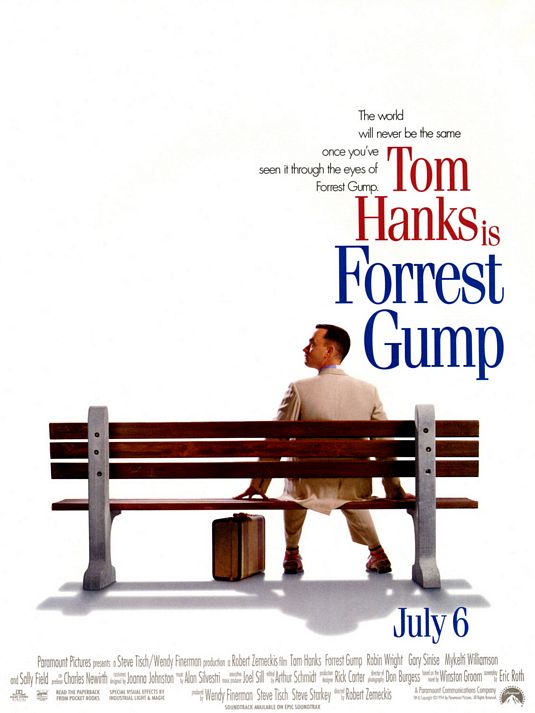
My 40 Favorite Films of the 90's - 14 - Forrest Gump (1994)

Forrest Gump (1994; Paramount Pictures)
Director: Robert Zemeckis
Writers: Eric Roth (Screenplay); Winston Groom (Novel)
Starring: Tom Hanks, Gary Sinise, Sally Field

Winston Groom’s tale of a mentally-disabled man who directly experienced almost every world-changing event in the later half of the 20th Century is a truly charming and heartfelt examination of spirit and love.  Widely considered one of the greatest films of all time, ranking #14 on IMDB’s top 250 at the time of this post, number 76 on the American Film Institute’s list of the 100 greatest American films of all time, and cleaning up in the 1995 Academy Awards with an astounding six wins, Forrest Gump is one of the essentials.  There are a few movies that I would recommend everyone see, and this is definitely one of them.

Tom Hanks plays Forrest Gump, a chatty man who patiently waits at a Savannah, GA bus stop just casually talking with his various benchmates.  He tells them tales of the things he’s done, the people he has met and the places he has been not knowing just how much of an impact he had on the lives of so many people.  Cutting back and forth from the story’s present time and flashbacks to various key moments in Forrest’s life, we see him meet presidents, fight in Vietnam, chat up John Lennon at a Black Panther Party meeting, and ultimately start a hugely-successful business, and he did all of this never knowing how great his achievements really were.

Along the way, as we explore Gump’s life, we meet a few people who will shape him.  His mother (Field) helps to ensure he lives as normal a life as possible and we watch as his childhood friend Jenny (Robin Wright) goes from a pretty tomboy to a broken and abused soul.  Gump’s lieutenant during his tour in Vietnam, Dan Taylor, leaves the war a crippled and angry man, embittered towards the so-called American dream.  We see Lieutenant Dan befriend the devoted Gump, despite occasional periods of frustration.  Then there is Bubba, a fellow recruit who is also slow, who becomes the titular protagonist’s best friend during his time in the Army, ultimately planting the seed of starting a hugely-successful shrimping business.  

Tom Hanks deservedly netted an Oscar for his performance of the kindhearted Gump.  Filled with shining moments of greatness, his performance is famously endearing.  The performances from the supporting cast including greats like Sally Field and Gary Sinise are stunning as well, and act as a great contrast to the unwitting Gump, reflecting the grievances and the disenfranchisement of the late 60’s and early 70’s.  Mykelti Williamson plays Bubba Blue with famous wit and a warmth that nearly matches Hank’s own Oscar-winning role, and every moment with the two on screen is either very funny, or extremely emotional.

Forrest Gump literally has everything.  It is a comedy, a drama, a war story, a romance, a period piece and a smart examination of the ideals and the passions that erupted during the Vietnam War era.  Despite literally trying to be everything, the film never misses a beat, always hitting just the right notes and crafting a very big, but cohesive story.  Ever since Citizen Kane there have been countless movies that have tried to weave a complex and intricate story around a single character through the years, but few have done it better than Forrest Gump.

Sunday, May 4, 2014

My 40 Favorite Films of the 90's - 28 - Rushmore (1998)

Director: Wes Anderson
Writers: Wes Anderson, Owen Wilson
Starring: Jason Schwartzman, Bill Murray

Wes Anderson makes his first appearance on my list with his 1998 film Rushmore.  This is Anderson’s second feature film and the first one he did to really get promotion, thanks to a more recognizable cast and a higher-profile marketing campaign.  Rushmore is a strange film, as is typical for Anderson, only, it is strange in a proper way.  I will go more into Anderson’s style of filmmaking later but suffice it to say for now, if you have not seen a film by Wes Anderson, then  you have not really seen anything like it.

Rushmore is the story of a super-intelligent teenager named Max Fisher (Schwartzman) who has a great deal of influence at an exclusive private academy called Rushmore.  He is followed by his much younger protege who more or less acts as his secretary as he heads and organizes a bevy of time-consuming clubs.  As a result of his devotion to extra-curricular activities, Max’s grades are suffering and he finds himself at odds with the headmaster, who places him on academic probation.  Meanwhile, a beautiful young teacher named Ms. Cross becomes the target of Max’s affection, a crush that comes between him and his much older friend named Herman Blum (Murray), when she and Blum begin dating.  The plot shifts to focus primarily on Fisher and Blum’s fight over Ms. Cross, which increases in desperation.

If the synopsis seems a little broad, that would be because it is a Wes Anderson film.  Anderson’s stories are usually a series of layered plots that are intermingled with the film never focusing firmly on just one for too long.  There is enough of an underlying focus for the story for there to actually be a movie, but it never becomes the center of the film, it is just there to tie together the various other subplots.  Rushmore is a constant stream of sight gags and an odd awkwardness that may come off as ineptitude, until you actually watch the entire film.  The strange pauses, fourth-wall-breaking montages and tone throughout the film all add up to a strange experience, but a funny one.  Chances are, however, that if you do not like one Wes Anderson movie, you will probably dislike all of them, with the one exception of the more recent Moonrise Kingdom, which was an excellent movie, and a definite evolution for Anderson as a filmmaker.  

Rushmore is a funny, slightly disjointed and unhinged movie about teenage awkwardness and social standing and it challenges norms of filmmaking in just about every scene.  Anderson has made it part of his style to break the established “rules” of direction, and what comes of it is both a funny film, and a unique artistic idea.  All of his movies have a distinct palette as well, which further add to their identity.  Anderson makes a distinct sharp yellow the chromatic focus of every scene, with browns and soft greens becoming compliments.  These earth-tones are then contrasted with foreground elements like Max’s bright red beret.  Another interesting trademark of Anderson is how he makes certain performances stand out in scenes by have them follow slightly more subdued acting from other lead characters.  This makes some more dramatic scenes seem louder than they really are, giving the illusion of a heightened series of events, without ever breaking the sardonic feel of the movie.