Chitika Ad

Showing posts with label action. Show all posts

Sunday, April 19, 2015

Animation Therapy - Turbo Teen (1984)

Turbo Teen (1984; ABC Network)
Sometimes there’s a show that is both very easy to describe yet impossible to explain to someone who hasn’t seen it.  That said, I cannot fathom a scenario where the people behind Turbo Teen weren’t met with either uproarious mocking laughter, or an irritated slap to the face.  A lot of the shows I really got into were from the late 80’s, so this was just shy of that period for me, and it was too big of a failure to really maintain any post-run momentum in syndication or home video that I recall.  Now, even as a kid I was very picky and didn’t like a lot of the shows my friends did either because of the way the characters looked, or because of the show’s pacing or tone (not that I really understood what that meant back then, but it’s a quality that is often recognized without definition).  So, I guess even then I was sort of a jerk when it comes to entertainment (wink).  That begs the question: Do I regret watching an episode now?  Nope!  Because this is one of the greatest things I’ve ever seen in my life!

The awesomely stupid premise for Turbo Teen is as follows: Brett Matthews is a teen driving home from work in his sports car when a tree is struck by lightning, forcing him to swerve and sending him flying off the road, over a cliff and into the side of a secret lab where he crashes right into the path of a ray that merges the molecules of Brett’s body with those of the machine’s, giving the teen the power to transform into his car.  When exposed to heat (hot water, food, ect.) Brett uncontrollably takes the form of his car where cold then turns him back (Where have I heard a similar premise before..?)  Together with his friends Patti and Alex (who have skills of their own) and Comic-Relief-Dog, Brett goes on crime-fighting adventures against powerful enemies.  Yes!  This exists!!!  I am SO happy about this!

In the 80’s there was no absence of bad animated series.  Really, the quality spike didn’t peak until the late 80’s when Disney Animation Studios started hitting their stride and series like Transformers and G.I. Joe reached their pinnacle.  Things will stay good for a while until the airwaves became flooded with bad knockoffs and celebrity-themed animated shows like Wishkid (THAT damn show’s day is coming…).  Before that, there is this strange dead zone filled with bland animated tripe from Hanna-Barbera Productions (who were already starting to fade in quality by that point) and a few other companies like Dic, for instance.  Turbo Teen lands somewhere in-between debuting in 1984 and lasting just one season.  It never really gained an audience, probably because it is such a ludicrous premise that a kid may find it more stupid than anything.  It takes a few years (or decades) for a show like this to re-emerge and become a sort of cult favorite.  I think, from what I’ve seen, Turbo Teen is ripe for that sort of cult rebirth.

Now, as out-there as the show’s premise is, knowing the episode I saw as a jumping-off point will make things even more enticing.  The episode is entitled “Video Venger” and opens on the teens playing an arcade game but when Brett has a piece of pizza land on his face he transforms into his car right there in the Pizza parlor while playing the game.  Still wanting to beat Alex’s highscore, Brett has his friend plug him into the arcade cabinet via a universal cable in his dashboard so he can control the game as a car.  This causes a military insurgent group monitoring the game to unleash an army of robots onto the city resembling enemies from the game and only the Turbo Teen and his friends can save the day.  This episode ends with the group saving the President by having two ice-firing tanks crossfire into each other through some Turbo-Teen-Trickery right in the White House… driveway..?  Ultimately the President awards them with medals.  

Okay, so if I missed anything it could be that while watching this I was mesmerized by its existence and was also somewhat distracted with bouts of hysterical laughter.  There is so much stupid in that last paragraph that I can understand you wondering why I would recommend this to anyone.  All I will say is, if you’re a fan of over-the-top, so-bad-it’s-good entertainment, and are just in awe by really, really awesomely bad TV in-general, you will probably love this show.  If you go in with the right attitude, you may be surprised by how much enjoyment you get out of it.  I went in expecting it to be one of the worst shows of the decade by reputation.  It isn’t.  The worst animation from the 80’s-90’s is either boring, a cheap cash-in, or is MEANT to be funny but isn’t.  This is none of those things.  It’s too insane to be boring, there really isn’t much like it (unless you pick out parts from about six different shows), and it isn’t really meant to be a comedy.  It’s an action show.  Sure there are gags in it but for the most part it was played straight.  I love so-bad-it’s-good stuff and this is up there for me.  I enjoyed the Hell out of Turbo Teen!


Watch Turbo Teen: Video Venger in Cartoon | View More Free Videos Online at Veoh.com

Tuesday, April 14, 2015

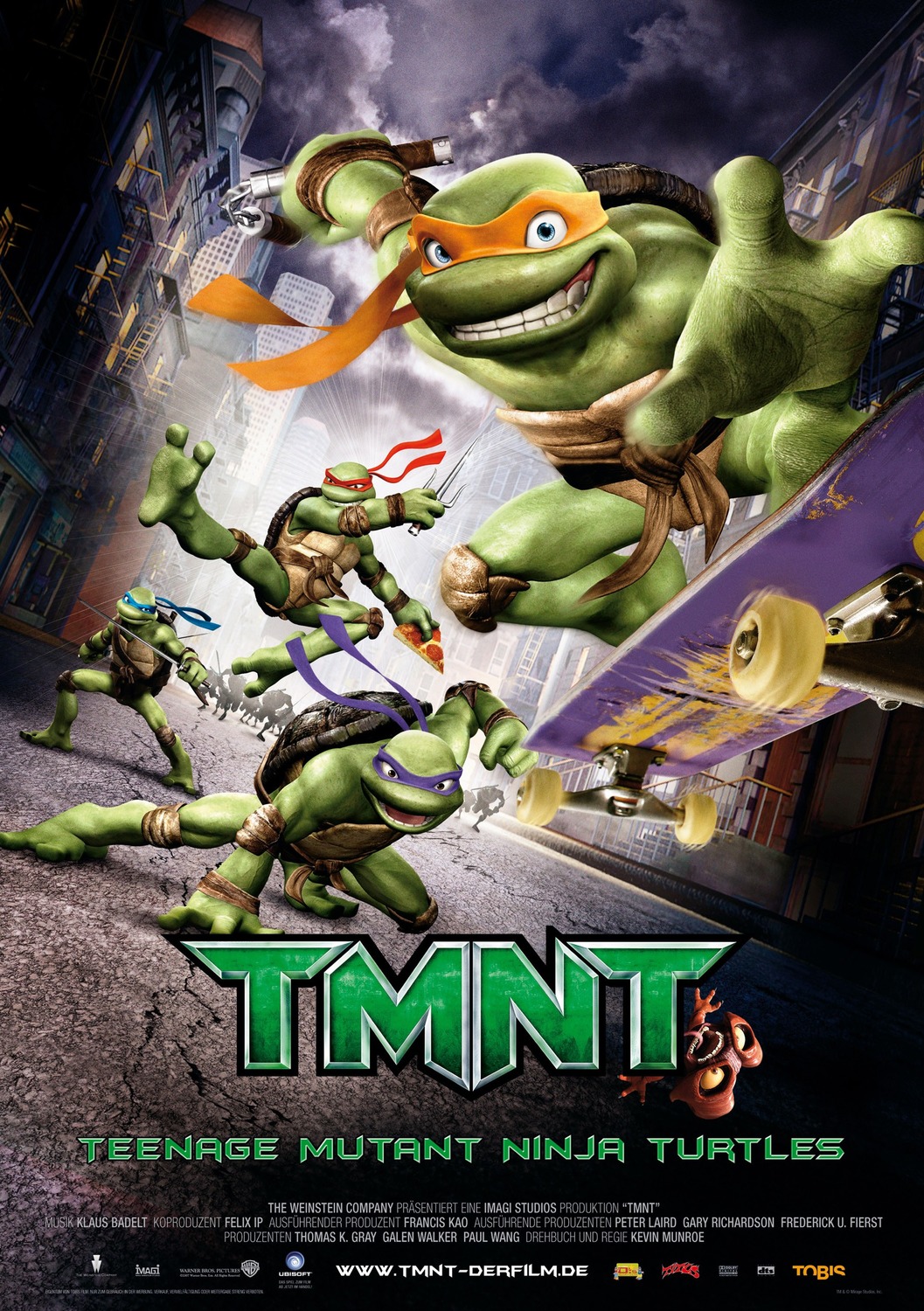
Generation Wars: Teenage Mutant Ninja Turtles (1990) vs. TMNT (2007)


Now, I know I’m not the first person to do this, but I would like to see how many of these classic series have evolved over the years and I decided to start this series with Teenage Mutant Ninja Turtles.  

Originally based on Mirage Comic’s violent cult series of the same name (created by the duo of Laird and Eastman), the Teenage Mutant Ninja Turtles made their mainstream debut in the late 80’s.  Now, it’s important to note that this was a time where a lot of major companies were seeing great success with animated series based on toy tie-ins.  The two biggest ones before TMNT were G.I. Joe and Transformers.  These two series drew huge fans to the stores to buy every toy for everything they saw on the 30 minute TV series.  The fact was, these shows really didn’t have much in terms of plot.  They were really just toy advertisements.  The same goes for a lot of hit series from the time, including The Real Ghostbusters and Thundercats.  Then came 1987…

‘87 was a bad, BAAAAD year for movies, but on TV, things were changing.  Some of the biggest shows ever made their debuts in this year.  Three notable entries were Star Trek: The Next Generation, Duck Tales and Teenage Mutant Ninja Turtles.  The latter of the two did something very different.  Unlike a lot of their tie-in contemporaries, these two animated series attempted to craft short stories around existing characters with established relationships and arcs.  They weren’t Shakespeare, but they were smart, funny and entertaining.  These two shows were essentially responsible for the huge boom of Saturday Morning animation in the late-80’s and early 90’s, a genre that was starting to fade a little at the time.

Fast forward to 1990.  A series as big as Ninja Turtles was not going to escape the Hollywood treatment, and on March 30th, fans of the series were treated to a hard-edge, energetic, fun and somewhat edgy action flick.  This was NOT a kids movie, in spite of its rating.  It had pacing, action, and the characters that were mostly known by everyone at that point were treated well in terms of their nature and relationships.  It must be said, that if you did not grow up in this period, you likely have no idea just how massive this series was.  Compare it to anything big today, and you may be close, but just short.  TMNT was a phenomenon, and it was everywhere.  So much so that it never actually went away.  The series lasted well into the 90’s, running for nearly a decade (that was HUGE for an animated series), and other animated shows, comics, games, movies (to a lesser extent) and other spin-offs continued to come out.  Still, the question is, does the 90’s movie hold up?

Well, not too long before writing this article I went back and watched it and was astonished by how good it still is.  No, seriously.  The action was good, the characters were spot on, they stayed true to the overall story and, thanks to help from Jim Henson’s Creature Shop, the Turtles themselves were amazing.  The movie hit the nail on the head, transporting the Turtles out of the realm of 2D and bringing them to life.  Naturally the movie was a big hit.  The sequels… not so good, though.  They didn’t hold up and tried too hard to be more kid-friendly, ultimately losing some of the momentum the first film built.  This was partially in-response to some backlash that the first film was “for kids” but was too violent and dark for a few parents to handle… Boy how times have changed.

As a sort of hiatus, the Turtles went back to the shadows and remained out of the mainstream for a short time until being revitalized in a new 2007 animated film.  TMNT debuted to mixed reviews.  It sits at a 37% on Rotten Tomatoes and was generally panned by critics.  Two things are wrong with this picture.  First, having watched the movie, it was not a bad film; not by any means.  It was certainly better than a 37%.  I have SEEN what a 37% looks like and it’s a Hell of a lot worse than this.  No, I think there was some backlash to the tone in some cases.  First, the new movie addresses some of the things that were just glossed over in the original film and series more directly, in-particularly, April O’Neil’s restlessness and Raphael’s rebelliousness.  The latter is a prominent plot point early in the movie as it is an established and ongoing trait of the character.  No complaints there.  

Another point of contention is the 2007 film’s plot.  The story revolves around an ancient immortal warrior who is able to resurrect his ancient generals when the stars align, and with the moment right, he can open a portal to conjure up monsters and take over the world.  It’s like something out of a Final Fantasy game, and it’s goofy, but it’s not the worst I’ve seen from that type of story.  The other subplots involve a barely glossed-over relationship between fellow-vigilante Casey Jones and April O’Neil and the returning theme of Raphael’s lone crime fighting ways.  What I liked about TMNT is how it addressed the latter.  Leonardo, who returns from a prolonged absence of self reflection, finds his family in disarray and is faced with bridging a severed relationship with Raph.  It turns out, another armored vigilante hero has been taking out thugs around New York and Leo, in an attempt to stop him, finds that this so-named Nightwatcher is actually Raphael.  This leads to the two brothers having a nearly-fatal brawl on the rooftop.  As a long-time fan of these characters, THIS was satisfying to me.  It was the obvious and inevitable result of their rough relationship and at that point I was sold.

As a standalone movie, TMNT is not a masterpiece, but it does what it set out to do: Make a fun and solid TMNT adventure.  The only real complaints I have about the movie is it has that odd, jagged CGI animation a lot of series do today, that has these 3D characters with Disney eyes that looks sort of odd in the high-detail world around them, and a few of the “chase” scenes are a little overlong and are basically just filler.  These long action scenes make the few more meaningful ones seem longer than necessary by association.  Lastly, the plot is nothing fresh or astonishing, but it sets the stage for some cool character design for the villains, and a few pretty solid fights.

Really, I do not see why this has such bad reviews.  It is NOT a bad movie.  It’s faithful, it was obviously made by people with a lot of love for the source material, it has a lot of quality animation (especially in the case of the Turtles) and the attention to detail in the production design is great.  I also like that they didn’t go overboard with references to the old series.  Sure they’re eating pizza, Splinter is watching soap operas and Casey Jones is donning his trademark hockey mask, but it isn’t abused and shoved in our faces like a lot of throwback remakes and reboots tend to try to do.  It’s respectful is what I’m saying.

So, which one is better.  Well, in this case it really isn’t a contest.  The 1990 film was engaging and had warmth as well as tension.  There is just something about seeing these characters in the “real world” that brings them to life.  Also, practical effects always look better than CGI and while at least the 2007 movie is entirely animated, the tangible Turtles from the earlier film are much more believable.  For anyone who didn’t grow up during Turtlemania, I would say watch the original movie.  It is not too dissimilar but definitely feels more real and, on the whole, is a much better movie.

Tuesday, March 3, 2015

My 40 Favorite Films of the 90's - 3 - Pulp Fiction (1994)

Director: Quentin Tarantino
Pulp Fiction (1994; Miramax)
Writer: Quentin Tarantino
Starring: Samuel L. Jackson, John Travolta, Uma Thurman, Ving Rhames, Bruce Willis, Harvey Keitel, Tim Roth, Amanda Plummer

I want to be clear here, and I do not think this is hyperbole: 1994 is one of the greatest years in the history of film.  SEVEN of my top 40 movies of the 90’s are just from 1994.  The American Film Institute released their updated list of 100 Greatest Movies in 2005, a list spanning a century of film, and there were four movies on their list from 1994.  In fact, Pulp Fiction isn’t even the last film on THIS list from that year!

Pulp Fiction is a series of interwoven stories of violence and debauchery and it is absolutely glorious.  There is no one scene that isn’t captivating.  It is a powerhouse of cool direction, a distinct and fresh look and tone, and most of all a stunning screenplay.  So, naturally, it didn’t win the Oscar in 1995, but I’ve already gone over how worthless the Academy Awards are so I won’t bother you with that again.  Instead, let’s talk about one of the greatest films of all time.

Before directing Pulp Fiction, Quentin Tarantino made a couple other genre films including the previously-reviewed Reservoir Dogs.  Tarantino draws heavy inspiration from the classic 42nd St. Grindhouses of the 60’s and 70’s.  These theaters were known for their release of unvetted indie films, often branding the exploitation label, that for the most part remained unrated and rarely saw any release outside of these theatres until the mid-to-late 80’s.  These are the theatres that brought us the great Blaxploitation classics like Shaft and Superfly, the two of which were rare examples of great movies leaving the Grindhouse and getting a wide release (largely thanks to their hit theme songs).  We also saw a lot of graphic horror from Italian directors like Lucio Fulci and Bruno Mattei who rarely saw any form of wide distribution, even in the video market, their films mostly remaining cult classics looming in the underground horror scene.

So, what does this have to do with Pulp Fiction?  Well, this is a movie that amalgamates ideas from the various genres of the time.  The title refers to “Pulp” a largely pejorative word used to describe entertainment that is considered low-quality but is widely popular.  The movie uses directorial styles, fashions and concepts that were common in the Grindhouses, but were rarely embraced by the mainstream film industry.  This is part of what makes Pulp Fiction such an amazing film, it is a beloved, winning classic that employs and draws its inspiration from films that were almost entirely marginalized.  It’s very acclaim and success is itself a commentary on the manufactured idea of “mainstream” entertainment.

Pulp Fiction’s plot is actually a series of interconnected storylines all wrapped around a handful of jobs and the daily lives of two hitmen, Julius and Vincent (Jackson and Travolta).  They exchange memorable banter as they travel around Los Angeles, from cleaning out an apartment of misguided college kids, to taking a local crime lord’s wife (Thurmond) out for a night on the town.  Between these wrapper plot lines, we get other stories revolving around a boxer on a rough deal and a couple of crazed robbers, and that really does only scratch the surface.

The fascinating thing about the film is how everything really comes together.  We see plotlines that are, at first, complete non sequiturs, but as the film goes on, harkening back to these scenes reveals a beautifully-woven series of smaller stories forming a greater whole.  In fact, I believe (and this is speculation) a large part of why this film is so beloved is how it uses these stories to paint an involving picture that encourages audiences to see how it all comes together, creating a sort of active viewing experience.  You mind is processing the stories individually, and when it all comes together it is like an ecstatic revelation.  

There isn’t a bad performance in this movie.  Not one.  This is very rare as even the best movies have a few throwaway acting choices, but Tarantino's meticulousness pays off here.  The cast is huge and everyone has a reason to be there.  This is all supported by the screenplay and, to be honest, if this were a top 40 based on writing alone, Pulp Fiction would be number one.  This is hands down one of the greatest screenplays of all time.  It’s fast, witty and the dialogue, even from the simplest scenes, is superb.  It’s funny and has a charm and character you just don’t see in most movies, this especially goes for Oscar movies, which actually trend on the boring side (and I say this as a film snob).

Saturday, February 14, 2015

My 40 Faovirte Films of the 90's - 12 - The Usual Suspects (1995)

The Usual Suspects; 1995,
Polygram Filmed Entertainment
Director: Bryan Singer
Writer: Christopher McQuarrie
Starring: Gabriel Byrne, Benicio Del Toro, Kevin Pollak, Stephen Baldwin, Chazz Palminteri, Kevin Spacey

I’m not usually a huge fan of ensemble films.  They are often pretty bad.  To me they always harken back to the likes of North or the Ocean’s Eleven sequels (the first one wasn’t really all that bad).  The movies are selling themselves on their cast alone, with little effort in the actual script or direction.  There are always exceptions to this rule, however as we will see in a few entries.  That brings us to the Usual Suspects.  For audiences today, this is a major cast, but in the mid-90’s… Well, many of these guys were known but were not huge stars.  The biggest gets in this movie by far were Gabriel Byrne and Chazz Palminteri, who were already well-regarded and praised actors at the time and they sort of held the unofficial position of being the main draw for audiences.  This was also only the second feature directed by soon-to-be X-Men director, Bryan Singer.

The Usual Suspects just may be the best heist movie of all time.  If it isn’t THE best, it’s up there.  This movie has a great cast of characters you believe were career criminals.  They knew the drill and it showed.  They were cynical, untrusting and just aggressive as Hell to everyone, especially each other.  They were brought together to pull a major job as commissioned by the enigmatic Kaiser Sousse, a shadowy figure that is often the subject of thieves’ lore.  The entire movie is told in flashback as a mentally challenged man named Verbal (Spacey) conveys the tale of a heist gone really, really bad to the impatient Det. Kujan (Palminteri).  He tells the story of the characters, who they were, how they were brought together by the mysterious Sousse and how the job became a total disaster.  

This is a damn-smart movie.  The film scored an Oscar for McQuarrie’s clever, fast and naturalistic screenplay and he deserved it.  He was a regular collaborator with Bryan Singer in the 90’s but sort of fell off the earth for nearly a decade.  He’s made a comeback in recent years, though.  He wrote/co-wrote a few would-be Hollywood epics like the box-office bomb Valkyrie and another Tom Cruise-headed flop The Edge of Tomorrow.  This is sad because, judging by The Usual Suspects, he is a damn-good writer.  The foul-mouthed, quippy and aggressive screenplay to Suspects really highlights the ideas of the 90’s, which were influenced heavily by Spike Lee and Quentin Tarantino, and drew from the grim attitude and gritty action of police films of the 70’s and 80’s like The French Connection and Prince of the City.  These influences in the 90’s led to a pretty solid series of b-grade actioners and high-quality independent films like this one.  If you like action, heists and a brilliant script, you will like The Usual Suspects.

Saturday, July 19, 2014

My 40 Favorite Films of the 90's - 19 - Princess Mononoke (1997)

Princess Mononoke (1997; Studio Ghibli,
Miramax (U.S. Distributor))
Director: Hayao Miyazaki
Writer: Hayao Miyazaki
Starring: (Original Japanese Cast) Youji Matsuda, Yoriko Ishida; (English voice cast) Billy Crudup, Claire Danes

Anime is a modern type of filmmaking that spans many genres and ranges from quality dramas to silly romps.  Spanning decades in Japan and growing immensely in popularity in America in the late 90’s due to the domestication of series like Dragonball Z, Neon Genesis Evangelion and Cowboy Bebop, and with the help of movie releases like the cult classic Akira and the wondrous piece of fantasy Princess Mononoke or もののけ姫 (Mononoke-hime) in Japanese.  Written and directed by the Walt Disney of Japanese animation, and arguably the second greatest animation director in film history (after the great Disney, of course), Hayao Miyazaki, Mononoke is a fantasy that is powerful and brilliant in every way.

The story begins following a warrior name Ashitaka, who is cursed by a rogue boar that became possessed by a evil spirit.  When he returns home he is forced to exile so as not to curse the rest of his village.  He travels a great distance on the back of his companion, a “red elk” (that isn’t a freaking elk, by the way) named Yakui.  Hoping to find a cure for his ailment, he seeks aid from the spirits of the forest that guard the untouched natural landscape from the fires of man, in particular those coming from the nearby forge fortress of Irontown.  Run by a headstrong matron named Lady Eboshi (Minnie Driver), who rescued many of her working girls from the cities’ brothels to help forge more powerful weapons, the town awaits the return of its men and readies itself for war against the animal spirits.  When the town is attacked by a nimble and fearless girl named Mononoke, who refuses to identify herself as human as she grew up with the guardian wolves in the nearby forest, Ashitaka rescues her from her fate but is wounded in the process.  Nursed back to health by the wolf girl, the young warrior is now caught in the middle of a war between his fellow man, and the spirits of nature that could cure him of his curse.

Typically, the man versus nature theme is done very, very poorly.  This is especially the case when the story has a shoehorned, heavy-handed environmental message in it.  Films like Avatar always came off to me as more PSA than film, especially since that movie in-particular is just several hours of Cameron telling everyone how “awesome” he is.  However, Mononoke actually shows us the struggle of violence against nature and puts us in the shoes of the creatures and lives destroyed by man’s lust for power.  Mononoke herself is a direct contrast to Eboshi. The titular heroine is gruff, strong and devoted to her forest family, while Eboshi is arrogant, beautiful and willing to sacrifice her own people to get what she wants.  The most interesting thing about this contrast is how the characters are introduced.  When we first meet Eboshi, it is a natural assumption to assume she is good, while Mononoke, clad in furs and a wooden mask, wields a dagger and slashes and dives at the frightened villagers.  

Princess Mononoke plays with expectations, and is actually, and surprisingly, not bound by too many cliches, despite the obvious references to Burroughs’ Tarzan novels as well as a number of other man-vs.-nature stories.  It is an inspired story that is both empowering and heartbreaking.  We see the once-mighty spirits stumbling and bleeding from the powerful weapons of the humans of Irontown.  They are prophets of their own doom, so willing to give in to their collective fate.  We see that nature becomes helpless against man’s rage unless some are willing to help fight with and for it.

Like all of Miyazaki’s writings, this film has touches of Japanese folklore and spiritualism in it as well, and the cultural elements of his movies are often some of the of most fascinating parts.  Environmental themes aside, this is a great allegory to growing into one’s self, overcoming the past and accepting who you really are.  It pulls you into the world and shows you the pain each character is feeling without being emotionally-manipulative, instead it relies on one’s own empathy to truly relate to and understand what these characters are going through.  What is even a greater testament to the complexity of this film: I did not even scratch the surface in terms of plot.  There is a lot going on here that tie the emotional elements and themes of the film together better than most that have tried have been able to do in narratives past.  Miyazaki created a masterwork here, and it is widely regarded as one of the greatest animated films of all time.  It earned this title, as Princess Mononoke is a deep, engaging masterpiece, and even though it is only my second favorite film of Miyazaki’s (Spirited Away is my #1), it is certainly high among the greatest animated features in the history of movies.

My 40 Favorite Films of the 90's - 20 - Army of Darkness (1992)

Army of Darkness (1992; Universal Pictures)
Director: Sam Raimi
Writers: Sam and Ivan Raimi
Starring: Bruce Campbell, Marcus Gilbert, Anabeth Davidtz


Way back in 1981, two decades before he turned Spiderman into a blockbuster series, a young director named Sam Raimi brought together a small group of actors to star in a low-budget horror film called The Evil Dead (inflation-adjusted, the movie cost just under $1m, Daddy Day Camp cost $6m. Was it worth it, Hollywood?).  It is the story of Ashley “Ash” Williams and his group of friends who vacation to a cabin and find that the previous resident had gotten himself involved some unworldly stuff during his research into the Necronomicon ex Mortis: The Book of the Dead (A reference to the writings of H.P. Lovecraft).  What he found opened a portal to another world, allowing vile demons to enter our realm.  The young vacationers get more than they bargained for and things get kind of tragic.


What Raimi intended here was to make a legitimate horror film, one that is both terrifying and entertaining.  What he made instead was an unintentionally-funny cult classic (which is actually better, honestly).  Raimi was not discouraged by this and he set out to do one better.  The Evil Dead II was a combination of a sequel, a remake and a sendup of horror movie tropes.  There may be no single horror comedy (or horror film for that matter) that is more beloved by fans.  It is laugh-out-loud funny with tons of gore, over-the-top moments and very, very quotable lines.  The film ends with our hero Ash being sucked into a wormhole and waking up in the middle of a wasteland, with only his chainsaw arm to accompany him… at least in the beginning.


The above build-up was essential as the story of Ash getting here is part of Army of Darkness’ greatness.  As a direct follow-up, it takes the story in a direction nobody saw coming: Army of Darkness is a fantasy/action/comedy.  Now, I do not mean a comedy in that it has a few jokes in it among the actual action and horror, no, this movie is a straight up comedy starring the epic Bruce Campbell fighting the undead in a medieval world… and it’s AWESOME!  Army of Darkness is a work of perfection because Raimi set out to make a movie that just goes all-out and does the most ridiculous things, and as a result, makes a fun, exciting and damn-entertaining flick.


AoD starts with Ash in that strange world from the end of 2 in a chain gang locked in a yoke, forced into slavery.  When he proves himself an asset in helping to defeat the Deadites that plague the land, he is tasked with defeating the titular army, but first he must retrieve the fabled Necronomicon from its resting place.  It all culminates in an epic battle with the Deadite army as Ash does everything he can to save the day and finally get home to his job at S-Mart.

Occasionally silly and always energetic, Army of Darkness goes into some cartoonish territory, but at least for me, that’s a plus.  The movie does not take itself seriously at all, embracing the insanity wholeheartedly and just doing everything it can to mock its genre and utterly abuse its poor hero.  However, beyond the intermittent slapstick humor, there is a legitimate adventure film here, with some pretty good action and great makeup effects.  The film was fortunately made before the advent (and eventual abuse) of computer animation, so the practical effects have a spirit and a tangibility to them.  Knowing the actor is actually on screen with the makeup-covered actors helps to maintain the illusion of actual stakes.  CGI has, in more recent years, taken the place of classic makeup, puppetry, stop motion and animatronics and, as a result, much of the heart of special effects is lost.  Army of Darkness just may mark the last really good fantasy adventure released before CGI gave us sweeping shots of cartoonish castles and lazily-animated copy and paste creatures.  This is a film with actual sets and costumes, rather than a few actors standing in front of a green screen.

Thursday, April 24, 2014

My 40 Favorite Films of the 90's - 36 - Terminator 2: Judgement Day (1991)

T2: Judgement Day (1991; Tristar Pictures)
Director: James Cameron
Writers: James Cameron, William Wisher, Jr.
Starring: Arnold Schwarzenegger, Linda Hamilton, Edward Furlong, Robert Patrick

I am pretty sure it is safe to call The Terminator one of the best thrillers of the 80’s.  It is a very simple movie in its story and structure, yet it was intensely explosive and entertaining.  In the film Linda Hamilton plays Sarah Connor, a waitress who becomes the target of a time-traveling killing machine called the T-800 sent from the future by a computer-controlled consciousness called Skynet.  She was to bear the child who would lead the resistance against the machines.  Her death would mark the end of the fight for man in the future, so a time travelling human named Kyle Reese was sent back to protect her, but inadvertently falls for her, and well-shot love scene marks a major turning point in the film.  In the end, Sarah successfully destroys the machine that pursued her and shortly after the events of the film, she finds that she was pregnant with Kyle’s child, who she named John, and this brings us to Terminator 2: Judgement Day.

The titular Judgement Day is in reference to a nuclear attack from Skynet that was its first strike in the war against mankind.  The sequel is set a few years before Judgement Day, this time the Terminator is reprogrammed and sent back by the human resistance to protect John Connor.  It is discovered that Skynet is making the first move on the teenage John’s life by sending back a deadly new type of Terminator called the T-1000, a cybernetic liquid metal alloy that can take any solid shape and even replicate the face and voice of humans.  It is Skynet’s deadliest weapon yet, and sending back a requisitioned terminator is the only hope to save John’s life.  

The film focuses on the T-1000’s pursuit of John Connor, and the T-800’s attempts to protect him.  Along the way John orders his protector to help him break his mother out of a mental institution where Sarah Connor was incarcerated after her traumatic encounter with the machine in 80’s had led her to warn of their coming threat and the authorities’ rejection of her warnings resulted in her becoming increasingly violent.  After a successful rescue, he three heroes meet with a weapons dealer, gather a small arsenal, and make an attempt to stop Judgement Day by finding the machines’ architect Miles Dyson and killing him, but ultimately they acquire his aid and attempt to stop the devastating nuclear attack that was only a few years away.

Judgement Day was a mix of ideas from the start.  It was part high-concept science fiction, part action blockbuster and it featured solid performances from everyone.  A big takeaway from this film is Robert Patrick as the T-1000, which is a seemingly-unstoppable juggernaut willing and able to kill anyone and do anything to accomplish its task.  Like the Terminator that tried to kill Sarah before, it is a terror that does not sleep, eat or even slow down.  Yet, the T-1000 is even more deadly as all weapons seem useless and all attempts at eliminating it are futile.  The villain is easily the best thing about this movie, but it still quite excellent as a whole.

I do want to take just a moment and talk about James Cameron as a director.  I will not go on too long here, but I do want to say that he is incredibly talented visual artist, able to weave together great action scenes and has always been ahead of the curve in his ability to harness the latest visual effects technology to its fullest potential.  That said, he has never really come across to me as a particularly capable storyteller.  The Terminator series has a pretty straightforward story as a whole, despite a few attempts to add depth.  Yet, it seems to me that, while Cameron can certainly write an action scene and a solid David vs. Goliath plot, he does not seem particularly good at handling human characters.  One major flaw with Terminator 2 is how Sarah is a normal working woman in the 80’s yet finds herself institutionalized then escapes this facility a trained tactical weapons expert.  There is also the fact that John Connor is a conveniently-skilled hacker, an ability that is necessary for the plot to work, but not fully utilized or expounded upon.  Lastly, there are the plot holes surrounding the Terminator himself.  If he was reprogrammed, how is he being controlled?.  For that matter, how is Skynet controlling him?  If he was assigned orders before he was sent back, then why is he able to deviate from these orders at all?  We see in the unbelievably-flawed Terminator 3 that the machine is more than capable of defying the orders of anyone that sent it back in order to accomplish its ultimate task.  How are the humans able to send anyone back at all?  All of this has been addressed to an extent by outside media like books, comics and (to a certain degree) the later films, but Terminator 2 seems to exist solely for the action.  There is not much of an attempt to expound upon the basic premise, there is only the effort to make everything big and pretty.  This is a problem I would continue to have with Cameron’s films even up until today.  There is simply so much that makes no sense in all of his films, yet these problems are readily dismissed.  I just cannot let him off the hook for his films’ issues, however, because there are just too many of them.

So, why then is Terminator 2 (or T2, as it is known from its early-90's marketing campaign) even on my list at all?  Well, that is a very easy question to answer.  Terminator 2 sits at number 36 because it is a loud, aggressive, fun action flick.  Nothing more, nothing less.  For the same reason Die Hard is held at such high regard, Terminator 2 is a movie I love because it is simply fun to watch.  The performances, while written in a hackneyed sort of way, are still acted well, and the action set pieces and effects scenes are all some of the best of the 90’s.  It is a driving, high-energy film with very little downtime, and that pace keeps me coming back to it every once in a while.

Saturday, August 3, 2013

Revenge of Godfrey Ho Month - Undefeatable (1993)

By the turn of the 90’s, Godfrey Ho’s directorial career started to slow.  It was in 1993 that he decided to do a film starring a successful star in the martial arts circuit named Cynthia Rothrock.  Already an accomplished competitive martial artist, Cynthia Rothrock was still having trouble breaking out of the home video market.  She appeared in several failed straight-to-video films such as Rage and Honor and the exceptionally dull Fast Getaway starring a washed up, teenage Corey Haim.  She decided to do Undefeated, hoping, I assume, it would help her gain a wider audience stateside.  This, obviously, did not turn out as she had hoped, but that does not mean Cynthia Rothrock is bad.  Quite the opposite, actually.


I cannot blame Rothrock for her film choices, as a vast majority of martial arts themed movies of the late 80’s and early 90’s were severely lacking in the quality department, especially when they were made in the U.S.  However, in spite of most of her movies being pretty bad, she herself is a talented fighter with a surprisingly large influence on popular culture.  To video game fans out there, you may be surprised to know that there would be no Sonya Blade if it weren't for her inspiration, Ms. Rothrock herself.  Rothrock is presently in a sort of revival period in her career, starting to appear in frequent films and is working towards making the A-list in martial arts once again.  I cannot say that Undefeatable really hurt her career as she did appear in a number of action flicks in the 90’s after its release, but I honestly cannot help but think it had some negative effect on her ability to capture a wider audience.


Undefeatable is a movie that began to grow in popularity thanks to, of all things, a YouTube clip.  The final fight scene began to show up on YouTube under the title “Best Fight Scene Ever”, or something along those lines, and became a big hit.  This was around the point that Godfrey Ho’s films started to get a following from cult film enthusiasts such as myself, who wanted to know more about this man’s work.  Before the clip began to circulate, I had seen other scenes from his older films, where he would dress his actors up in comically-bad ninja costumes with headbands that had the word “Ninja” printed prominently across the forehead.  These clips were often mocked for bad dubbing and goofy acting, and the Undefeatable clip took notice thanks to the extremely goofy performance of Don Niam as Stingray and John Miller as Nick.  It was eyebrows vs. mullet in this epic martial arts showdown!


So, what is Undefeatable all about beyond the notorious final fight scene?  The story follows Kristi (Rothrock), who looks out for her sister Karen after their mother’s death, and participates in underground street fights to earn money to support her sibling’s college education.  She is part of a street fighting gang of sorts, though, the gang aspect of the film is more or less pointless.  Karen is concerned for her sister, knowing she may one day be severely hurt or even killed, so she urges her not to fight.  Kristi begins finding it hard to get away with the fights as a homicide detective named Nick seems to exist to interrupt her.


Meanwhile we are also introduced to Stingray, the villain of the movie, who’s bug eyed expression and grandfather of all mullets makes him fodder for some serious riffing.  After an illegal fight, where he kills his opponent, he returns home to his wife Anna whom he abuses and he rapes her.  This is the last straw for Anna, who promptly leaves him.  This enrages Stingray and he begins a deadly killing spree where he constantly calls every woman he sees “Anna”.  He starts targeting couples, killing the male and taking the woman (still calling her Anna) and ultimately killing her, removing her eyes in the process.


After the police start investigating, Nick takes the case and shortly thereafter, Stingray (who has not yet been identified) targets Karen and kills her.  Kristi, vengeful and enraged, begins to hunt down who is responsible by targeting local gang leaders, that is, until Nick stops her, and it is at this point where the investigation starts to lean towards Stingray.  They find out about Stingray through his fight promoter, who winds up dead after he discovers the villain’s killer ways.  Stingray makes a mistake, however, in kidnapping Anna’s shrink, who then uses his own psychosis against him while captive.  After sending Stingray to the store, pretending to be his mother who abandoned him, she uses her cell to contact Kristi, who leads the police to Stingray’s warehouse.


A two-on-one fight breaks out with Kristi and Nick taking on the maniacal Stingray, and ultimately, they manage to rescue his hostage but are unable to subdue Stingray himself.  Instead, they take the psychologist to the hospital, where Stingray, disguised as a doctor, promptly abducts her again, but Nick and Kristi are on the case, and they chase the madman down to the laundry room.  It is in this room where the legendary fight breaks out, and for that, just watch the clip.


With the evil Stingray dispatched, Kristi, at her sister’s grave, finally gives up her fighting side and everyone seemed to have enrolled everyone else into college.  No, I’m serious.  The credits roll right after an ending high five.  In most movies this high five would be a freeze frame, but not in Godfrey Ho Land, oh no!  No, this high five actually has the actors high five, then hold their places for a few seconds before the screen turns black.  This is, for some reason, is so funny to me, that it is just the cherry on top of an already goofy-as-hell sundae.


Untouchable is awesome!  It is so silly, so flat, so bizarre that you kind of have to respect it.  It stands out from many of Ho’s other films as it does not employ the cut-and-paste technique.  Instead, Ho filmed this entire movie from scratch, which for him is commendable.  This has the added benefit of making a fully comprehensible, if not occasionally silly and padded-out, action flick.  


There is nothing here that you haven’t seen before in similar films, but Ho’s direction, the hilarious script and Don Niam and John Miller’s epically terrible performances make this a fun watch.  The movie is derivative, sure, but it is also great fun.  There are a few points where the movie is brought to a complete halt so that an actor can give the audience a martial arts demonstration, and these scenes, while still entertaining are blatant padding.  This is a 90 minute film with about twenty minutes of fat on it.  Still, it’s obvious why it was padded out, otherwise it wouldn't really be feature-length.  

Cynthia Rothrock shows some chops here, thought a lot of that may be due to the comparatively-worse supporting cast.  Still, as is often the case with Godfrey Ho, the choreography is good, and Cynthia Rothrock is a badass here, coming off as significantly faster and more agile than her opponents, which is how you become a martial arts superstar.  I like her in general and in this movie you also get a funny series of “bad laughs” and some of Ho’s best quirks on full display.  Check Undefeatable out.  I must admit, I needed this after sitting through Catman 2, which just... sucked.

Thursday, August 1, 2013

The Revenge of Godfrey Ho Month - Thunder of Gigantic Serpent (1988)

Thunder of Gigantic Serpent (1988)

When you sit and think about it, Thunder of Gigantic Serpent makes perfect sense.  Since the late 60’s the genre called Kaiju has been a popular choice for sci-fi filmmakers.  The genre, commonly referred to in the U.S. as “Giant Monster” is a huge cult movement, sparked by the release of the 1954 film Godzilla (or Gojira of you want to be pretentious about it).  The King of the Monsters has been everywhere, appearing in dozens of his own Kaiju films, as well as becoming a mainstay in the world’s pop culture lexicon.

The 1980’s saw a sort of a dry spell for this sub-genre, as it would be several years until Godzilla vs. King Ghidorah would see its release.  It is likely that Ho wanted to bring this back into popularity with his 1988 film Thunder of Gigantic Serpent.  I don’t think it really worked, but I will admit that this movie is entertaining as all Hell!

This is one of several Ho films starring actor Pierre Kirby, a mysterious action star who went as quickly as he came.  He appeared in several movies in the late 80’s, all under Ho’s direction, then just vanished.  No, seriously, there is mass-speculation among films fans as to what actually happened to Pierre Kirby, because few people actually know for sure.  It was confirmed by Brad Jones of thecinemasnob.com that Kirby did, in fact, die at sea, as stated by the actor’s sister. This fuels a widely-accepted conspiracy theory that pirates were involved.  

So, with that bit of back-story out of the way, what is up with Thunder of Gigantic Serpent?  The film follows a young girl who has a secret pet snake.  I have not been able to really find out what she’s calling the snake in the movie.  I want to say it’s something like Mazla, or Mozra or something like that.  She hides the snake from her parents and when it is discovered, they refuse to let her keep it, but she defies them.  

Meanwhile we get plot #2 involving a formula that could save the world from starvation.  It is a super-growth serum that can cause things to grow more than three times their original size.  The experiments are a success but the military confiscates the good doctors’ research for their own ends.  At the same time, an evil Terrorist named Solomon wants to take over the world’s food supply, and he believes obtaining this formula with give him that power.  He stages a siege on the lab to steal the scientific wonder and begin... taking.. over the world.... (ho, boy).

Image Source: foywonder.com
Things go wrong, however, as an assistant takes the formula in a clear case and flees, throwing it out of the car into an embankment right before driving off of a cliff.  She survives, however, and the terrorists fail to catch her.  The young girl, her pet snake in mind, finds the container and brings it home, using it as a sort of terrarium.  Upon putting Mazla (?) in the case, it grows to a huge size.  The snake appears to have consumed the formula.

Image Source: roberthood.net
Solomon discovers the girl has the case and assumes, as he finds the case empty, that she has the formula too.  Sending his goons after her angers Mazla and the ensuing entanglement leads Mazla trapped in an electric fence, but the snake doesn't die.  No!  It grows!  To a massive size.  From here the girl attempts to protect her pet while the gangsters subdue her, holding her hostage as ransom for the formula.  It all comes to a head as Mazla is destroyed by the military and the young girl mourns the loss of her pet and friend.  The end..?  Nope.  We still have one scene left.

Pierre Kirby in Thunder of Gigantic Serpent
So, I bet you were wondering where Pierre Kirby comes into play in all of this.  Well, the Solomon character was cut into the existing movie as the villain, and Kirby is as well.  Kirby plays... are you ready for this?  Fast.  Ted Fast.  A super-agent who “always works alone” (Yes, that’s actually a line from the movie).  He cuts in and sort of comments on events in the movie, but is rarely given anything until the end of the film, and really has less than five minutes of screen time.  After Mazla dies Kirby tracks down and takes on Solomon in a brief, but entertaining Kung Fu battle.  Then the abrupt credits roll and the film comes to a close.

Thunder of Gigantic Serpent is comedy gold.  It is filled to the brim with 80’s cheese action clichés and goofy dialogue.  The dubbing can, however, become a little insufferable as the young girl (I never was able to fully decipher her name but I think her parents are calling her Ting Ting) spends the last act just shouting her pet snake’s name ad nauseum in her whiny dub voice.  The thing that really makes Thunder of Gigantic Serpent a must-watch is the effects work.

The original film used as a starting point for Ho’s cut is a strange movie on its own.  Obviously a Kaiju send-up, this movie has one of the most hilarious puppets I have ever seen in a movie.  Mazla, the snake, is not a real snake.  It is an inanimate foam form of a snake that is obscured in poor-lighting in earlier scenes and revealed in all of its comic majesty in later ones, after growing to a large size.  The first act has Mazla nodding and shaking its head “yes” and “no” in response to the girl’s prompts.  That’s funny enough, but later on, after growing, the snake appears to fly out of a window and then it takes out a bridge as a giant. These moments just kept me in stitches.

This is a great dumbass movie and if you want to watch a film that will keep you laughing (for numerous reasons) this one should do it.  The only downside, as I mentioned, is occasionally-annoying dub work and some poor lighting that gives the film a muddy, grayish look, typical of straight to video movies of the 80’s, I know, but it seems a little worse here than usual.  As of the time of this post, this one is watchable in its entirety on YouTube.  Check it out for a good time.

The Revenge of Godfrey Ho Appreciation Month - An Introduction

Godfrey Ho; Image source: popmatters.com
One year ago, I dubbed August “Godfrey Ho Appreciation Month”, named for one of my favorite schlock directors of all time.  I love his over-the-top dub acting, the silly plot lines and, of course, his legendary cut-and-paste editing, which mixes two entirely unrelated films together.  At one point I actually really hated this director’s films, but over time they grew on me, and now I enjoy the insanity.  So, last year, I dedicated a series of articles to some of his films.  This year I will continue in that tradition.

There is something to be said about Godfrey Ho’s films.  They aren't exactly unique, as there are a ton of these poorly-dubbed, poorly edited, kung fu/ninja films out there from the 70’s and 80’s.  What makes Ho’s different, if not slightly so, is the way he would often film new footage, usually with white actors, to edit into the old footage, often attempting to change the context of the film entirely.  Sometimes this actually works.  As silly as it is, Ninja Terminator sort of works as a movie plot-wise.  Most of the time, however, it’s a mess; a beautiful, hilarious mess.

So how did Godfrey Ho make it in America?  Well, it all comes back to the home video market, which opened the doors for hundreds (if not thousands) of wannabe filmmakers and foreign veterans to begin inexpensively releasing their films in the U.S.  Early on (mostly in the 70’s) distribution of these films was pretty much chaotic, but generally easy, since there was no stranglehold on the home video market from larger studios, nor were there any strict laws about content (in the form of censorship; because that is what it is) from the government.  If you could make a movie, and the master could pass customs, you had a release.  

The rise of home video stores in the 80’s fed this push and ultimately, it collapsed as the studios began to crawl out of their fifteen-year-hole as the mid-to-late 80’s saw blockbuster after blockbuster begin to make huge sums of money.  They bought up most of the distributors they could, and, for the most part, the mostly-free home video market died in the early 90’s, leaving only a few of the original distributors (pretty much the ones who were already big enough to stand on their own two feet) to ultimately die a slightly slower death.

Godfrey Ho did continue to release films into the 90’s, thanks to revenue he earned in the 80’s, and is, I think, largely responsible for the rise in popularity of ninjas in pop culture, though you may not know it.  Yes, his movies were goofy, but they predated Teenage Mutant Ninja Turtles, and they followed an extremely popular kung-fu craze in the 70’s and early 80’s.  Godfrey Ho released dozens of ninja films in the 80’s, and yes, they made money.  So, it stands to reason his ubiquity would lead to influence somewhere.  Could Godfrey Ho be the reason for the massive popularity of ninjas in pop culture?  I dunno.  I just think it would have been one hell of a coincidence if he weren't.

So, I start this month with a very... special movie.  Ho’s attempt at making a Kaiju film.  Well, sort of a Kaiju film anyway.  It is a hilarious mix of a child’s pet story, mixed with an evil overlord trying to take over the world’s food supply.  I’d say that’s a perfect way to start things off this month, wouldn't you?