Chitika Ad

Showing posts with label greatest films. Show all posts

Wednesday, February 18, 2015

My 40 Favorite Films of the 90's - 8 - Jackie Brown (1997)

Jackie Brown (1997; Miramax)
Director: Quentin Tarantino
Writer: Quentin Tarantino based on the novel by Elmore Leonard
Starring: Pam Grier, Robert Forster, Samuel L. Jackson, Robert De Niro,

Tarantino is a master at crafting complex stories with a large cast of characters and interweaving stories and in 1997, he would direct one of his best films.  Jackie Brown is both a throwback to 70’s Blaxploitation and the complex filmmaking styles of classic directors like Akira Kurosawa and Fritz Lang.

The interweaving plot follows a flight attendant named Jackie Brown who is drawn into a smuggling scam by a local weapons dealer and is then turned by a cop who becomes oddly enamoured with her.  Throughout the film, Jackie is constantly playing both sides (ala Yojimbo).  On one end, you have a tired, veteran cop who is sick of always doing the right thing.  Then, on the opposite side you have a disturbed arms dealer (Jackson) who is working out a sale to a sleazy thug (De Niro), whom Jackie is running money for by smuggling it through her flights.  Ultimately, the film focuses on a plan executed masterfully by the titular heroine to break out of the cycle in which she has found herself trapped.

Our lead character’s plan is reminiscent of Yojimbo, and the final act of Jackie Brown is a call back to another Kurosawa classic: Rashomon.  The scene is played out multiple times, once for each character’s perspective, until we have seen the big scam unfold from all angles.  Somehow, Tarantino reveals this over and over yet each time we see it we learn something new about what is happening.  This film is worth seeing just for the third act, which is a captivatingly-complex series of events.

Jackie Brown is a darkly comical and deeply intricate story filled with references to exploitation and b-cinema.  The film’s very title is a throwback to the 1974 film Foxy Brown, which also starred a lovely Pam Grier.  The mood, atmosphere and sudden moments of shocking violence seemingly out of the blue are distinctly “Tarantino” and this movie has one trait that is astonishingly rare: There is almost no exposition… at all.  Outside of the occasional reference to an association or what someone does, nothing is spelled out for the audience.  Rather, we see a very self-contained story play out as a visual narrative.  It is a great accomplishment in storytelling through film.

Thursday, July 24, 2014

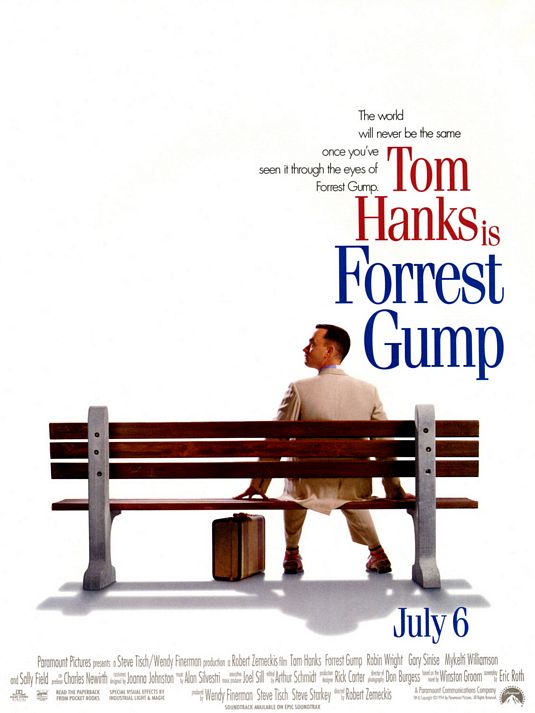
My 40 Favorite Films of the 90's - 14 - Forrest Gump (1994)

Forrest Gump (1994; Paramount Pictures)
Director: Robert Zemeckis
Writers: Eric Roth (Screenplay); Winston Groom (Novel)
Starring: Tom Hanks, Gary Sinise, Sally Field

Winston Groom’s tale of a mentally-disabled man who directly experienced almost every world-changing event in the later half of the 20th Century is a truly charming and heartfelt examination of spirit and love.  Widely considered one of the greatest films of all time, ranking #14 on IMDB’s top 250 at the time of this post, number 76 on the American Film Institute’s list of the 100 greatest American films of all time, and cleaning up in the 1995 Academy Awards with an astounding six wins, Forrest Gump is one of the essentials.  There are a few movies that I would recommend everyone see, and this is definitely one of them.

Tom Hanks plays Forrest Gump, a chatty man who patiently waits at a Savannah, GA bus stop just casually talking with his various benchmates.  He tells them tales of the things he’s done, the people he has met and the places he has been not knowing just how much of an impact he had on the lives of so many people.  Cutting back and forth from the story’s present time and flashbacks to various key moments in Forrest’s life, we see him meet presidents, fight in Vietnam, chat up John Lennon at a Black Panther Party meeting, and ultimately start a hugely-successful business, and he did all of this never knowing how great his achievements really were.

Along the way, as we explore Gump’s life, we meet a few people who will shape him.  His mother (Field) helps to ensure he lives as normal a life as possible and we watch as his childhood friend Jenny (Robin Wright) goes from a pretty tomboy to a broken and abused soul.  Gump’s lieutenant during his tour in Vietnam, Dan Taylor, leaves the war a crippled and angry man, embittered towards the so-called American dream.  We see Lieutenant Dan befriend the devoted Gump, despite occasional periods of frustration.  Then there is Bubba, a fellow recruit who is also slow, who becomes the titular protagonist’s best friend during his time in the Army, ultimately planting the seed of starting a hugely-successful shrimping business.  

Tom Hanks deservedly netted an Oscar for his performance of the kindhearted Gump.  Filled with shining moments of greatness, his performance is famously endearing.  The performances from the supporting cast including greats like Sally Field and Gary Sinise are stunning as well, and act as a great contrast to the unwitting Gump, reflecting the grievances and the disenfranchisement of the late 60’s and early 70’s.  Mykelti Williamson plays Bubba Blue with famous wit and a warmth that nearly matches Hank’s own Oscar-winning role, and every moment with the two on screen is either very funny, or extremely emotional.

Forrest Gump literally has everything.  It is a comedy, a drama, a war story, a romance, a period piece and a smart examination of the ideals and the passions that erupted during the Vietnam War era.  Despite literally trying to be everything, the film never misses a beat, always hitting just the right notes and crafting a very big, but cohesive story.  Ever since Citizen Kane there have been countless movies that have tried to weave a complex and intricate story around a single character through the years, but few have done it better than Forrest Gump.

Monday, July 21, 2014

My 40 Favorite Films of the 90's - 17 - Philadelphia (1993)

Philadelphia (1993; Tristar Pictures)
Director: Jonathan Demme
Writer: Ron Nyswaner
Starring: Tom Hanks, Denzel Washington, Jason Robards

I sat and thought carefully about how I would approach this film.  If you already know what Philadelphia is about, I’m sure one could understand how difficult this subject is, both on an emotional and (unfortunately) a political level.  That said…  Here we go:

By the late 80’s the AIDS scare was in full effect, with many people unsure how the disease operates, and despite educational material being out there, most people preferred to be afraid of the victim rather than the disease itself.  Much of this fear was founded in bigotry, as AIDS was originally considered an illness that only affected gay men.  Despite this being utterly untrue, the facts did not alter the stigma.  As we began to understand the disease HIV, and its progression into AIDS, things and attitudes began to change, but even by 1993, there was still a great deal of ignorance about the subject.

Philadelphia is the incredibly challenging and heartfelt story of an attorney named Andrew Beckett (Tom Hanks), a gay man who contracts the dreaded virus.  After his termination from his firm, which was claimed to be due to negligence, he concludes it was because of his own bosses’ ignorance and bigotry.  Beckett asks another attorney named Joe Miller to help him with his case, but is turned down as Miller is himself a homophobe.  Feeling alone and fearful, the young Beckett steadfastly begins to file his own case.  With support from his partner Miguel (Antonio Banderas) and his family, Beckett struggles with his future.  Ultimately, with guilt and empathy, Miller comes around and offers to represent the man.  This leads to a rough trial both in the courtroom and in the life of a horribly afflicted man.

Philadelphia is an emotional and complex exploration of the time and the fear and unfair prejudice surrounding the AIDS epidemic.  The associations of the characters reflect of a variety of feelings about the subject, discrimination and acceptance and the struggle of a man who becomes the center of a charged political melee.  Hanks won his first of two Academy Awards for his performance in this film, as only the third actor to be nominated for playing a gay character in a Hollywood film.  Philadelphia won other awards including a Golden Globe for best drama as well as a list other international statuettes.  

Philadelphia is a rough sit made even more emotional by its characters.  Tom Hanks gives an incredibly moving performance here.  In particular, during his scenes on the stand, which most likely netted him the Oscar win.  The years leading up to Philadelphia were marked with a few hits and a lot of misses for the now-lauded actor, who was mostly known for comedies.  Philadelphia was not Hanks’ first Oscar nomination as he was nominated for the 1988 classic Big, and he received critical acclaim for his performance in the touching drama Sleepless in Seattle.  However, despite his recognition before the release of Philadelphia, the film marked a turning point in Hanks’ career, where he began focusing on more dramatic performances almost exclusively, with a line of Oscar nominated movies after 1993.

Denzel Washington gives an excellent performance as well, strengthening his already established dramatic resume as an outsider’s point of relatability to the subject.  The ideas of others change as he changes from a bigoted man to one who befriends and begins to care about Beckett and his plight.  Washington was perfect for this role.  He has a strong voice, tremendous screen presence and has always been an excellent dramatic performer.  Here, however, I would argue he gives the best performance of his excellent career.  We see a transformation in Joe Miller through him, and throughout the movie, even when the character’s views are detestable, he has a charm that is instantly gripping, and as he warms to Beckett, we feel their bond growing.  The two actors have an admirable chemistry that works and paints a vivid picture of a man whose heart steadily changes over the course of the story.

These performances, along with just about every other aspect of the film, makes Philadelphia a must-watch classic.  It is one of the most celebrated films of the 90’s for good reason, it is a strong, heart-wrenching story told wonderfully through masterful performances.  Jonathan Demme, who won an Academy Award for his Oscar-sweeping 1992 film The Silence of the Lambs, was a perfect choice for this movie.  He uses an interesting device throughout the film showing us a number of scenes with actors appearing to break the fourth wall.  While this begins as a strange little idea that would likely take one out of the movie, instead, here it puts us in the shoes of the characters and as the film goes on, is used to show us the pain and fear of Andrew Beckett as he steadily deteriorates.  There is a love for these characters that we feel through Deme’s direction, which makes the movie that much more powerful.  When screenwriters and directors really care about the characters they are creating on screen, the viewer can certainly tell.  They feel like real people, and in Philadelphia, it is very, very easy to forget, from time to time, that despite the film being loosely based on a true story, is not real itself.  Philadelphia is easily one of the greatest, and most heartbreaking films ever made.

Saturday, July 19, 2014

My 40 Favorite Films of the 90's - 19 - Princess Mononoke (1997)

Princess Mononoke (1997; Studio Ghibli,
Miramax (U.S. Distributor))
Director: Hayao Miyazaki
Writer: Hayao Miyazaki
Starring: (Original Japanese Cast) Youji Matsuda, Yoriko Ishida; (English voice cast) Billy Crudup, Claire Danes

Anime is a modern type of filmmaking that spans many genres and ranges from quality dramas to silly romps.  Spanning decades in Japan and growing immensely in popularity in America in the late 90’s due to the domestication of series like Dragonball Z, Neon Genesis Evangelion and Cowboy Bebop, and with the help of movie releases like the cult classic Akira and the wondrous piece of fantasy Princess Mononoke or もののけ姫 (Mononoke-hime) in Japanese.  Written and directed by the Walt Disney of Japanese animation, and arguably the second greatest animation director in film history (after the great Disney, of course), Hayao Miyazaki, Mononoke is a fantasy that is powerful and brilliant in every way.

The story begins following a warrior name Ashitaka, who is cursed by a rogue boar that became possessed by a evil spirit.  When he returns home he is forced to exile so as not to curse the rest of his village.  He travels a great distance on the back of his companion, a “red elk” (that isn’t a freaking elk, by the way) named Yakui.  Hoping to find a cure for his ailment, he seeks aid from the spirits of the forest that guard the untouched natural landscape from the fires of man, in particular those coming from the nearby forge fortress of Irontown.  Run by a headstrong matron named Lady Eboshi (Minnie Driver), who rescued many of her working girls from the cities’ brothels to help forge more powerful weapons, the town awaits the return of its men and readies itself for war against the animal spirits.  When the town is attacked by a nimble and fearless girl named Mononoke, who refuses to identify herself as human as she grew up with the guardian wolves in the nearby forest, Ashitaka rescues her from her fate but is wounded in the process.  Nursed back to health by the wolf girl, the young warrior is now caught in the middle of a war between his fellow man, and the spirits of nature that could cure him of his curse.

Typically, the man versus nature theme is done very, very poorly.  This is especially the case when the story has a shoehorned, heavy-handed environmental message in it.  Films like Avatar always came off to me as more PSA than film, especially since that movie in-particular is just several hours of Cameron telling everyone how “awesome” he is.  However, Mononoke actually shows us the struggle of violence against nature and puts us in the shoes of the creatures and lives destroyed by man’s lust for power.  Mononoke herself is a direct contrast to Eboshi. The titular heroine is gruff, strong and devoted to her forest family, while Eboshi is arrogant, beautiful and willing to sacrifice her own people to get what she wants.  The most interesting thing about this contrast is how the characters are introduced.  When we first meet Eboshi, it is a natural assumption to assume she is good, while Mononoke, clad in furs and a wooden mask, wields a dagger and slashes and dives at the frightened villagers.  

Princess Mononoke plays with expectations, and is actually, and surprisingly, not bound by too many cliches, despite the obvious references to Burroughs’ Tarzan novels as well as a number of other man-vs.-nature stories.  It is an inspired story that is both empowering and heartbreaking.  We see the once-mighty spirits stumbling and bleeding from the powerful weapons of the humans of Irontown.  They are prophets of their own doom, so willing to give in to their collective fate.  We see that nature becomes helpless against man’s rage unless some are willing to help fight with and for it.

Like all of Miyazaki’s writings, this film has touches of Japanese folklore and spiritualism in it as well, and the cultural elements of his movies are often some of the of most fascinating parts.  Environmental themes aside, this is a great allegory to growing into one’s self, overcoming the past and accepting who you really are.  It pulls you into the world and shows you the pain each character is feeling without being emotionally-manipulative, instead it relies on one’s own empathy to truly relate to and understand what these characters are going through.  What is even a greater testament to the complexity of this film: I did not even scratch the surface in terms of plot.  There is a lot going on here that tie the emotional elements and themes of the film together better than most that have tried have been able to do in narratives past.  Miyazaki created a masterwork here, and it is widely regarded as one of the greatest animated films of all time.  It earned this title, as Princess Mononoke is a deep, engaging masterpiece, and even though it is only my second favorite film of Miyazaki’s (Spirited Away is my #1), it is certainly high among the greatest animated features in the history of movies.

Friday, July 18, 2014

My 40 Favorite Films of the 90's - 22 - Seven (1995)

Seven (1995; New Line Cinema)
Director: David Fincher
Writer: Andrew Kevin Walker
Starring: Morgan Freeman, Brad Pitt, Kevin Spacey

I have already featured two of Fincher’s films on my top 40.  He is a talented director with a standout voice.  After heading his first feature, Alien 3, in ‘92, this music video director needed a challenge.  Seven was a pretty obvious screenplay, taking the episodic structure of “this many of this thing is going to happen over this period of time”, giving a moody, grim and violent tone and putting two opposing styles of detection in the same room together to solve the case.  From the screenplay, you would think there was not an original idea in there.  However, this is no ordinary procedural.  Seven is more than a crime thriller, it is a study in the psychology of a killer, and as a movie, it is an examination of how subtle techniques in filmmaking paint a deeper image of the story that you may not even know you are seeing.  It delves into the mind of the villain long before we see or even hear him, and we can almost see his face in every scene leading up to the character’s introduction.

When an attorney is found facedown in a bowl of spaghetti, force-fed to death, a series of other strange crimes begin to occur, each one tagged with one of the Seven Deadly Sins, as taught in Catholic literature and explored in classical writings like The Divine Comedy and Paradise Lost., of which the killer deemed them guilty.  Morgan Freeman plays Det. Somerset, a soon-to-be-retired veteran who is known for his “over-analysis”.  He is tagged to show his replacement the ropes, and it turns out he is to be succeeded by an overzealous and occasionally petulant younger detective named Mills (Pitt).  Initially unwilling to take the case as he felt it would never end, Somerset is stuck trying to solve the murders as Mills and his wife slowly begin to break Somerset’s tough exterior.  However, this is a crime with a counter, and the killer will not give up until at least seven souls are punished for their sins.

Like so many of Fincher’s films, Seven has a great ending.  It is a film that actively involves the viewer, drawing them into the events as they unfold.  Concentrating makes you feel the tension and stress of each scene.  An air of dread fills every room, hall and street as Fincher plays games with your brain by choosing very specific levels of lighting and ambiance to match each moment in the script.  Every line of dialogue matters, every drop of rain is deliberate and the moments of slow dialogue bring some of the ambiance to a haunting silence, as though you did not notice it until it was gone.  All of Fincher’s subtleties executed here make Seven a stunning example of filmmaking.  Aside from it being a good movie, it is a good point of study for the psychology of film, in how sights and sounds effect the audience.  In a way, a movie hypnotizes you into feeling or thinking a certain way about a character, and the more subtle, the better.  Seven is on my list, not only because I think it is an excellent thriller, but also because it is an exceptional exercise in suggestion from a master of his craft.

My 40 Favorite Films of the 90's - 23 - Barton Fink (1991)

Director: Joel Coen

Writers: Joel and Ethan Coen
Starring: John Turturro, John Goodman

The fourth film from the acclaimed Coen Brothers is a masterfully-complex, harrowing, slow burn (literally) of a black comedy.  The movie centers on the titular upstart playwright who is commissioned to write a screenplay for a B-grade Hollywood picture.  Despite being somewhat uncomfortable with the proposition, he travels from New York to Hollywood and checks into a dreary hotel.  The room is hot, dank, grim and he is unable to sleep due to the endless racket from his neighboring tenants.  As he struggles to even begin writing an outline, Fink is befriended by his neighbor Charlie, a noisy but friendly man whom he takes an immediately liking to.  As he continues to overcome the crippling frustration of writers’ block, Fink runs into conflict with an agent and a producer as well as a writer he looks up to, who is constantly protected by his seemingly-imprisoned wife.  Things eventually go haywire, however, as a shocking series of events unravels Finks idea of what Hollywood really is.

As the movie goes on, the film seems somewhat disjointed, and this is the problem I have with Barton Fink: It is damn hard to write about.  Anyone can write a short synopsis, but the film is a very detailed and intricate series of visual ideas and queues and, probably most essential, sounds.  Every sound in the movie reflects an image shown then or in a different scene, and much of it is so subtle as to be subconscious, as the sounds we hear trigger memories of moments we may or may not even really remember.  Every sound in the film helps paint a picture and while this is always the case with movies, Barton Fink’s sound, mixed with its eerie production design (the sets, setting, scene layout, ect.) create a moody tone that is intensified by the very dark contrast and saturation used in the hotel scenes.

One thing that makes this one difficult to really summarize is it is hard for me to really convey the plot without spoiling anything.  I used the word “disjointed”, and I mean that as a positive.  Barton Fink arrives in Hollywood an outsider.  He is intimidated by seemingly everyone, from the fast-talking, energetic Bellhop named “Chet!”, to the imposing figures of the film industry, who have sudden bipolar changes from excitement to anger in what seems like a single, jarring second.  We explore this strange world through Fink’s own experiences, and everything seems insurmountable.  Therefore, the events that dominate the third act of the film cannot be truly discussed without ruining the movie.  It would be like visiting a fortune teller to find out every detail of your next day.  Nothing would be a surprise.

Barton Fink is a “put yourself in his shoes” sort of film and that can only work if the direction and acting is just right.  The Coen Brothers have a long history of masterful films, from the chilling Blood Simple, to the cult classic The Big Lebowski, to the tense and powerful No Country For Old Men.  So, even though I only listed a few of their titles, it is easy to see why these two filmmakers are considered to some of the best (of not the best) filmmakers of their generation.  In their more-than-capable hands, John Turturro gives one of his best performances in his storied career.  He is an actor who dominated in some of the best films of the 90’s, but has, in recent years, fallen victim to dreadful blockbusters and moronic comedies, which has caused somewhat of a slump, despite steady work.  John Goodman, like Turturro, has a strong career spanning the last twenty-five years or so.  Starting in the 80’s as a bit and character actor before moving on to the super-hit TV series Roseanne (which lasted nearly a decade, a lifetime in sitcom-years).  Goodman became a household name by the early 90’s and during his time on the Award-winning show, he appeared in number of successes, and some of his performances stand out significantly, in-particular those he did with the Brothers Coen.  These are just three people involved in this complex movie which also features supporting performances from the likes of character actor Michael Lerner, Judy Davis, Steven Buscemi and Tony Shalhoub, just to name a few.  Ultimately, Barton Fink has the names, the brains, and the mood that makes for one hell of a climax.  If you have not see this movie, do yourself a favor: Watch it.

Friday, July 11, 2014

My 40 Favorite Films of the 90's - 25 - Fear and Loathing in Las Vegas (1998)

NOTE: I apologize for my absence, life and sickness have made it difficult for me to focus or even get motivated to write anything.  Hopefully I can pick up the pace here some.  Also, a lot, if not most, of the coming articles in this series will be much shorter than the last fifteen because I am so far behind.

Fear and Loathing in Las Vegas (1998;
Summit Entertainment & Universal Pictures)
Director: Terry Gilliam
Writers: Hunter S. Thompson (Book), Terry Gilliam, Tony Grisoni, Tod Davies, Alex Cox
Starring: Johnny Depp, Benicio Del Toro


When Hunter S. Thompson decides to write an indictment of society’s ills, he does it through his own experiences.  Drugs, travel, paranoia, success and failure all present themselves in Fear and Loathing in Las Vegas, a film adaptation of a seemingly unadaptable story.  Hunter S. Thompson writes himself under the pseudonym Raoul Duke as he travels across the American Southwest towards Las Vegas on the dime of Sports Illustrated as he is commissioned to cover a racing event in Sin City.  However, he and his attorney Dr. Gonzo (a slightly-fictionalized version of real-life attorney and public figure Oscar Zeta Acosta) are constantly sidetracked due to their rapid and excessive abuse of a hodgepodge of mind-altering substances.


On the surface, Fear and Loathing seems like a disjointed, meaningless, drug-fueled romp through Vegas, however, it is much more than that.  Upon its release, many mainstream film critics dismissed it as a “mess” and disputed its value thereby missing the point entirely.  The reality is, this is a film where it is almost required to understand the backstory to get the real gist of what is going on.  It is unfortunate, and normally I would knock off points for requiring supplementary materials, but this makes perfect sense.  If we were given thirty minutes of setup for this movie we would be disconnected from Thompson’s own perspective of the events that were occurring, which is 100% essential to the films’ quality.  The real backstory is complex but the long-and-short of it is, in real life Thompson was hired by SI, just like in the book, but the magazine rejected his novel on grounds of being “out there” and therefore he responded with this story, which is a cursory glance at the reality of Americana told from the perspective of an outsider who rejected the ideals of this fictionalized way of life.  The anti-establishment ideas in the film come across in some subtle (and some not-so-subtle) moments in the film, but it is never outwardly given to us in any form of narration or exposition with the exception of a few passing lines.  Thus, the film is difficult to digest for those who do not fully understand its origins.

Myself being somewhat of an outsider to both the world of Americana and the drug-driven anti-establishment movement of the 60’s and 70’s, I look at the film as an opposing voice to the “way things should be” as sold to us by our “leaders” and a shocking glimpse into the mind of the conflicted and disenfranchised.  It has always been a fascinating movie to me, as it is worthy of hours of dissection, discussion and debate and is still analyzed to this day.  Bad movies generally do not get this honor, so that can only mean that Fear and Loathing means a lot to a lot of people, and, at least in my view, has ascended above what some would consider “cult status”.

Wednesday, May 14, 2014

My 40 Favorite Films of the 90's - 26 - Toy Story (1995)

Toy Story (1995; Walt Disney/Pixar Studios)
Director: John Lasseter
Writers: John Lasseter, Joe Ranft, Andrew Stanton, Joss Whedon, Joel Cohen, Alec Sokolov
Starring: Tom Hanks, Tim Allen

In July of 1928, Steamboat Willie became the first “talkie”, with a full spoken audio track playing over an animated short film.  It was a landmark achievement in filmmaking from an idealistic young director named Walt Disney.  A decade later, Snow White and the Seven Dwarfs became the first feature-length animated film and set the standard for the art of animation in its time.  Walt did much more for filmmaking than adapting classic fairy tales and building theme parks, though.  He designed and engineered the multiplane camera, allowing for the effect of perspective and depth in 2D animated films and was responsible for implementing many new forms of editing and effects that would revolutionize the way we look at the art of movies.

By the 70’s, however, Disney, as a company, was at an all-time low in terms of morale and success.  When Walt Disney died from cancer in 1966, the studio had a hard time keeping up the pace and begin producing fewer and fewer successes until the late 80’s saw the Disney Renaissance, a period of massive growth for Disney as a company.  In 1994, Disney gave us The Lion King, a massive achievement in filmmaking, and a year later, a small group of animators introduced the world to the first feature-length computer animated film: Toy Story.

Toy Story is an incredibly simple, timeless story told very, very well.  It follows the secret lives of toys when their owner, a boy named Andy, is not around.  They have a hierarchical ruling structure based on how much Andy loves them, with Woody (Voice of Tom Hanks), a pull-string talking cowboy, being the favorite and thus, the leader.  On Andy’s birthday he is given the next big toy, an electronic space hero named Buzz Lightyear.  Immediately Woody feels cast aside as Buzz appears to become Andy’s favorite new toy.  The only problem is, Buzz does not believe he is a toy, and thinks he is a real interstellar action hero.  Over time, Woody becomes so angry and envious of Buzz, that at one point he is accused by the other toys of killing Buzz when the space hero disappears.  This forces Woody to take action to find Buzz and prove his innocence, the two becoming friends in the process.  The film takes several turns in the story, with one surprisingly dark subplot involving a toy-torturing, truly messed-up kid who temporarily gains possession of Buzz and Woody.

Toy Story is a tale of unlikely friendship told through the a technology that was, at the time, still very new to general audiences.  Computer animation had been around for well over a decade but it was always very shallow-looking.  Bright colors and blocky figures dominated the artform, so imagine audiences’ collective surprise when Toy Story featured fully-animated characters in highly-detailed scenes.  It was a shock to most people, and it put Pixar near the top of the animation totem pole, right up there with Walt Disney Studios (a separate entity from Pixar) and Studio Ghibli.  The characters are interesting and relatable without being too cliched, the voice performances are all top-notch and art is still astounding by today’s standards, even after we spent years sitting through one mediocre CGI-fest after another, with the medium no longer being novel, just boring.  Toy Story is a reflection on a time when talented filmmakers were still very excited about a new art-form, and the potential of this new style of animation was still on the horizon.

NOTE: I would also point out that this was an early major screenwriting project for fan-favorite filmmaker Joss Whedon, so there's that, too!

Sunday, May 4, 2014

My 40 Favorite Films of the 90's - 28 - Rushmore (1998)

Director: Wes Anderson
Writers: Wes Anderson, Owen Wilson
Starring: Jason Schwartzman, Bill Murray

Wes Anderson makes his first appearance on my list with his 1998 film Rushmore.  This is Anderson’s second feature film and the first one he did to really get promotion, thanks to a more recognizable cast and a higher-profile marketing campaign.  Rushmore is a strange film, as is typical for Anderson, only, it is strange in a proper way.  I will go more into Anderson’s style of filmmaking later but suffice it to say for now, if you have not seen a film by Wes Anderson, then  you have not really seen anything like it.

Rushmore is the story of a super-intelligent teenager named Max Fisher (Schwartzman) who has a great deal of influence at an exclusive private academy called Rushmore.  He is followed by his much younger protege who more or less acts as his secretary as he heads and organizes a bevy of time-consuming clubs.  As a result of his devotion to extra-curricular activities, Max’s grades are suffering and he finds himself at odds with the headmaster, who places him on academic probation.  Meanwhile, a beautiful young teacher named Ms. Cross becomes the target of Max’s affection, a crush that comes between him and his much older friend named Herman Blum (Murray), when she and Blum begin dating.  The plot shifts to focus primarily on Fisher and Blum’s fight over Ms. Cross, which increases in desperation.

If the synopsis seems a little broad, that would be because it is a Wes Anderson film.  Anderson’s stories are usually a series of layered plots that are intermingled with the film never focusing firmly on just one for too long.  There is enough of an underlying focus for the story for there to actually be a movie, but it never becomes the center of the film, it is just there to tie together the various other subplots.  Rushmore is a constant stream of sight gags and an odd awkwardness that may come off as ineptitude, until you actually watch the entire film.  The strange pauses, fourth-wall-breaking montages and tone throughout the film all add up to a strange experience, but a funny one.  Chances are, however, that if you do not like one Wes Anderson movie, you will probably dislike all of them, with the one exception of the more recent Moonrise Kingdom, which was an excellent movie, and a definite evolution for Anderson as a filmmaker.  

Rushmore is a funny, slightly disjointed and unhinged movie about teenage awkwardness and social standing and it challenges norms of filmmaking in just about every scene.  Anderson has made it part of his style to break the established “rules” of direction, and what comes of it is both a funny film, and a unique artistic idea.  All of his movies have a distinct palette as well, which further add to their identity.  Anderson makes a distinct sharp yellow the chromatic focus of every scene, with browns and soft greens becoming compliments.  These earth-tones are then contrasted with foreground elements like Max’s bright red beret.  Another interesting trademark of Anderson is how he makes certain performances stand out in scenes by have them follow slightly more subdued acting from other lead characters.  This makes some more dramatic scenes seem louder than they really are, giving the illusion of a heightened series of events, without ever breaking the sardonic feel of the movie.

Tuesday, April 29, 2014

My 40 Favorite Films of the 90's - 29 - Trainspotting (1996)

Trainspotting (1996; Channel Four Films)
Director: Danny Boyle
Writers: John Hodge
Starring: Ewan McGregor, Jonny Lee Miller, Robert Carlyle

My number 29 is the film that was voted by the UK public as the greatest Scottish film of all time, Trainspotting.  An examination of the lives of a group of twenty-somethings living in poverty in late-80’s Edinburgh and their constant struggle with heroin addiction, Danny Boyle’s award-winning film is a smart and occasionally horrifying melodrama.  This is easily one of my favorite films based on the theme of drugs and drug abuse as it has one of the best tonal shifts of any film I’ve ever seen.

The film primarily centers on Renton (McGregor), who narrates the film and expresses his thoughts on shooting up and coming down, as well as his inner-struggle about getting clean.  The film starts off with a funny series of narrations that run down why he and his friends do the things they do.  Unlike many other characters we see in movies, Renton is represented as loving heroin.  We hear from him the details of the high and the way it is narrated it seems almost as though the film is trying to sell the drug to its audience.  However, about halfway through the film the events take a dark turn and things get more than a little out of control.

Trainspotting is funny, but also very, very dark.  There is violence, tragedy and consequence, however the film never feels preachy.  Danny Boyle shows us some of Renton’s hallucinations that come in escapism, but also come in the form of terrifying torment as his family executes a harsh plan to force Renton to clean up, keeping him in a room as he is left to go cold turkey, a truly painful and awful experience.  As Renton writhes, sweats and screams, we see it and feel it with him thanks to Boyle’s masterful use of camera work and his flawless execution one of the most horrific scenes in film history.  I will not ruin it, though, as Trainspotting is a must-see.

Danny Boyle went on to direct the awesome 28 Days Later and was shortly-thereafter acknowledged by the Academy for his film Slumdog Millionaire.  Trainspotting is a film that looks very good, while also being occasionally unwatchable.  It is graphic, gruesome and disturbing but is never gratuitous.  Every scene has meaning to the plot, as Renton and his friends struggle with moving on from their addictions, but the drugs always seem to win.  It is tragic and smart.  It is neither a pro-drug comedy or an anti-drug propaganda film.  Instead Boyle just shows us these characters’ respective realities, as grim as they may be.

Saturday, April 26, 2014

My 40 Favorite Films of the 90's - 35 - L.A. Confidential (1997)

L.A. Confidential (1997; Warner Bros.)
Director: Curtis Hanson
Writers: Brian Helgeland,  Curtis Hanson
Starring: Guy Pearce, Russell Crowe, Kevin Spacey, Danny DeVito, Kim Basinger


Curtis Hanson’s film adaptation of James Ellroy’s novel is an exploration of politics and corruption in the Los Angeles Police Department in the 1950’s.  Focusing on the investigation of a multiple homicide at a diner, the story reveals the investigation of this brutal crime from four perspectives: A sleazy tabloid writer and his LAPD celebrity detective ally, a crooked cop, and a young idealist.  The murders seem to lead in many different directions including a group of teens who abducted an Hispanic girl, a corrupt cop’s illicit dealings and a brothel specializing in celebrity lookalikes.  


Putting a simple label on the plot of L.A. Confidential, I would say it is a study of how corruption leaves death in its wake as it corrupts as many as it can in its path.  It shows us how the few corrupted by power can bleed everyone beneath them for more of that power and how even the most just men can be seduced by the promise of a medal, a photo-op and a prestigious label.  However, the story is much more complex than a simple few sentences can describe.


The interweaving stories are set into motion after a detective named Dick Stensland is identified as a victim in the dining shooting.  Edmund Exley (Guy Pearce) is a young cop who wants to keep the investigation on the up and up, but he is constantly in conflict with the violent and trigger happy Bud White (Russell Crowe), Stensland’s former partner.  White finds himself caught up in a part of the investigation leading to an illicit escort service through a romance with a call girl named Lynn (Kim Basinger).  A media-hungry celebrity cop named Jack Vincennes (Kevin Spacey) uses his considerable connections to pull his weight in uncovering who was truly behind the killings.  Misdirections and dead ends abound in the investigation, as the officers are constantly deceived by everyone, including people in their own department.  Ultimately, the investigation leads to answers that get Exley and White in deeper than they had ever expected.


The film benefits from a considerable supporting cast including Danny DeVito, David Strathairn,  James Cromwell, Matt McCoy and Ron Rifkin and while it does tend to meander about quite a bit, it has a solid screenplay.  The branching plotlines tend to veer a little too much at times and there are way too many characters, many of which ultimately have little-to-nothing to do with the actual plot.  Obviously attempting a film Noir style, L.A. Confidential misses many of the key elements of Noir.  The narration is told to us through the perspective of tabloid writer Sid Hudgens, who is not directly involved with any but one of the major characters, so we are not able to get the traditional Film Noir introspection on first impressions of characters and events.  In fact, of the numerous characters in the film, there are several that could have made a better narrator than Hudgens and there would have still been issues with perspective.  

Needless to say, L.A. Confidential is not a perfect film.  It is an entertaining movie though, full of elements you would expect from a mid-20th century mystery film but with much more sex, drugs and violence thrown in the mix.  It has a rough edge to it that makes it cast a shadow over the idealized 1950’s of classic cinema and the performances of Pearce, Spacey and Crowe make up for any plot detours and slow pacing.  It is a solid procedural piece told with an aggressive style and lot of polish.  

Thursday, April 24, 2014

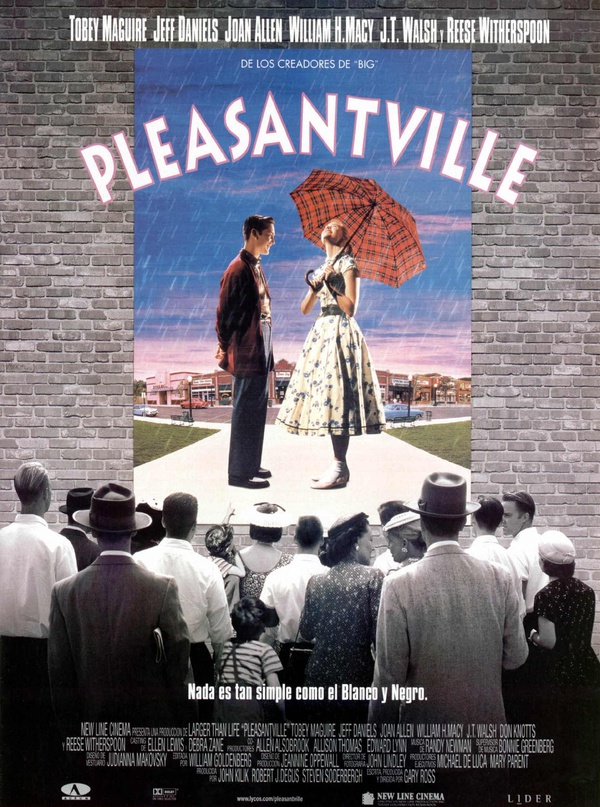
My 40 Favorite Films of the 90's - 38 - Pleasantville (1998)

Pleasantville (1998); New Line Cinema
Driector: Gary Ross
Writer: Gary Ross
Starring: Tobey Maguire, Reese Witherspoon, William H. Macy, Jeff Daniels, Joan Allen

Americana: The mid-20th Century ideal of white, upper-middle class families in the United States.  You have a husband, a wife, two perfect kids, a dog, a picket fence, a promotion always right around the corner and a feast on the table whenever the husband gets home from work.  There was no bigger advertisement for this Perfect LifeTM than television in the 50’s and 60’s.  The reality of the times, however, did not reflect the escapism of the world we were being sold.  Segregation and discrimination of blacks in America was prevalent, women’s rights were a relatively-new concept that was still not fully embraced, and the Cuban Missile Crisis and news reports of looming death by atomic fire had the Eastern Seaboard cowering in their collective basements.  It was a time of unrest and fear cloaked in a veil of idealism and propaganda.  So, what better way to expose and explore these ideals versus the reality than through a stark contrast?

Pleasantville was the directorial debut of Gary Ross, who specializes in social commentary with his films, the most recent being the successful 2012 film, the Hunger Games.  It is an exploration of the darker side of society as told through the perspective of a few characters living in a once-utopian world.  David is a modern-day American teenager with an obsession for pop-culture.  In-particular, he finds himself lost in escapism while watching his favorite 1950’s television series, Pleasantville: An Ozzie and Harriet nightmare of successful white American perfection.  Long awaiting a marathon of the series, David clashes with his sister Jennifer over possession of the TV after she lands an at-home date with a popular guy from school.  Their struggle leads to the inadvertent destruction of the remote, which (by means of contrivance) renders the television unusable.  So, a mysterious TV repairman (played by the Andy Griffith Show’s Don Knotts in a perfect cameo) arrives with a replacement remote, seemingly out of nowhere.  When the two begin fighting over this new remote the same as the last, they find themselves sucked into Pleasantville through their TV.  Yep.  It is one of THOSE!

Only, unlike other fantasy films of its ilk, Pleasantville actually does something clever with its premise.  Shocking, right?!  After arriving, the two find they have taken over the bodies of the two lead teenagers from the show, Bud and Mary Sue (I love her name here).  They aren’t themselves, they are living the lives of the characters in the show.  However, they remain conscious of their own personalities at the same time, aware of their predicament.  So, they are trapped in a reality that is both familiar and foreign at the same time.  David uses his extensive knowledge of the show, its characters and events to survive and aid his sister in making it out of this prison they’ve created after they find that they are trapped there for at least one week.  

Over the course of the film, Mary Sue and Bud’s modern influences and instincts take over, however, and as a result, they being to alter things.  As ideas that were absent from Pleasantville, like art, literature, king-sized beds, sex and even the outside world are introduced to the unaware fictional characters, things begin to change.  Surroundings and eventually people start appearing in color, and this disturbs the town committee.  After Bud and Mary Sue’s mother finds herself in color, while their father remains in black-and-white, a conflict emerges within their own family.  Ultimately, these changes result in the town banning the new introductions and eventually leads to widespread prejudice against the characters that find themselves in color.  Destruction of art, book burnings, and other acts of violence break out, and the once-perfect world of Pleasantville becomes a reflection of modern, post war America.  

Needless to say, I love this movie.  It takes a smart idea and actually makes it work.  The concept of being sucked into a fictional world was not new at this point, it was just never done particularly well.  The only exception being the personal affection I have for a small 90’s comedy called Stay Tuned, in which a married couple find themselves in Hell, only Hell is a series of increasingly-sadistic television shows (Think, UHF as written by Charles Manson).  However, Pleasantville executes this overused premise originally and cleverly, creating an allegorical commentary on society and how we perceive ourselves and others.  It is about racism, acceptance, sex, romance, censorship, and the furthering of one’s self.  It is a surprisingly-intellectual study given its premise and its predecessors, executed nearly flawlessly.  

A lot of credit goes to Pleasantville’s excellent cast.  This film is a Who’s Who of character actors including Joan Allen, William H. Macy, J. T. Walsh and Jeff Daniels.  Tobey Maguire gives the best performance of his career, Reese Witherspoon is energetic and funny and they both play off each other quite well.  There is even a very solid performance from the late Paul Walker, who shows early promise as a charming-yet-derpy jock. The acting as a whole is good, right down to a scene in City Hall where David (as Bud) gives a speech about tolerance which is an obvious throwback to Gregory Peck’s legendary monologue as Atticus Finch in To Kill a Mockingbird.  Everything works here, from the references to sitcom cliches to the social commentary thanks to a smart and funny screenplay and the way the film is directed.

This leads me to the production design and effects.  Holy crap is this movie gorgeous.  Even if one does not get all of the more complex ideas of the film, it is undeniable that this movie is a visual work of art.  The black and white creates a very traditional contrast and as things fill with color, such as a bright red apple hanging from a gray tree, and a pink dress against a colorless backdrop, it makes for a vivid and beautiful series of scenes.  This is a breathtaking movie that can and should be enjoyed by most audiences.  It was a success and most movie fans adore it, but if you have not seen this one, it should be a priority “must see”.

Wednesday, April 23, 2014

My 40 Favorite Films of the 90's - 40 - Audition (1999)

Audition: 1999; Basara Pictures
Director: Takashi Miike
Writer: Daisuke Tengan
Starring: Ryo Ishibashi, Eihi Shiina

Kicking off this list of my 40 favorite movies from the 90's is one of the hardest sits of my life.  I watched Audition shortly after its release and was disturbed, disgusted, shocked and yet I loved every minute of it.  I will not hold back in saying that Audition is easily one of the most disturbing films ever made as director Takashi Miike is a master of sensory filmmaking and with films like Gozu and the Happiness of the Katakuris he blends different visual and tonal ideas, all having a certain visceral feel to them.  Audition is built upon a very simple, yet structural, use of tension and as it grows and grows the events in the movie become even more disturbing, revealing one of the most hard-to-watch final acts of any film I have ever seen.  

The plot follows a widower named Shigeru (Ishibashi) who is convinced by his brother to hold a fake audition for musicians, with the true intention being to find a new wife for the lonely man.  The one perfect girl, Asami (Shiina), seems so beautiful and so sweet to Shigeru and we get the same impressions of her from the start.  However, this expectation is promptly crushed as the film progresses and, at the start of the 2nd act, we finally get a glimpse into just how disturbed she really is.  The conclusion of this film is a prolonged, slow and quiet torture scene, where we can hear and even feel the acupuncture needles going behind the eyes and the piano-wire sawing Shigeru's feet off.  It is all done in graphic detail and with a shocking level of intimacy, especially in the sound production, which is some of the best in the horror genre.  Every sinew, every severed vein, ever prick and prod is heard over a deafening silence, otherwise only broken by a heavily-drugged and nearly-paralyzed Shigeru’s stifled cries of pain and Asami’s gleeful yet eerily-soft singing.

Now, despite its disturbing premise and final scenes, Audition is a beautiful film.  It is all very soft and delicate, with lots of close shots and lingering scenes that do not feel dragged out, instead they all add to the boiling pot.  There are a few scenes in particular that are framed just beautifully.  Long shots down a dark hallway lit in the foreground by a soft blue fluorescent light, and beautifully-framed scenes of silhouette and interior scenery that are surprisingly not boring.  Miike is very good at visual tone, and he uses the cold, sterile fluorescent lights of Shigeru's life to contrast with the warmer golden of Asami’s.  It is meant, I believe, to be a siren’s song for the audience, as though she can bring warmth and color to his world again.  We know in the end, however that this will not happen.