Chitika Ad

Showing posts with label drama. Show all posts

Wednesday, March 18, 2015

"Know" More Culture - The Way ‘The Day the Clown Cried’ Died

Jerry Lewis in 'The Day the Clown Cried' (1972;
src: notrecinema.com)
It was the 1970’s.  One-time A-lister Jerry Lewis was working in various capacities in Hollywood but really wanted to leave his mark, and the tone and style of film was changing rapidly, more or less leaving him behind.  Screenwriters Joan O’Brien and Charles Denton finished their script for the Day the Clown Cried and Lewis was approached to play the lead.  He was apprehensive to say the least.  Mostly known for screwball humor, Lewis feared he just wasn’t the right person for this sort of role.  Yet, ultimately, he came to the conclusion that it is an opportunity to star in something truly meaningful, and took up the reins as the lead character, the doomed clown named “Karl Schmidt”.

The film’s story is pretty straightforward.  Set during the start of the Holocaust, a clown who was once a top performer at a major circus falls hard after a career slump.  One day after being arrested by the Gestapo for mocking Hitler, he finds himself in a work camp.  At the lowest point in his life, during a chance encounter with some child prisoners, he realizes that he may still be able to at least bring joy to these young kids.  Performing the best he can, the broken man is heartened by the reactions of his young audience.  However, the Nazi leaders at the camp are not too thrilled by his bringing of joy and force him to be separated.  Ultimately, after he continues to defy their orders, he is commanded by pain of death to rally and escort the children to a train headed to the notorious death camp Auschwitz, but after a mistake finds he, himself, trapped in one of the cars, he is forced to accept fate.  Ultimately he is tasked with leading the children into the “showers”, and the film ends with him entertaining the children one last time before fading out.  Their fate was sealed.  

Doesn’t that sound like fun?!  No.  This was the reaction of just about everyone who saw the film during its limited screenings in 1972.  The film was described in the nicest terms as “misguided” and “confused” and at worst “a catastrophe”.  The question is, what really happened?  Well, Lewis himself had always been rather secretive about the project, but other sources indicate that during filming and post, he took over as director and began making a plethora of changes to the script to make the lead character more sympathetic.  The clown was meant to have a redemption arc, but instead he was written as a man who was simply broken and needed that last moment of inspiration to feel redeemed, as opposed to being a complete dirtbag at the start.  On top of that, Lewis attempted to inject more of his personality into the character.  He renamed the protagonist to Helmut Doork and added several moments of schtick to the screenplay.  The days leading up the film’s initial screenings led Lewis to believe he was making something important, and his notorious arrogance shined through, not only during the production but during the pitches and press bytes.  The movie showed, and his time as a leading man was marked as “over”.  Sure, Lewis continued performing, but this movie was a demarcation point in his career.  To this day, with all of his legacy aside, The Day the Clown Cried is the single piece of ephemera that has boundlessly captivated film historians, students and fans.

Becoming something of a legend these days, The Day the Clown Cried has been the subject of discussions in terms of remakes, documentaries and just plain fascination in Hollywood for over twenty years.  A number of performers, including Robin Williams, have been considered for a remake, adapting the film’s original screenplay, but nothing ever came about.  This movie has such a legendary stigma to it that it has become somewhat untouchable, while at the same time remaining a holy grail among cinema fanatics.  It’s very, very difficult to find footage of the movie and very few people have actually seen it in its entirety, in its original cut.  Every few years or so, footage of the film will leak onto the Internet but will often be removed.  This is largely due to the fact that the only official print of the movie is in Lewis’ own possession, as he continues to demand the film never be released or seen by anyone.  It has also been tied up in litigation for decades, with various involved parties fighting over control of the finished product, but the stalwart Lewis has never stopped fighting to prevent it from coming to light.  

By all accounts, the lore and history behind the Day the Clown Cried is far more captivating than the film itself.  I’ve only seen glimpses of the finished product, getting the rest of my knowledge of the plot from various sources online.  From what I saw, it’s a dreary and honestly kind of ugly film visually, with very low-lighting and lots of walls and backdrops that are dirty or aged.  The scenes I’ve seen that are a little brighter looking are overshadowed by the film’s tone.  It doesn’t help going in knowing what the movie is actually about.  All of the fluff at the start seems that much more meaningless.  

I have always wondered what the ultimate intention was for The Day the Clown Cried.  I am of the mind that any story can be told, and any story told well, no matter what the subject, can be appreciated.  However, from all I’ve heard, this is one big hot mess.  Any time footage leaks onto the Internet, there is a brief period of buzz followed by a sudden silence.  Almost as though everyone who was ever excited about seeing it actually really regrets their decision afterward. 

Tuesday, March 3, 2015

My 40 Favorite Films of the 90's - 1 - The Shawshank Redemption (1994)

The Shawshank Redemption (1994;
Castle Rock Entertainment)
Director: Frank Darabont
Writers: Frank Darabont screenplay adapted from the short story by Stephen King
Starring: Tim Robbins, Morgan Freeman, Bob Gunton, Clancy Brown

Here it is.  After all this time, all the delays, everything… I’m here.  The Shawshank Redemption is my favorite film of all time.  I have a few reasons for this.  First, this movie came out when I was still pretty young, and I saw it for the first time at thirteen (I think).  It changed the way I saw movies forever.  It was the first real drama that I ever fell in love with, and after seeing it I needed to see more.  I was inspired to seek out all the movies I had heard about but never saw because they weren’t action or comedy movies, and it opened up an entirely new world for me.  Aside from the very personal influence this had on me as a film fan, it is objectively a great, great movie.  It was nominated for numerous Oscars but did not take home any statuettes, but then again, it was the 1995 Academy Awards, where it was up against the likes of Forrest Gump, Quiz Show and Pulp Fiction.  That is some stiff, STIFF competition.

The film follows a banker named Andy Dufresne who is convicted of murdering his wife and her supposed lover and sentenced to life within the dreary stone walls of Shawshank Prison.  There he befriends a slick smuggler named Red who begins to guide him and help him adjust to the reality that faces him.  However, Andy refuses to embrace his fate, taking every opportunity to remind his fellow inmates that there is hope beyond the prison’s walls.  He enters the corrupt prison and changes the lives of everyone there by simply refusing to let go of hope.

The Shawshank Redemption is not slogged down by a lot of the typical cliches of modern dramas.  There is no forced romance, no comic relief, no big tense dramatic moments (at least not until the very, very end of the film) and no forced melodrama.  The movie is told over several years of Andy’s sentence until his ultimate and impossible escape.  He leaves behind hope to his friends and retribution to those who abused their power.

One can come up with any number of allegories that may fit the story of Shawshank, but I like it as a simple story of a man who changes everything.  I know deeper meaning can be found, but I prefer to see this film today the same as I did in my young age.  It means something to me.  It was a demarcation point in my life as a kid growing up in a period of excess, where I began to seek out something different than what was being sold to me.  It has had a tremendous impact on me because, to this day, I remember how this movie changed me, and I am always willing to find the next movie to forever alter the way I perceive popular culture.

My 40 Favorite Films of the 90's - 2 - Schindler's List (1993)

Schindler's List (1993; Universal Pictures)
Director: Steven Spielberg
Writers: Thomas Keneally (novel); Steven Zaillian (Screenplay)
Starring: Liam Neeson, Ben Kingsley, Ralph Fiennes

This is the film a lot of hardcore film fans probably expected to be #1.  It currently ranks #7 on the IMDB top 100, it’s #8 on the American Film Institute’s, and it won an impressive seven Oscars including best picture.  It’s probably as close to “perfect” as a film can get.  The only reason it is number 2 on my list is because the number one slot is reserved for my favorite film of all time.  It’s a personal choice, and does in no way mean I think less of this movie.  That said…

Schindler’s List tells the story of industrialist Oskar Schindler (Neeson), a shrewd businessman who operates in the employ of the Third Reich for the war effort while turning a profit, but in the end, he is faced with a choice: greed, or the right thing.  The film is told in two parts: the first focuses on the Nazi’s advance in power and their segregation of Jews into the ghettos, the second centers on the Final Solution, where the remaining few were shipped to camps and a systematic genocide began.  Meanwhile, Schindler himself is hiring a number of Jewish workers for his factory and as he is essential to the Reich’s success at the time, he becomes an obstacle of sorts for the cruel Nazi Lieutenant Amon Goeth (Fiennes).  Schindler’s right-hand man Mr. Stern (Kingsley) begs him to help, but at first Schindler is reluctant until a fateful encounter at a Nazi train depot almost finds Stern in Birkenau until Schindler cames to his rescue.  After this near loss of his colleague and friend he is inspired to do all he can to save as many lives as possible by signing them on as recruits for his factories to protect them from the trains to the concentration camps.  Of course, there is a lot more to this film than that, but for a core synopsis, that’s the best I can word it.

Schindler’s List forces the audience into a hard position.  If you were Oskar Schindler, how far would you go to save these otherwise-doomed souls from the hands of the evil Third Reich?  Because, his stand against Hitler’s forces could have not only cost him his enterprise, but his very life.  Yet, the revelation that he can use his influence to help people, even if it is just a few in the grand scheme, makes his actions all that more meaningful.  This is a story of one man doing all he can to save only a few lives at the risk of losing his freedom.

The film is shot in beautiful black and white, having a deep contrast creating a very crisp look.  Every shot is astounding, too.  There are beautiful scenes juxtaposed against a rightfully-mournful tone.  Likely the most striking and memorable visual moment shows a young girl in a bright red dress against the entirely black and white scene.  This one piece of symbolism has become the defining image of the film from an artistic standpoint.

The performances by all involved are just excellent, too.  Ralph Fiennes in-particular gives a grim and harrowing Oscar-nominated performance as the Nazi officer.  Every scene with him is just chilling.  Unlike a cartoonish villain lacking humanity, we see that in him because we know what he is, but his performance is quite understated despite a few shocking moments.  Liam Neeson gives the best performance of his career here and shows a hint of just how much of an essential performer he could have continued to be if it weren’t for the dreadful Phantom Menace grinding his career to a screeching halt for nearly a decade.

I railed against the Oscars a few times during this list but the Academy got it right in 1994, because in-spite of not ONE actor from this film winning an Oscar, the movie as a whole was recognized for the artistic achievement it was.  There are very, very few films that really depict the Holocaust in any capacity for a few reasons.  First, it isn’t the sort of subject one associates with “entertainment” and secondly, if you mess things up, you are through.  Nobody will respect you as a filmmaker again.  This goes all the way back to the notorious Italian Nazi exploitation flicks of the 70’s which have gone down in legend as some of the most deplorable pieces of cinema ever filmed.  So, it’s understandably-rare to see a quality, successful film tackle this subject, especially as masterfully as Schindler’s List does.

My 40 Favorite Films of the 90's - 3 - Pulp Fiction (1994)

Director: Quentin Tarantino
Pulp Fiction (1994; Miramax)
Writer: Quentin Tarantino
Starring: Samuel L. Jackson, John Travolta, Uma Thurman, Ving Rhames, Bruce Willis, Harvey Keitel, Tim Roth, Amanda Plummer

I want to be clear here, and I do not think this is hyperbole: 1994 is one of the greatest years in the history of film.  SEVEN of my top 40 movies of the 90’s are just from 1994.  The American Film Institute released their updated list of 100 Greatest Movies in 2005, a list spanning a century of film, and there were four movies on their list from 1994.  In fact, Pulp Fiction isn’t even the last film on THIS list from that year!

Pulp Fiction is a series of interwoven stories of violence and debauchery and it is absolutely glorious.  There is no one scene that isn’t captivating.  It is a powerhouse of cool direction, a distinct and fresh look and tone, and most of all a stunning screenplay.  So, naturally, it didn’t win the Oscar in 1995, but I’ve already gone over how worthless the Academy Awards are so I won’t bother you with that again.  Instead, let’s talk about one of the greatest films of all time.

Before directing Pulp Fiction, Quentin Tarantino made a couple other genre films including the previously-reviewed Reservoir Dogs.  Tarantino draws heavy inspiration from the classic 42nd St. Grindhouses of the 60’s and 70’s.  These theaters were known for their release of unvetted indie films, often branding the exploitation label, that for the most part remained unrated and rarely saw any release outside of these theatres until the mid-to-late 80’s.  These are the theatres that brought us the great Blaxploitation classics like Shaft and Superfly, the two of which were rare examples of great movies leaving the Grindhouse and getting a wide release (largely thanks to their hit theme songs).  We also saw a lot of graphic horror from Italian directors like Lucio Fulci and Bruno Mattei who rarely saw any form of wide distribution, even in the video market, their films mostly remaining cult classics looming in the underground horror scene.

So, what does this have to do with Pulp Fiction?  Well, this is a movie that amalgamates ideas from the various genres of the time.  The title refers to “Pulp” a largely pejorative word used to describe entertainment that is considered low-quality but is widely popular.  The movie uses directorial styles, fashions and concepts that were common in the Grindhouses, but were rarely embraced by the mainstream film industry.  This is part of what makes Pulp Fiction such an amazing film, it is a beloved, winning classic that employs and draws its inspiration from films that were almost entirely marginalized.  It’s very acclaim and success is itself a commentary on the manufactured idea of “mainstream” entertainment.

Pulp Fiction’s plot is actually a series of interconnected storylines all wrapped around a handful of jobs and the daily lives of two hitmen, Julius and Vincent (Jackson and Travolta).  They exchange memorable banter as they travel around Los Angeles, from cleaning out an apartment of misguided college kids, to taking a local crime lord’s wife (Thurmond) out for a night on the town.  Between these wrapper plot lines, we get other stories revolving around a boxer on a rough deal and a couple of crazed robbers, and that really does only scratch the surface.

The fascinating thing about the film is how everything really comes together.  We see plotlines that are, at first, complete non sequiturs, but as the film goes on, harkening back to these scenes reveals a beautifully-woven series of smaller stories forming a greater whole.  In fact, I believe (and this is speculation) a large part of why this film is so beloved is how it uses these stories to paint an involving picture that encourages audiences to see how it all comes together, creating a sort of active viewing experience.  You mind is processing the stories individually, and when it all comes together it is like an ecstatic revelation.  

There isn’t a bad performance in this movie.  Not one.  This is very rare as even the best movies have a few throwaway acting choices, but Tarantino's meticulousness pays off here.  The cast is huge and everyone has a reason to be there.  This is all supported by the screenplay and, to be honest, if this were a top 40 based on writing alone, Pulp Fiction would be number one.  This is hands down one of the greatest screenplays of all time.  It’s fast, witty and the dialogue, even from the simplest scenes, is superb.  It’s funny and has a charm and character you just don’t see in most movies, this especially goes for Oscar movies, which actually trend on the boring side (and I say this as a film snob).

Monday, March 2, 2015

My 40 Favorite Films of the 90's - 4 - Goodfellas (1990)

Goodfellas (1990; Warner Bros.)
Director: Martin Scorsese
Writer: Nicholas Peleggi
Starring: Ray Liotta, Joe Pesci, Robert De Niro

Scorsese returns for his final film on my list.  Goodfellas is the astoundingly-told odyssee of a man’s rise through the ranks of a local crime family, and his ultimate fall.  Henry Hill (Liotta) grew up admiring the local gangs.  The mob guys were the ones with the fancy clothes, nice cars and most of all, the respect.  As he grew up, his ties to a local heavy-hitter named Jim Conway (De Niro) and his association with the violent and unpredictable Tommy (Pesci), drove him to climb the ranks in the Family, at his peak becoming a successful and respected leader.  All seems well, but as a shaky marriage crumbles, and addiction consumes his life, Hill’s legacy becomes a faded memory barely filling an otherwise hollow shell.

As I said in my article on Casino, Scorsese knows how to tell an epic character study that spans many years.  Goodfellas’ narrative is told from the perspective of a man who always loved what he had become, until finally we see what he becomes by the end of the story.  It seems like it may have even been glorifying the life of a gangster, until we see what happens to those who are deep inside.  It’s a hard-edge look at the lives of a few powerful guys and how everything can all so easily fall apart.

Liotta gives a career-defining performance here.  I’ve always liked him as an actor, but I have yet seen him recreate the excellence he showed here.  Scorsese can often bring the best out of his performers and Liotta seems like he was just right for this role.  Good looking, smart, fast, a strong commanding voice… everything he needed was there and he didn’t just take it and run, he owned it.  Every scene he is in is highlighted by a subtle acting style that reflects mood and tone so well that you feel sucked in.  Joe Pesci gives his most famous (and Oscar-winning) role here, notably in the classic “Am I funny to you?!” scene.  Lastly, De Niro gives one of his more understated performances here, never going too far into the extreme, rather finding a nice soft balance.  His emotional scenes are so good, and he has just enough presence to not be overshadowed while never feeling like he’s trying to steal the show, as De Niro is occasionally want to do.  

Goodfellas has gone down as one of the greatest films of all time, and like many movies that share this title, it was heavily snubbed by the tone-deaf Academy.  It received a number of nominations, but Liotta was snubbed his nomination shot, and the film lost the Best Picture nod to the absolutely dull Dances With Wolves, a film that only has a legacy of being the movie Avatar rips off.  1991’s awards have somewhat become notorious, and deservingly-so.  Have YOU heard of most of those movies?  Probably not.  Dances with Wolves, sure.  Awakenings was a good movie, yes.  However, Goodfellas’ Oscar-snub is just another mark on an already messy and unreliable record for The Academy Awards, with most of the more winning films going down as forgotten or mediocre pieces, while the movies that got the finger tend to be highly praised… I’m talking to YOU How Green Was My Valley?! (If you don’t know, look it up)

Wednesday, February 18, 2015

My 40 Favorite Films of the 90's - 8 - Jackie Brown (1997)

Jackie Brown (1997; Miramax)
Director: Quentin Tarantino
Writer: Quentin Tarantino based on the novel by Elmore Leonard
Starring: Pam Grier, Robert Forster, Samuel L. Jackson, Robert De Niro,

Tarantino is a master at crafting complex stories with a large cast of characters and interweaving stories and in 1997, he would direct one of his best films.  Jackie Brown is both a throwback to 70’s Blaxploitation and the complex filmmaking styles of classic directors like Akira Kurosawa and Fritz Lang.

The interweaving plot follows a flight attendant named Jackie Brown who is drawn into a smuggling scam by a local weapons dealer and is then turned by a cop who becomes oddly enamoured with her.  Throughout the film, Jackie is constantly playing both sides (ala Yojimbo).  On one end, you have a tired, veteran cop who is sick of always doing the right thing.  Then, on the opposite side you have a disturbed arms dealer (Jackson) who is working out a sale to a sleazy thug (De Niro), whom Jackie is running money for by smuggling it through her flights.  Ultimately, the film focuses on a plan executed masterfully by the titular heroine to break out of the cycle in which she has found herself trapped.

Our lead character’s plan is reminiscent of Yojimbo, and the final act of Jackie Brown is a call back to another Kurosawa classic: Rashomon.  The scene is played out multiple times, once for each character’s perspective, until we have seen the big scam unfold from all angles.  Somehow, Tarantino reveals this over and over yet each time we see it we learn something new about what is happening.  This film is worth seeing just for the third act, which is a captivatingly-complex series of events.

Jackie Brown is a darkly comical and deeply intricate story filled with references to exploitation and b-cinema.  The film’s very title is a throwback to the 1974 film Foxy Brown, which also starred a lovely Pam Grier.  The mood, atmosphere and sudden moments of shocking violence seemingly out of the blue are distinctly “Tarantino” and this movie has one trait that is astonishingly rare: There is almost no exposition… at all.  Outside of the occasional reference to an association or what someone does, nothing is spelled out for the audience.  Rather, we see a very self-contained story play out as a visual narrative.  It is a great accomplishment in storytelling through film.

Tuesday, February 17, 2015

My 40 Favorite Films of the 90's - 9 - Quiz Show (1994)

Quiz Show (1994; Hollywood Pictures)
Director: Robert Redford
Writer: Paul Attanasio based the book by Richard N. Goodwin
Starring: John Turturro, Ralph Fiennes, Rob Morrow, David Paymer, Hank Azaria

In November of 1959, wealthy heir and university professor Charles Van Doren approached a House Committee in Congress and confessed to his complicity in a series of deceptive acts involving the super-hit NBC trivia game show “Twenty-One”.  It was a long-brewing and highly televised controversy that brought to light the deception of Hollywood and the way the entertainment industry is more than willing to deceive millions for ratings, a fact we simply take for granted these days.  The controversy began when a former superstar contestant, Herb Stempel, confessed to investigators at the House Committee on Legislative Oversight that he was asked by the popular show’s producers to lose to Van Doren.  In retaliation, he began to pursue aggressive legal action and took steps to expose the deception, not necessarily out of the desire to bring the show’s practices to light, rather it was to do harm to those he felt wronged him, Van Doren in-particular.  Envy and bitterness consumed him.

All of this actually happened, and has gone down as one of the most infamous controversies in Hollywood history, and it was all chronicled masterfully in Richard N. Goodwin’s captivating examination.  In spite of the book’s success at the time, by 1994, most of America had forgotten about the events surrounding Twenty-One, with nearly forty years of powerful events separating and drowning out this seemingly-”trivial” (pardon the pun) federal case.  Leave it to The Sundance Kid and an unknown screenwriter to bring the events to life for a whole new generation in the most fascinating form imaginable.  

Quiz Show is a masterwork of procedural storytelling.  As the events play out, it all feels too real.  The performances are outstanding, bringing these long-forgotten individuals back to life.  John Turturro, still in his prime, and Ralph Fiennes masterfully recreate the show’s embattled contestants, B-list actor Rob Morrow’s performance as a House Investigator ties the story together, and Paymer and Azaria’s sleezy producers are detestable to the extent that you can’t look away.  There is not a boring moment in this movie.  In spite of a seemingly-dull premise, Quiz Show is a gripping portal into the lives and mentalities of a few TV semi-celebrities whose legacies would be forever tainted by their decisions to embrace greed and fame over their own intellectual integrity.

Sunday, February 15, 2015

My 40 Favorite Films of the 90's - 11 - The Sixth Sense (1999)

The Sixth Sense (1999; Hollywood Pictures)
Director: M. Night Shyamalan
Writer: M. Night Shyamalan
Starring: Bruce Willis, Haley Joel Osment, Toni Collette

I just do not get Shyamalan.  He had a great start.  Wide Awake was corny and sort of Hallmark-Channel-Original-ly, but it had a childlike outlook on ideas of religion, skepticism and mortality that was simultaneously tragic and charming.  After Wide Awake (which wasn’t his first film project, but still…), he created what rates high on most film fans’ list of the greatest films of the 90’s.  The Sixth Sense was an astounding accomplishment in filmmaking.  Forgetting the “trademark” Shyamalan Twist for a moment it was just a great film all around.  Osment left a huge impression on the audience here, with a performance so good that the audience’s fear reflected his own.  To add to that he was entirely sympathetic.  For many years, the tale of the child with supernatural connections has been handled with the kid either being enigmatic or creepy, or was simply sage like and wiser than just about any other character.  In a few cases, they were also “okay” with the presence of the supernatural, never understanding what the big deal is.  Cole (Osment) is terrified of just about everything, and it shows.  It permeates every scene.  He is always pensive entering a room, always looks down to avoid seeing anything scary, and almost never makes eye contact.  It’s subtle characterization you rarely see in modern movies.

The very simple story revolves around a child psychologist named Malcom Crowe (Willis) troubled by a case that went horribly wrong who meets his new patient Cole Sear.  Everything seems to be falling apart in Crowe’s life.  His wife is distant and nobody seems to care that he’s there, nobody except Cole, that is, who suffers from the baleful ability to see ghosts.  There is a strange connection between the two characters that is sudden and, at first, inexplicable.  As the story moves along, Cole is helped by Crowe to overcome his fear and begins to find meaning in what he once considered his curse.

There aren’t many movies like The Sixth Sense, at least not anything of quality released after 1980.  It is a straightforward story with few characters told well through great performances.  It has no villain, no pointless subplots, no focus on any characters except the two leads and their interactions with those around them and no freaking comic relief.  We have a story that reveals itself quickly but steadily, with almost no exposition, with all emotions conveyed through the actor’s faces.  There are actually scenes with little to no dialogue at all, where we just experience the world as Cole does.  It’s truly astonishing how well this tale is told.

So what happened?  Shyamalan has shown a steady decline in quality over the last decade and a half.  The subtlety and sincerity of The Sixth Sense is all but gone, with actors forcing emotion, over-or-underacting or being just plain silly.  It’s the curse of the great filmmaker, really.  If you release your Magnum Opus too soon, you will never be able to make another “good movie” again because all of the other films you release will be compared to the one that made your career.

Thursday, July 24, 2014

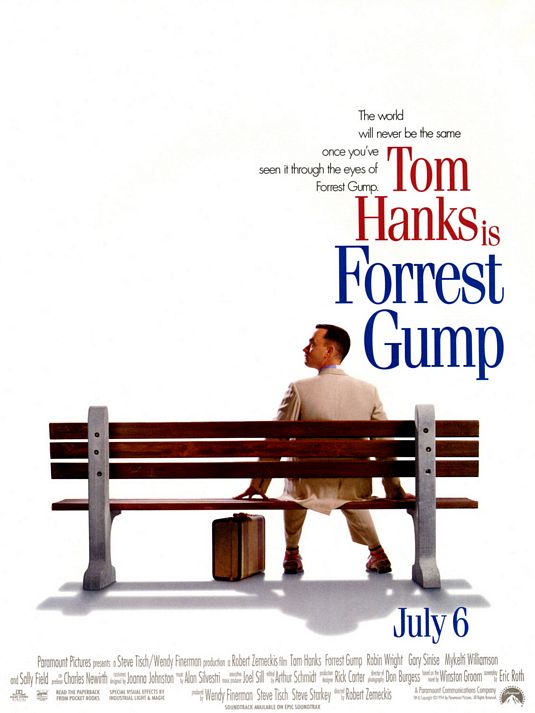
My 40 Favorite Films of the 90's - 14 - Forrest Gump (1994)

Forrest Gump (1994; Paramount Pictures)
Director: Robert Zemeckis
Writers: Eric Roth (Screenplay); Winston Groom (Novel)
Starring: Tom Hanks, Gary Sinise, Sally Field

Winston Groom’s tale of a mentally-disabled man who directly experienced almost every world-changing event in the later half of the 20th Century is a truly charming and heartfelt examination of spirit and love.  Widely considered one of the greatest films of all time, ranking #14 on IMDB’s top 250 at the time of this post, number 76 on the American Film Institute’s list of the 100 greatest American films of all time, and cleaning up in the 1995 Academy Awards with an astounding six wins, Forrest Gump is one of the essentials.  There are a few movies that I would recommend everyone see, and this is definitely one of them.

Tom Hanks plays Forrest Gump, a chatty man who patiently waits at a Savannah, GA bus stop just casually talking with his various benchmates.  He tells them tales of the things he’s done, the people he has met and the places he has been not knowing just how much of an impact he had on the lives of so many people.  Cutting back and forth from the story’s present time and flashbacks to various key moments in Forrest’s life, we see him meet presidents, fight in Vietnam, chat up John Lennon at a Black Panther Party meeting, and ultimately start a hugely-successful business, and he did all of this never knowing how great his achievements really were.

Along the way, as we explore Gump’s life, we meet a few people who will shape him.  His mother (Field) helps to ensure he lives as normal a life as possible and we watch as his childhood friend Jenny (Robin Wright) goes from a pretty tomboy to a broken and abused soul.  Gump’s lieutenant during his tour in Vietnam, Dan Taylor, leaves the war a crippled and angry man, embittered towards the so-called American dream.  We see Lieutenant Dan befriend the devoted Gump, despite occasional periods of frustration.  Then there is Bubba, a fellow recruit who is also slow, who becomes the titular protagonist’s best friend during his time in the Army, ultimately planting the seed of starting a hugely-successful shrimping business.  

Tom Hanks deservedly netted an Oscar for his performance of the kindhearted Gump.  Filled with shining moments of greatness, his performance is famously endearing.  The performances from the supporting cast including greats like Sally Field and Gary Sinise are stunning as well, and act as a great contrast to the unwitting Gump, reflecting the grievances and the disenfranchisement of the late 60’s and early 70’s.  Mykelti Williamson plays Bubba Blue with famous wit and a warmth that nearly matches Hank’s own Oscar-winning role, and every moment with the two on screen is either very funny, or extremely emotional.

Forrest Gump literally has everything.  It is a comedy, a drama, a war story, a romance, a period piece and a smart examination of the ideals and the passions that erupted during the Vietnam War era.  Despite literally trying to be everything, the film never misses a beat, always hitting just the right notes and crafting a very big, but cohesive story.  Ever since Citizen Kane there have been countless movies that have tried to weave a complex and intricate story around a single character through the years, but few have done it better than Forrest Gump.

Monday, July 21, 2014

My 40 Favorite Films of the 90's - 17 - Philadelphia (1993)

Philadelphia (1993; Tristar Pictures)
Director: Jonathan Demme
Writer: Ron Nyswaner
Starring: Tom Hanks, Denzel Washington, Jason Robards

I sat and thought carefully about how I would approach this film.  If you already know what Philadelphia is about, I’m sure one could understand how difficult this subject is, both on an emotional and (unfortunately) a political level.  That said…  Here we go:

By the late 80’s the AIDS scare was in full effect, with many people unsure how the disease operates, and despite educational material being out there, most people preferred to be afraid of the victim rather than the disease itself.  Much of this fear was founded in bigotry, as AIDS was originally considered an illness that only affected gay men.  Despite this being utterly untrue, the facts did not alter the stigma.  As we began to understand the disease HIV, and its progression into AIDS, things and attitudes began to change, but even by 1993, there was still a great deal of ignorance about the subject.

Philadelphia is the incredibly challenging and heartfelt story of an attorney named Andrew Beckett (Tom Hanks), a gay man who contracts the dreaded virus.  After his termination from his firm, which was claimed to be due to negligence, he concludes it was because of his own bosses’ ignorance and bigotry.  Beckett asks another attorney named Joe Miller to help him with his case, but is turned down as Miller is himself a homophobe.  Feeling alone and fearful, the young Beckett steadfastly begins to file his own case.  With support from his partner Miguel (Antonio Banderas) and his family, Beckett struggles with his future.  Ultimately, with guilt and empathy, Miller comes around and offers to represent the man.  This leads to a rough trial both in the courtroom and in the life of a horribly afflicted man.

Philadelphia is an emotional and complex exploration of the time and the fear and unfair prejudice surrounding the AIDS epidemic.  The associations of the characters reflect of a variety of feelings about the subject, discrimination and acceptance and the struggle of a man who becomes the center of a charged political melee.  Hanks won his first of two Academy Awards for his performance in this film, as only the third actor to be nominated for playing a gay character in a Hollywood film.  Philadelphia won other awards including a Golden Globe for best drama as well as a list other international statuettes.  

Philadelphia is a rough sit made even more emotional by its characters.  Tom Hanks gives an incredibly moving performance here.  In particular, during his scenes on the stand, which most likely netted him the Oscar win.  The years leading up to Philadelphia were marked with a few hits and a lot of misses for the now-lauded actor, who was mostly known for comedies.  Philadelphia was not Hanks’ first Oscar nomination as he was nominated for the 1988 classic Big, and he received critical acclaim for his performance in the touching drama Sleepless in Seattle.  However, despite his recognition before the release of Philadelphia, the film marked a turning point in Hanks’ career, where he began focusing on more dramatic performances almost exclusively, with a line of Oscar nominated movies after 1993.

Denzel Washington gives an excellent performance as well, strengthening his already established dramatic resume as an outsider’s point of relatability to the subject.  The ideas of others change as he changes from a bigoted man to one who befriends and begins to care about Beckett and his plight.  Washington was perfect for this role.  He has a strong voice, tremendous screen presence and has always been an excellent dramatic performer.  Here, however, I would argue he gives the best performance of his excellent career.  We see a transformation in Joe Miller through him, and throughout the movie, even when the character’s views are detestable, he has a charm that is instantly gripping, and as he warms to Beckett, we feel their bond growing.  The two actors have an admirable chemistry that works and paints a vivid picture of a man whose heart steadily changes over the course of the story.

These performances, along with just about every other aspect of the film, makes Philadelphia a must-watch classic.  It is one of the most celebrated films of the 90’s for good reason, it is a strong, heart-wrenching story told wonderfully through masterful performances.  Jonathan Demme, who won an Academy Award for his Oscar-sweeping 1992 film The Silence of the Lambs, was a perfect choice for this movie.  He uses an interesting device throughout the film showing us a number of scenes with actors appearing to break the fourth wall.  While this begins as a strange little idea that would likely take one out of the movie, instead, here it puts us in the shoes of the characters and as the film goes on, is used to show us the pain and fear of Andrew Beckett as he steadily deteriorates.  There is a love for these characters that we feel through Deme’s direction, which makes the movie that much more powerful.  When screenwriters and directors really care about the characters they are creating on screen, the viewer can certainly tell.  They feel like real people, and in Philadelphia, it is very, very easy to forget, from time to time, that despite the film being loosely based on a true story, is not real itself.  Philadelphia is easily one of the greatest, and most heartbreaking films ever made.

Sunday, July 20, 2014

My 40 Favorite Films of the 90's - 18 - American History X (1998)

American History X (1998; New Line Cinema)
Director: Tony Kaye
Writer: David McKenna
Starring: Edward Norton, Edward Furlong, Ethan Suplee

Kaye and McKenna’s tragic tale of a reformed Neo-Nazi is one of those movies I’m kind of struggling to write about.  The basic plot of American HIstory X follows Darek Vinyard (Norton), a high-ranking member of a Skinhead gang in Los Angeles.  After going to prison for murder, he reforms and begins to change his ways, starting with the rejection of his former Nazi beliefs, but during his sentence, his brother had joined the gang and is now a full fledged member.  The bulk of the story is told in flashbacks to Darek’s growth as a Neo-Nazi from his father’s death to his early adulthood all the way up to his prison stint, and in present time where Darek struggles to separate himself from his lifelong friends while mixing in moments of time during his incarceration.  Meanwhile we get glimpses into his brother’s own downfall that reflect those in Darek’s life.  

American History X is a very, very rough sit.  It’s brutality reflects the evil in the beliefs of its characters.  They are bigoted, violent, and unapologetic.  Darek’s reformation begins to show us an outsider’s view of the reality that surrounds the character, but even with this, the movie is still unflinching in showing the lengths that some will go to to achieve their evil goals.

This film has a great narrative structure.  There are three timelines told parallel to each other, one showing us Darek after he has begun to reform leading up to the film’s powerful conclusion, one showing the events from the time Derek commits the crime that has him put away up to his release, and one showing Darek’s influences and growths from his teenage years up to the point where he commits the life-changing crime.  The nonlinear approach is what gives American History X its voice, giving it strength and showing us how and why he originally became what he did.  The film challenges you to actually empathize with this man, and then we see how one event changed him to a hate-fueled, violent gang member to his ultimate return to humanity.  It is a strong psychological study as well as an excellent story that is told with a fearless approach.  That said, if you plan to watch this film, be prepared because this movie does not hesitate to show us hate in all of its ugliest forms.

Thursday, May 8, 2014

My 40 Favorite Films of the 90's - 27 - Fight Club (1999)

Fight Club (1999; 20th Century Fox Pictures)
Director: David Fincher
Writer: Jim Uhls
Starring: Edward Norton, Brad Pitt, Helena Bonham Carter

Fight Club is the 1999 film adaptation of the novel of the same name from writer Chuck Palahniuk.  It is a funny indictment of unbridled consumerism, drawing comparisons to shopping from Ikea with enslavement and disease.  It is certainly an anti-establishment message shoved into a strange series of parallels and metaphors.  So, who better to put together a plot puzzle like this than the man who directed The Game and Seven?

Edward Norton plays a (sort of) unnamed narrator who is tormented by his endless fight with daily life and his sudden urge to buy increasingly-useless crap from the consumer catalog du jour.  Depressed and struggling with crippling insomnia, our narrator begins to attend various support groups for disease and addiction for things he does not even suffer from, only to feel… something.  This therapy works, until a woman named Marla (Carter) begins showing up for the same groups, becoming a plaguing distraction.  During a business trip, he meets an outgoing, fast-talking man named Tyler Durden (Pitt), who seems to have none of the same fears and worries he suffers from.  Essentially, he is the narrator’s polar opposite.  A freak disaster leads the narrator to contact Tyler and they meet up, becoming friends, and eventually, this leads to them fighting in an alley.  Over time, this one fight evolves into hundreds, all over the country, from multiple groups of Fight Clubs, and replaces any need for support groups and shoulders to cry on.  Things grow and grow, becoming even more desperate, and Marla is dragged back in with Tyler, with whom she begins a very, very loud sexual relationship.  With the narrator's own vision of what Fight Club becoming distorted into a movement that has grown far out of his control, the film’s tone becomes extremely dark and more than a little threatening, all leading to a climax that is surprising and kind of terrifying..

Fight Club is a brutal rejection of casual consumerism.  It mocks marketing, and even has the Club members use that marketing as a weapon against the system they feel has enslaved them.  The mood shifts from comic to thriller steadily throughout the film, but from the very beginning there is a sense of unease.  We are told early in the film that “With insomnia nothing’s real.  Everything’s far away.  Everything’s a copy of a copy of a copy…”, and that is exactly what much of the first act feels like.  Scenes are very dreamlike, full of strange imagery of floating catalog price information and CGI penguins.  There are subliminal images that flicker and disappear, almost like hallucinations, and the whole production has this very cold, artificial feel to its benefit.  The surrealist elements of the film never feel too out of place since we are meant to be seeing this world through the eyes of a troubled man.  

David Fincher was the perfect choice to direct this movie.  He is able to weave incredibly complex and layered narratives into a cohesive and captivating story.  He is probably better at this than just about any other director working in Hollywood today, with successes like Zodiac and The Social Network telling stories that span several years with a great deal of coherence, something that is very difficult to do without losing your audience.  Fight Club just may be one of the most ambitious film adaptations of all time.  Not because of thousands of fighting soldiers and castles that need to be modeled and CGI’d, but because it is a story told in first person, from the perspective of an individual who sees the world very differently from the way most people do.  Fincher’s ability to put you in the eyes of this one broken and desperate man is simply astounding.  

Now, I am trying to stay vague with this article because if you have not seen this movie yet, it is a must-watch.  It is violent, gritty, and even a little convicting.  You could have been doing something great, and you did nothing productive.  In a shocking and brutal, but funny scene, Tyler holds a young man at gunpoint for “wasting his life” and not pursuing his dream career, for which he lets the man live with the promise that he will pursue a better life.  It is mean, but it is also honest.  Fight Club certainly has a little bit of preachiness to it, which is usually a turn-off, but I never got the feeling that this was based on some schizophrenic’s insane ramblings like I did with tripe like The Day After Tomorrow or overwrought, heavy-handed ripoff material like Avatar.  I was entranced by the film’s fun visuals and darkly humorous tone.  The screenplay is freaking outstanding and every performance is damn good.  Brad Pitt gives what is probably my favorite performance of his career as Tyler Durden and Edward Norton is bringing his A-Game as an awkward, nerdy doormat who is transformed into a tough-as-nails, takes-no-crap badass over the course of the movie.

Tuesday, April 29, 2014

My 40 Favorite Films of the 90's - 29 - Trainspotting (1996)

Trainspotting (1996; Channel Four Films)
Director: Danny Boyle
Writers: John Hodge
Starring: Ewan McGregor, Jonny Lee Miller, Robert Carlyle

My number 29 is the film that was voted by the UK public as the greatest Scottish film of all time, Trainspotting.  An examination of the lives of a group of twenty-somethings living in poverty in late-80’s Edinburgh and their constant struggle with heroin addiction, Danny Boyle’s award-winning film is a smart and occasionally horrifying melodrama.  This is easily one of my favorite films based on the theme of drugs and drug abuse as it has one of the best tonal shifts of any film I’ve ever seen.

The film primarily centers on Renton (McGregor), who narrates the film and expresses his thoughts on shooting up and coming down, as well as his inner-struggle about getting clean.  The film starts off with a funny series of narrations that run down why he and his friends do the things they do.  Unlike many other characters we see in movies, Renton is represented as loving heroin.  We hear from him the details of the high and the way it is narrated it seems almost as though the film is trying to sell the drug to its audience.  However, about halfway through the film the events take a dark turn and things get more than a little out of control.

Trainspotting is funny, but also very, very dark.  There is violence, tragedy and consequence, however the film never feels preachy.  Danny Boyle shows us some of Renton’s hallucinations that come in escapism, but also come in the form of terrifying torment as his family executes a harsh plan to force Renton to clean up, keeping him in a room as he is left to go cold turkey, a truly painful and awful experience.  As Renton writhes, sweats and screams, we see it and feel it with him thanks to Boyle’s masterful use of camera work and his flawless execution one of the most horrific scenes in film history.  I will not ruin it, though, as Trainspotting is a must-see.

Danny Boyle went on to direct the awesome 28 Days Later and was shortly-thereafter acknowledged by the Academy for his film Slumdog Millionaire.  Trainspotting is a film that looks very good, while also being occasionally unwatchable.  It is graphic, gruesome and disturbing but is never gratuitous.  Every scene has meaning to the plot, as Renton and his friends struggle with moving on from their addictions, but the drugs always seem to win.  It is tragic and smart.  It is neither a pro-drug comedy or an anti-drug propaganda film.  Instead Boyle just shows us these characters’ respective realities, as grim as they may be.

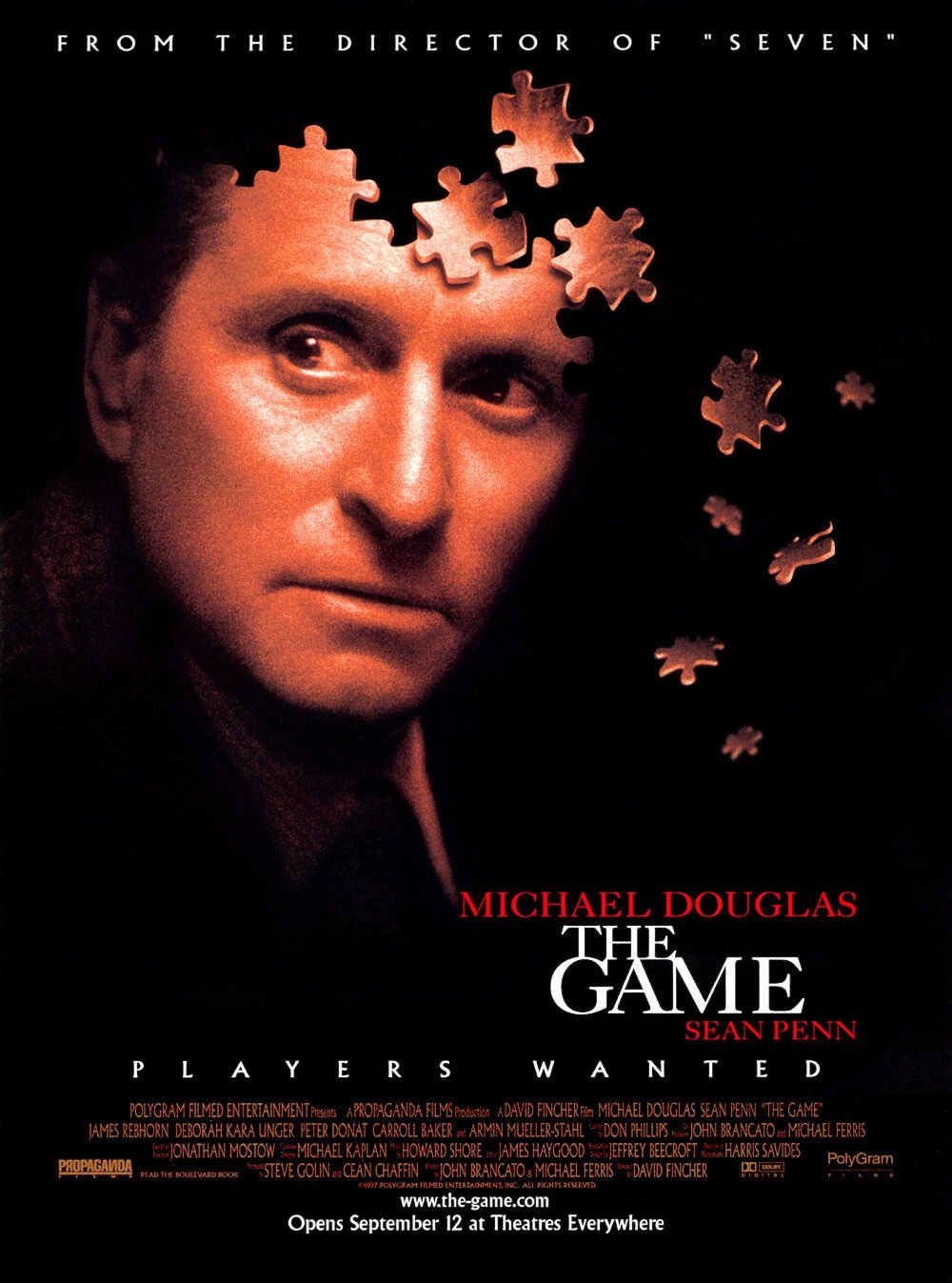
My 40 Favorite Films of the 90's - 30 - The Game (1997)

The Game (1997; Polygram Filmed Entertainment)
Director: David Fincher
Writers: John D. Brancato, Michael Ferris
Starring: Michael Douglas, Sean Penn

The Game is the first film by David Fincher to appear on this list.  The story revolves around a wealthy businessman named Nicholas Van Orton who seems to have lost his way, at least in the eyes of his brother, Conrad.  For Nick’s birthday, Conrad gives him a pass for a company that provides a strange role playing game that is interweaved into the "player's" daily life.  He reluctantly follows through with the gift and what follows is a bizarre, twisting and dark series of events where you never know what is truly real, and what is all part of the game.  Along the way, he meets a woman who becomes an unexpected ally through the course of events.

By the time The Game was released, David Fincher had already established himself as a talented filmmaker with his 1995 film, Seven.  His dark, complex cinematic style has become a trademark and his talent for weaving together complex ideas into solid and cohesive stories is undeniable.  The Game is an extremely deep fantasy, where the real world seems to disappear into the background as the events become more and more bizarre.  The interesting aspect of The Game is how the story is told.  We experience the events almost solely from the perspective of the protagonist, where rarely a single scene goes by where Nick is not present, so the audience experiences the threatening “game” exactly as he does.

The distinct style of Fincher begins to mature in this film.  The dark imagery, the creepy use of things like clowns and more abstract images like formless shadows and even the simplest reflections on stone walls are used to create a dreamlike atmosphere.  The mood of the film is easily its biggest strength.  It is unsettling, and this sense of unease throughout is palpable and effective.  Michael Douglas gives a good performance as a man who transforms through the film, starting off as a cynical and almost bitter man.  As the film goes on, and the game becomes more and more unnerving, we experience this arc with him.  Survivalist instincts take over and we see this in Douglas’ most subtle actions and expressions.  It is a great performance from a seasoned actor and it only adds to the strangeness of the events, as we can read his response and mimic him sympathetically.

The first time sitting through The Game is quite the experience.  It really is not the kind of movie that holds up to countless re-watches, however, because once we see the end, there really is no journey anymore.  Still, a new watcher of this film will likely find themselves puzzled, captivated and excited about the unfolding story.  This is a must-see for fans of complex films and puzzling mysteries.

Monday, April 28, 2014

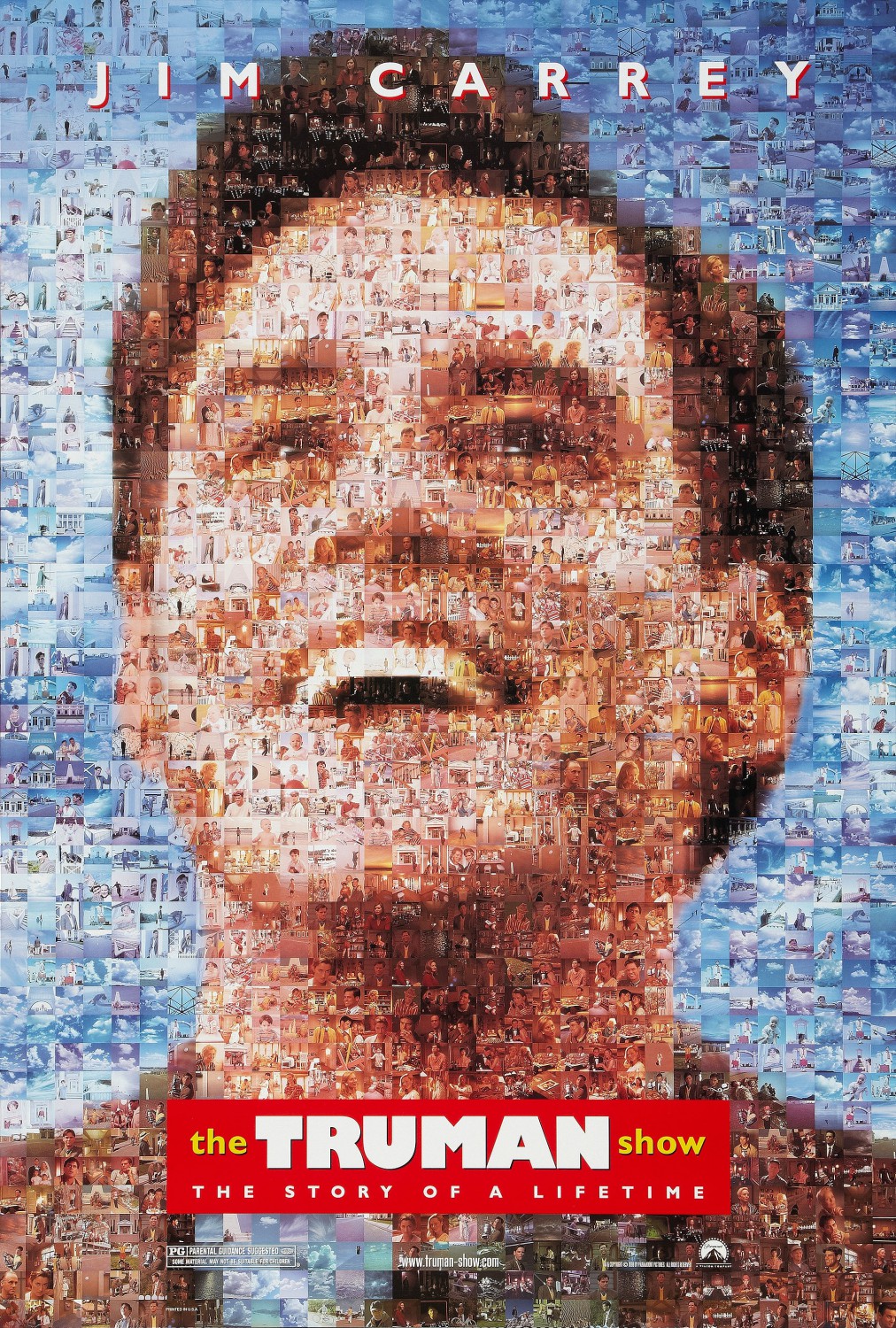
My 40 Favorite Films of the 90's - 32 - The Truman Show (1998)

The Truman Show (1993; Paramount Pictures)
The Truman Show
Director: Peter Weir
Writer: Andrew Niccol
Starring: Jim Carrey, Ed Harris, Laura Linney, Noah Emmerich

Before 1998, I do not think anybody would have thought that Jim Carrey star in a film that would be nominated for multiple Academy Awards.  The Truman Show, however, was Carrey’s chance to prove that not only could he act, but he could act in a great film and still bring his trademark energy and cheer to the role.  This is a film about a man who discovers everything he ever knew was a fabrication, a design by a few people, and a man who sees himself as “the Creator”.  It is an incredibly complex idea built on a far-fetched, but still somewhat believable, premise.

Truman was born on live TV.  He was adopted before birth to become the subject of a television show that would document his entire life in real time.  A massive town was created, with everyone but Truman in on the act.  Myths and lies were made upon which his entire life was built and the show went so far as to have his father “killed off” to make him afraid of water, as the set is built inside one of the largest structures ever created.  Truman’s world is a perfect one, where everyone knows and loves him and his happiness is a comfort for his millions of viewers, even if he does not know he is being watched.  However, as an adult, his adventurousness and restlessness get the better of him and, after a series of events that cause him to become more than a little paranoid, he begins to discover the truth about his whole life.

Jim Carrey gives one of his best performances here as a kindhearted man living a carefree existence.  Carrey’s bright smile and warmth really shine through here as all of his previous films more or less required him to subdue those traits.  Here, however, he is completely and totally convincing as a once-oblivious man faced with a shocking reality.

The Truman Show is a must-see for all movie fans, casual or otherwise.  The film is funny, smart and existential and it has a great screenplay.  Ed Harris gives an awesome supporting performance as Cristof, the director of The Truman Show, a man obsessed with Truman but, whose career depends on the show’s continued run, yet seems to also care at the same time.  I see Christof as the idea of a deity, one being who can control the world of any man.  He is dichotomous, both moral and immoral, selfish and selfless, and his actions are both reprehensible and fathomable.  

How far will one man go to preserve his legacy?  If you have lived your whole life in utter comfort only to find it was a fabrication, would you reject it to embrace freedom?  The Truman Show is a social experiment and a smart idea written and filmed with love and patience.  It is allegorical.  Escaping slavery to embrace the responsibility of freedom.  It is an astounding concept, but this is not a fast comedy romp.  It is a deliberate light drama and a movie that lets us really get to know Truman as a character before his world crumbles around him.  It is definitely a journey that everyone should experience.